
Parma vs Sassuolo: Tactical Analysis of Serie A Season Finale
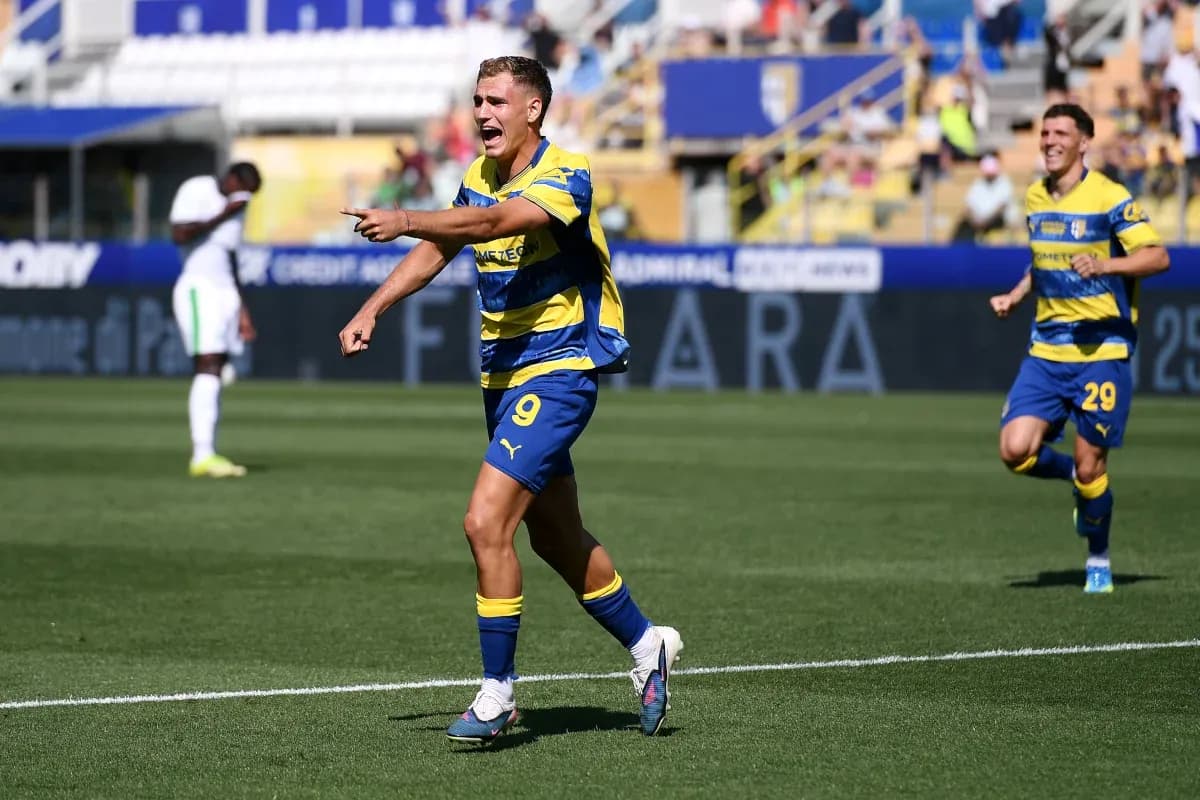
Stadio Ennio Tardini felt more like a proving ground than a simple season closer. Following this result, Parma’s 1–0 win over Sassuolo in Round 38 of Serie A did not rewrite the table – Parma remain 13th on 45 points, Sassuolo 11th on 49 – but it sharpened the outlines of who these sides are and where they are heading.
Across the campaign, Parma’s numbers have painted them as survivalists rather than stylists. Overall they scored 28 goals and conceded 46, a goal difference of -18 born from tight margins and low-scoring battles. At home they found the net only 16 times in 19 matches, an average of 0.8, while allowing 25 at 1.3 per game. Sassuolo, by contrast, lived a more open existence: 46 goals scored, 50 conceded overall (GD -4), and on their travels 21 for and 24 against, averaging 1.1 scored and 1.3 conceded away.
Within that statistical frame, this match unfolded as a tactical argument between control and chaos. Parma, in their familiar 3-5-2, leaned into what has defined their season: structure, compactness, and selective aggression. Carlos Cuesta’s back three of Mariano Troilo, M. Troilo, A. Circati and L. Valenti gave the shape its steel, with Troilo’s season profile underlining why he is so central. Across the campaign he blocked 18 shots and won 89 of 152 duels, the kind of numbers that explain how Parma have managed 13 clean sheets overall despite being outgunned on paper.
Ahead of them, the five-man midfield was less about flamboyance and more about balance. H. Nicolussi Caviglia and C. Ordonez worked as the pivots of circulation and pressing triggers, while M. Keita and E. Valeri offered width and legs to shuttle between full-back and half-space. S. Britschgi completed the line, giving Parma the capacity to crowd central zones against Sassuolo’s 4-3-3 and to spring quickly into the channels when the ball was won.
The absentees only amplified this necessity for structure. Parma were without a full creative cluster: A. Bernabe (muscle injury), B. Cremaschi (knee), N. Elphege (thigh), M. Frigan (knee), J. Ondrejka (leg), G. Oristanio (knee) and G. Strefezza (ankle) all missed out. That stripped Cuesta of dribblers, second strikers and line-breaking passers, pushing more responsibility onto the starters to manufacture chances in a team that already failed to score in 16 league games overall.
Sassuolo’s own absences had a different texture. Fabio Grosso had to do without D. Bakola, D. Boloca, F. Cande, E. Pieragnolo, F. Romagna, A. Vranckx and S. Walukiewicz. The spine of his rotation options – a holding midfielder in Boloca, a left-sided presence in Cande and Pieragnolo, plus central defensive depth – was weakened, but the attacking trident remained intact. That meant the visitors still arrived with a front line capable of stretching any back three: D. Berardi, A. Pinamonti and A. Laurienté.
The “Hunter vs Shield” duel was therefore clear. On one side, Sassuolo’s offensive leaders: Pinamonti, with 9 goals and 3 assists overall, and Berardi, with 8 goals and 4 assists, supported by Laurienté’s 7 goals and league-leading 9 assists. On the other, a Parma defence that, despite conceding 1.2 goals per game overall, has shown a knack for grimly hanging on, particularly in games where the attack offers little margin for error.
In this fixture, the Shield won. Troilo’s season-long disciplinary volatility – 7 yellow cards and 1 straight red – did not surface, and instead his defensive profile came to the fore. His ability to step out and intercept, combined with the back three’s compact distances, helped suffocate the central lanes where Pinamonti likes to receive. Parma’s wing-backs tracked Sassuolo’s wide forwards, forcing Berardi and Laurienté into deeper, less dangerous pockets.
The “Engine Room” confrontation was no less intriguing. Sassuolo’s midfield three featured K. Thorstvedt, L. Lipani and I. Kone. Thorstvedt, who has 4 goals, 4 assists and 9 yellow cards this season, embodies Sassuolo’s dual nature: progressive, vertical passing and late box arrivals, but also a readiness to foul and disrupt. Against Parma’s central trio, he was up against a block designed to deny him those third-man runs. Nicolussi Caviglia and Ordonez compressed space between the lines, while Keita’s athleticism allowed Parma to slide laterally without opening central seams.
Discipline had been a storyline heading into the game. Parma’s yellow cards peak at 46–60 and 76–90 minutes, both at 21.21%, with a notable red-card spike in the 31–45’ window (40.00% of their reds). Sassuolo’s caution profile is even more dramatic late on: 28.92% of their yellows arrive between 76–90 minutes, with additional red-card risk at 16–30, 46–60 and 76–90. Yet this time, the contest never boiled over into chaos. The fear of a late dismissal – with both sides already prone to disciplinary lapses – seemed to temper some of the risk-taking in midfield.
Up front for Parma, the narrative centred inevitably on Mateo Pellegrino. With 9 goals and 1 assist overall, plus 53 shots and 22 on target, he has been the home side’s reference point in a team averaging only 0.7 goals per game overall. His duel with Sassuolo’s centre-backs, J. Idzes and T. Macchioni, was a micro-battle in aerials and back-to-goal play. Pellegrino’s 546 duels this season, of which he has won 233, underline his role as a magnet for direct balls and a platform for second phases. Against a Sassuolo away defence conceding 1.3 goals per game, his presence was always likely to tilt one key moment.
That moment arrived in a match that felt, statistically, like a knife-edge encounter waiting to be decided by a single Expected Goals swing. With Parma’s attack limited but focused, and Sassuolo’s front line blunted by Parma’s structure, the xG balance would have leaned towards a narrow home edge: a side that, at home, scores less but concedes slightly more than Sassuolo do away, facing visitors who often open up the game on their travels.
Following this result, the tactical verdict is stark. Parma’s 3-5-2, even stripped of multiple creative pieces, proved capable of choking a more talented attacking unit when the defensive concentration holds. Their season-long defensive averages remain modest, but the clean sheet here reinforces the identity of a team that survives by compression, not expansion.
For Sassuolo, the loss is a reminder that a front three of Berardi, Pinamonti and Laurienté is not enough on its own. Without Boloca’s ballast and with a midfield that can be outnumbered by a five-man block, their 4-3-3 can be bent out of shape, leaving their away record – 5 wins, 5 draws, 9 defeats – as an accurate reflection of their fragility.
In the end, this was less about the table and more about trajectories. Parma close the campaign with a win that validates Cuesta’s structural blueprint. Sassuolo leave Tardini with the sense that, unless the balance between their Hunter and their Shield is recalibrated, their ceiling will remain frustratingly low, no matter how bright their individual stars shine.
Related News

David Alaba Poised for Surprising Move to Udinese in Serie A
Milan Dominates Lecce: Tactical Analysis of a 3-0 Victory

Juventus Defeats Atalanta 2-0: Tactical Insights and Key Matchups
Frosinone's Tactical Mastery Shines in 2–0 Victory Over Como
Fiorentina and Napoli Share Points in Serie A Clash
AS Roma vs Inter: Tactical Insights from Serie A Clash