
Ivory Coast Edges Ecuador 1-0 in Tactical Battle
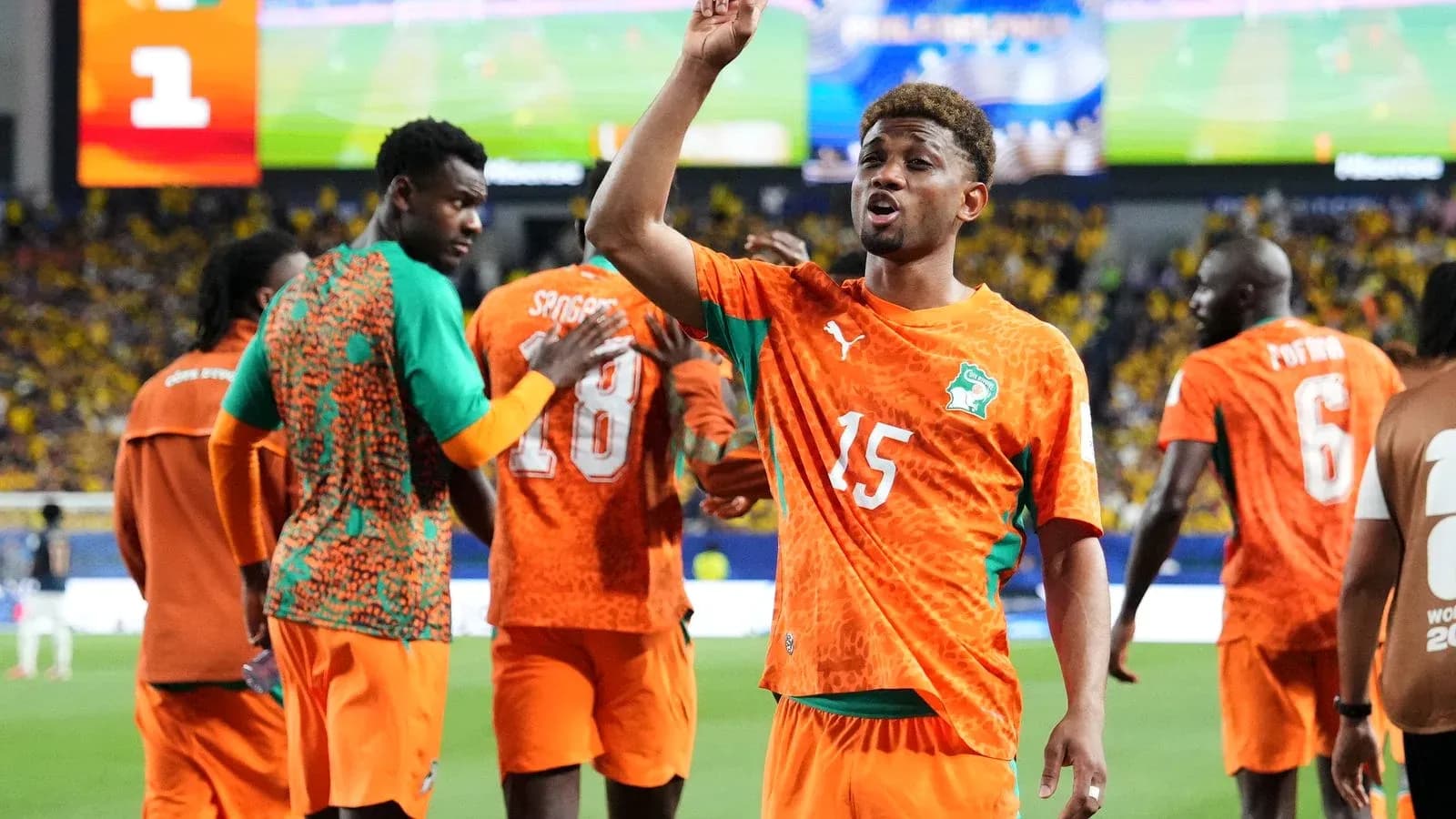
Ivory Coast’s 1-0 win over Ecuador at Lincoln Financial Field was a controlled, structurally disciplined performance built on a compact 4-4-2 and a decisive impact from the bench. Despite trailing Ecuador 48%–52% in possession, Emerse Fae’s side generated the clearer chances, posting 15 total shots to 12 and a superior xG of 1.52 to 1.01. The match hinged on Ivory Coast’s ability to turn a balanced midfield battle into territorial pressure in the second half, culminating in a late winner from Amad Diallo.
Both teams lined up in mirrored 4-4-2 shapes, but used them differently. Ivory Coast’s back four of Guéla Doué, Wilfried Singo, Emmanuel Agbadou and Ghislain Konan stayed relatively narrow, with the wide midfielders Bazoumana Touré and Yan Diomande tasked with tracking Ecuador’s advanced wide players rather than flying forward early. In possession, Seko Fofana and Franck Kessié formed a double pivot, with Fofana often dropping closer to the centre-backs to initiate build-up and Kessié stepping into higher half-spaces to link with Nicolas Pépé and Elye Wahi.
Ecuador’s 4-4-2 under Sebastian Beccacece was more possession-oriented. Moisés Caicedo and Pedro Vite tried to dictate from central zones, while John Yeboah and Alan Minda looked to stretch Ivory Coast horizontally. With 492 total passes and 419 accurate (85%), Ecuador circulated the ball slightly more cleanly than Ivory Coast’s 470 passes, 397 accurate (84%). However, much of Ecuador’s possession was kept in front of Ivory Coast’s block. The Ivorians accepted spells without the ball, relying on a compact mid-block and aggressive interventions from their central defenders to limit penetrative passes into Enner Valencia and Gonzalo Plata.
Defensively, Ivory Coast were assertive, sometimes overly so. Three first-half yellow cards — Seko Fofana for “Roughing” at 28', Franck Kessié for “Tripping” at 38', and Guéla Doué for “Tripping” at 40' — reflected a strategy of breaking Ecuador’s rhythm early, especially in central areas. Those bookings forced Fae to manage the risk in the second half, and they help explain the later substitutions of Fofana and Doué as legs tired and the risk of a second caution grew.
Ecuador’s defensive approach was more zonal, with the back four holding their line and Caicedo screening. They conceded 15 shots but allowed only 4 on goal, showing some success in forcing Ivory Coast into less optimal shooting positions. The defensive line of Willian Pacho and Joel Ordóñez dealt reasonably well with initial balls into Wahi, but struggled more once Ivory Coast introduced fresh pace and creativity from the bench.
The substitutions around the 56th minute were the tactical turning point. For Ecuador, Alan Minda (OUT) was replaced by Nilson Angulo (IN), a like-for-like wide option aimed at adding direct running. Ivory Coast, however, made more transformative changes: Elye Wahi (OUT) was replaced by Ange-Yoan Bonny (IN), and Bazoumana Touré (OUT) by Amad Diallo (IN). These moves effectively shifted Ivory Coast’s attacking reference points. Bonny provided a more physical presence up front, allowing Ivory Coast to play into feet and hold up under pressure, while Diallo drifted inside from the flank, operating between Ecuador’s lines and asking different questions of their full-backs.
As the game moved into its final third, Ecuador adjusted again at 62': John Yeboah (OUT) made way for Ángelo Preciado (IN), and Alan Franco (OUT) was replaced by Jackson Porozo (IN). Those changes suggested a tilt toward greater defensive solidity and aerial presence, especially with Porozo, but they also slightly blunted Ecuador’s width and attacking variety. The single Ecuador yellow card — Jackson Porozo for “Holding” at 73' — underlined how Ivory Coast’s substitutes began to stress Ecuador’s back line with more dynamic movement.
Ivory Coast’s continued reshaping at 77' further tilted the game. Nicolas Pépé (OUT) was replaced by Christ Inao Oulaï (IN), and Seko Fofana (OUT) by Ibrahim Sangaré (IN). Sangaré brought fresh energy and ball-winning in midfield, allowing Kessié to conserve his efforts and maintain structure while still offering forward support. Oulaï’s introduction on the flank added another runner capable of attacking space behind Ecuador’s full-backs. For Ecuador, Enner Valencia (OUT) made way for Kevin Rodriguez (IN) at the same moment, a change that maintained a central striking option but did not materially improve their chance creation.
The final Ivory Coast change at 89' — Guéla Doué (OUT) for Odilon Kossounou (IN) — was a clear defensive insurance move, adding fresh legs and aerial security on the right side just before the decisive moment. Yet it was their attacking reshuffle earlier that produced the winner.
The only goal came at 90', a move that neatly encapsulated Ivory Coast’s second-half adjustments. Amad Diallo, introduced to operate in pockets Ecuador had struggled to protect, finished after a key contribution from Wilfried Singo, who provided the assist. The centre-back’s forward involvement highlighted how Ivory Coast, chasing the win, were willing to commit an extra defender into advanced zones once Sangaré had stabilized midfield. Diallo’s timing and composure in that late phase rewarded Ivory Coast’s proactive use of the bench and their willingness to increase risk once they had drawn Ecuador into deeper positions.
In goal, Yahia Fofana (Ivory Coast) was largely protected by the structure in front of him, facing only 1 shot on target and making 1 save. The defensive unit’s ability to keep Ecuador’s 12 shots to mostly low-quality efforts is reflected in the xG against of 1.01. At the other end, Hernán Galíndez (Ecuador) made 3 saves, but Ivory Coast’s xG of 1.52 and 4 shots on goal show that his side allowed the more dangerous chances despite having slightly more of the ball.
Statistically, the match confirms the tactical story. Ecuador’s marginal edge in possession (52%) and passing efficiency did not translate into control of the key zones. Ivory Coast, with fewer passes but a similar completion rate, were more vertical and purposeful, turning 8 shots inside the box into sustained threat. Both teams recorded 3 blocked shots, indicating committed defending in both penalty areas, but Ivory Coast’s ability to generate that extra volume of attempts ultimately made the difference.
Discipline also played a subtle role. Ivory Coast finished with 3 yellow cards to Ecuador’s 1, all for contact-related infractions (“Roughing”, “Tripping”, “Tripping”), underlining their more combative approach in midfield. Ecuador’s single caution for “Holding” on Porozo came as they tried to contain Ivory Coast’s late surges. Yet despite the imbalance in cards, Ivory Coast managed the game state intelligently after taking the lead, using their deeper bench and fresh defenders to see out a 1-0 result that, on xG and chance quality, they fully merited.
Related News
Brazil's First Post-World Cup Friendly: What Should the Lineup Be?
Harry Kane Calls England’s World Cup Exit to Argentina His Deepest International Pain
Estevao Opens Up on World Cup Heartbreak and His Unexpected Return to Brazil Under Ancelotti
Thomas Tuchel Shares Unusual Regret After England's 10-Man World Cup Victory Over Mexico
South Korea Names Robert Moreno as Interim Coach After World Cup Exit
Jude Bellingham Returns to Form at Real Madrid Following World Cup Success