
Job Ochieng: From Nairobi Dust to La Liga Dreams
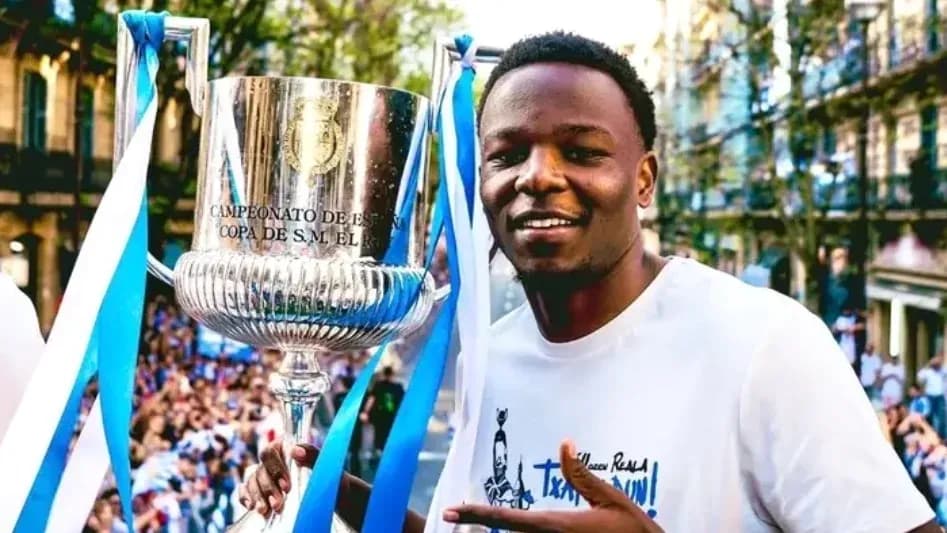
From the red dust of Lang’ata’s schoolyards to the sharp, white light of La Liga, Job Ochieng’s story reads less like a career path and more like a test of how far a dream can stretch before it snaps.
It has not snapped.
Nairobi roots, restless ambition
Born on January 17, 2003 in Nairobi, Ochieng grew up with one foot in the classroom and the other on rough, uneven pitches that doubled as his first stadiums. At PCEA Lang’ata School, his days were ruled by timetables and textbooks, his evenings by the chaos of playground football.
Those pitches were far from pristine. Dusty, imperfect, often unforgiving. But they gave him something no academy brochure can sell: a love for the game stripped of glamour.
“Those fields were not perfect,” he recalls. “Nothing about them was polished in any way, but they had something special for me because they taught me how to love football without conditions, how to play when there is no crowd, no spotlight, just pure joy and competition.”
Teachers drilled into him a second lesson: football without education is a dead end. “Talent without education is like running without direction,” they told him. The message stuck. While his boots chased balls, his mind chased structure, discipline and a sense of purpose.
From school teams he stepped into Nairobi’s grassroots conveyor belt, starting at Express Soccer Academy before moving to Ligi Ndogo Academy. That switch changed him.
“At Ligi Ndogo I stopped being just a fast boy who loved dribbling and running at defenders,” he says. Coaches demanded more than pace. They demanded thought. “They forced me to think differently about football, to scan the pitch, understand positioning and see patterns before they happened.”
He learned to arrive in spaces before the ball, to turn instinct into intelligence. That shift lit a new belief.
“That academy didn’t just improve my game,” he says. “It turned my instinct into intelligence, and that is the moment I truly started believing that maybe, just maybe, I could play beyond Kenya.”
A ticket to Spain, paid for in sacrifice
The dream leapt from theory to reality in 2020. An opportunity surfaced with CD Maspalomas in the Canary Islands. The distance was intimidating. The cost, even more so.
The move only happened because Nairobi rallied around him.
“Some people sold small things they depended on daily, others borrowed money they were not even sure they could repay, while some simply gave whatever little they had without asking for anything in return,” Ochieng says.
The boy became a project. A shared risk.
“That is when I understood I was no longer just Job Ochieng chasing a dream alone. I had become something bigger, almost like a collective responsibility.”
When he finally boarded the plane, he felt the weight.
“I felt like I was carrying hundreds of dreams inside my bag, not just my own, and I promised myself I would not let them down.”
Spain, though, did not greet him with open arms and instant stability. An agency arrangement collapsed soon after he landed in Gran Canaria. Contracts, promises, plans – gone.
“There was a moment I can never forget when I sat outside with my bags beside me and genuinely did not know where I would sleep that night or what the next day would look like,” he says.
New country. New language. No safety net. For the first time, he felt invisible.
Yet the crisis hardened him. “If I survive this phase of my life,” he told himself, “then nothing in football or life will ever intimidate me again.”
CD Maspalomas stepped in. Staff at the club gave him a bed, food, a routine, and something even more valuable: dignity.
“Those coaches didn’t just save my career in a football sense, they saved something deeper — they saved my dignity and belief in people,” he says.
They told him football needed no translation, only effort, consistency and honesty. He took that line into every training session, every match.
Zubieta and the art of survival
Performances in Spain’s lower divisions began to turn heads. Scouts with links to elite structures noticed. In 2022, Real Sociedad arrived with a pathway and a place in their revered Zubieta academy.
The jump was brutal.
“When I arrived at Real Sociedad, I immediately realised football here is on a completely different level. It is not just physical or technical, it is deeply mental, almost like chess played at full speed,” he says.
Every touch, every step, every decision came under the microscope. “There is no room for carelessness,” he adds. “I quickly understood that I had to evolve as a player or I would simply disappear at this level.”
Just as he tried to accelerate, injury slammed on the brakes. Knee problems stalled his integration and left him watching others move ahead.
“The injury felt like someone had pressed pause on my entire life while everyone else around me continued moving forward, improving and competing,” he reflects.
The medical team drilled a different kind of lesson into him: patience is part of the profession. Recovery, they told him, is work too.
“That period taught me something important — recovery is not just about waiting for the pain to disappear, it is about doing the silent work when nobody is watching and trusting it will show later.”
He did the silent work. When he returned, he climbed from Real Sociedad C into the B team and began to find his rhythm inside Spain’s tactical chessboard.
“In Spain, even defenders think like attackers, and that changes everything about how you approach the game,” he says. Speed and strength alone are not enough. “You need awareness, timing, intelligence and the ability to read situations before they fully develop.”
Every game in the lower leagues felt like a trial. “Every single match in the lower leagues felt like a final because one mistake could completely change the direction of your career.”
Under that pressure, he delivered. Across a standout campaign with Real Sociedad B, he made 25 appearances, scored nine goals and added two assists.
“People look at those numbers and think they are just statistics on a page, but I see something completely different,” he explains. “I see hours of pain, sacrifice and repetition behind every goal.”
He stayed out after training, alone with the ball, rehearsing finishes, movements, decisions. “Consistency is not about talent,” he says. “It is about discipline repeated every single day without excuses.”
One moment cut through all the repetition. A late winner against SD Huesca.
“That goal was not just about three points or a victory on the table,” he says. “It felt like confirmation of everything I had been through — every sacrifice, every difficult night and every doubt I had ever carried.”
As the ball hit the net, his mind flashed back to Nairobi, to family, to those who sold what they had so he could leave.
“In that moment I thought about my family and everyone who contributed to my journey, and I realised this success belonged to all of them too.”
La Liga lights and a phone call home
The rise carried him into the first-team picture under coach Pellegrino Matarazzo. The reward came on February 7, 2026, when he stepped onto the pitch for his La Liga debut against Elche.
“When I was told I would be coming on, my heart was beating so fast it almost felt louder than the stadium itself,” he says. “I just kept telling myself to stay calm and enjoy the moment.”
He looked at the Real Sociedad badge, rewound his life in a split second, and made a choice: this was not a time for nerves. This was an audition.
In 27 minutes, he completed 72 per cent of his passes in a 3-1 win. Modest numbers on paper, enormous weight in reality.
“Every touch of the ball felt heavier than usual because I knew people back home were watching, hoping and believing in me,” he says. Once the first few passes landed, the fear loosened. “I felt something shift inside me, like I had finally broken through a barrier I had carried for years.”
At full-time, there were no wild celebrations. No lap of honour. He stepped aside, pulled out his phone and called his mother, holding the device up so she could hear the roar of a La Liga stadium.
It was the sound of a promise kept.
His impact and trajectory convinced the club to commit. Real Sociedad extended his contract to 2028, and this time he did not walk into the room alone.
“Signing that contract was one of the most emotional moments of my life because I did not go alone, I went with my parents,” he says. His father’s hands shook as he held the pen. “In that moment I realised that everything we went through as a family had finally turned into stability, into something real and lasting.”
Carrying a nation
While his club star rises in Spain, Ochieng has also stepped into a different kind of spotlight with the Harambee Stars under Benni McCarthy.
“Playing for Kenya carries a completely different kind of weight because you are not just playing for yourself or your club, you are playing for an entire nation that is watching, hoping and believing,” he says.
The anthem hits differently. It feels heavier, he admits, but that weight does not crush him. It powers him.
“When you hear the anthem, it hits you differently because it feels like you are carrying the emotions of millions of people on your shoulders, and that responsibility gives you strength.”
Simple life, big horizon
Away from the pitch, the life is quieter than the story suggests. No entourage, no drama.
“Outside football I am actually very simple,” he says. He listens to Afrobeat and old-school Kenyan classics to stay tethered to home. He reads motivational books, dives into tactical analysis videos, walks with headphones on to clear his head. He plays video games, often football games, when the body needs rest but the mind still wants the ball.
Whenever he returns to Nairobi, he goes back to where it all started: kids playing barefoot, chasing a ball across dusty ground.
“When I go back home and see kids playing barefoot, I see myself in them,” he says. “That is why I always tell them that your situation is not your limit, it is simply your starting point.”
He repeats a line often, almost like a personal mantra: “I am still building every single day, nothing is complete yet, nothing is finished. Everything I have achieved so far is just the beginning, just the introduction to the story I want to write.”
His target is not just survival in La Liga. It is impact.
“My goal is not only to play in La Liga, but to leave a mark that people will remember long after I am gone from the pitch,” he says.
For now, he carries Nairobi into every duel, every sprint, every decision. That city, those dusty pitches, remain his engine.
“That is my strength, that is my reminder of where I come from,” he says. “That is why I will never stop running, never stop pushing and never stop believing.”
The question now is no longer whether he belongs at this level. It is how far this story, born in a crowded Nairobi classroom and sharpened in Spain’s unforgiving arenas, can still go.
Related News
Carlos Alcaraz Calls for Change After Laver Cup Court Conditions
Alexander Zverev Secures Laver Cup Victory for Team Europe with Straight-Set Win Over Learner Tien
Novak Djokovic Shares Fitness Update Before China Open Return After US Open Upset

Shubman Gill's Captaincy Record Across All Formats: Tests, ODIs, T20Is, and IPL
Kuldeep Yadav Named Player of the Match Over Virat Kohli Despite Century in IND vs WI 1st ODI
India Advances to Asian Games 2026 Cricket Semi-Finals After Rain Washout Against Afghanistan