
Jürgen Klopp's Bold New Era as Germany Head Coach
Jürgen Klopp’s first squads as Germany head coach made one thing clear: this new era will not be timid.
The 57-year-old has named two entirely separate groups for the upcoming Nations League fixtures, calling up a remarkable 44 players for four games against the Netherlands, Serbia and Greece. Sixteen of them have never played for the national team.
This is not a gentle evolution. It is a reset.
Two squads, one statement
Klopp will use one squad for the opening double-header — away to the Netherlands in Amsterdam on Thursday, September 24, then against Greece in Augsburg on September 27. A second group will take over for the home game with Serbia in Munich on October 1 and the return meeting with Greece in Thessaloniki on October 4.
The names tell their own story.
There is a strong injection of youth and unfamiliar faces: Said El Mala of Köln, Max Rosenfelder, Philipp Treu and Derry Scherhant from Freiburg, and Celtic midfielder Mika Baur are among those yet to win a cap. Sixteen debutants in all, thrown straight into a competitive Nations League schedule.
Klopp is not dipping a toe into the talent pool. He has dived in.
Big calls on big names
Amid the experimentation, there were firm decisions on established figures.
Marc-André ter Stegen, currently on loan at Ajax from Barcelona, has been confirmed as first-choice goalkeeper. No ambiguity, no shared role. The shirt is his.
There are recalls for Karim Adeyemi, Leeds United midfielder Anton Stach and Brentford forward Kevin Schade, all handed a fresh chance after spells out of the picture.
One of the clearest signals, though, concerned the captain. Joshua Kimmich, used frequently as a right-back under Julian Nagelsmann, will be deployed by Klopp where he has long insisted he belongs: in midfield. Germany’s new coach has nailed his colours to that mast from day one.
Not everyone made the cut. Stuttgart striker Deniz Undav, outstanding at club level last season, was left out, with Klopp explaining the omission as fitness-related. On form alone, he would be hard to ignore; on fitness, the risk was too great.
This is a long campaign. Klopp has chosen not to gamble in his first squad.
A new coach, a fractured country
Nagelsmann’s resignation after Germany’s World Cup last-32 elimination by Paraguay opened the door for Klopp. His first press conference in the job was never going to be low-key, but the football was not the only talking point.
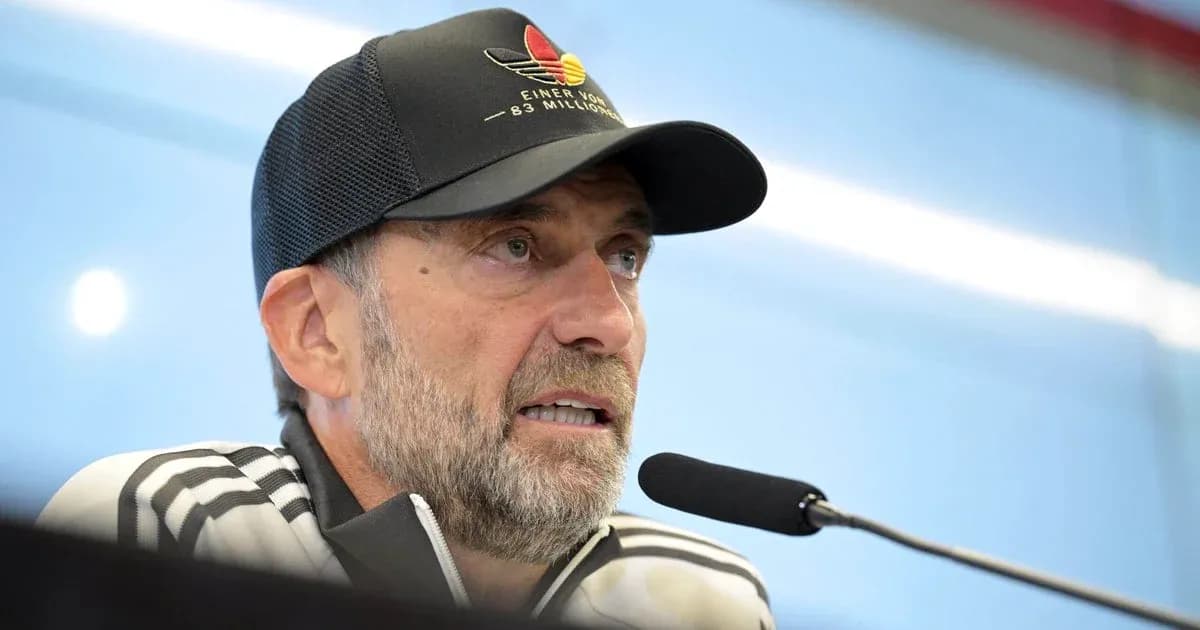
On his head, a baseball cap. On the cap, the words: “one of 83 million” in the colours of the German flag.
In a different time, it might have passed as a quirky fashion choice. Not now.
Germany is wrestling with a fraught political climate. The far-right Alternative für Deutschland (AfD) party recently won more than 43 per cent of the vote and a majority in the state election in Saxony-Anhalt, another marker in their growing support across East Germany and beyond. Their anti-immigration, nationalist rhetoric has found an audience in regions scarred by industrial decline and economic frustration, and their rise has been steady at both state and federal level.
For many, that ascent is not just a statistic. It is a source of anxiety, anger and division.
Klopp chose not to ignore that backdrop. Asked about the cap, he was blunt about what he wanted it to represent.
“We need to rediscover the fun in all of this,” he said. “I hope I won’t have to talk about political matters in the future. But I want to reclaim the flag for us. So that people feel happy and fortunate to live in this wonderful country.
“I don’t want to leave national pride to the wrong people. It fills me with pride to do this job. When we spend time focused on football, it’s meant to foster a sense of community and make us feel better. We have to create that atmosphere. But we also need people who embrace it.”
The message was unmistakable: the flag, the idea of Germany, should not belong to extremists.
The flag, the fault lines
That is where the cap becomes more than a slogan.
What does patriotism look like in modern Germany? What does the flag mean when the legacy of National Socialism still shapes every debate about national symbols? In a country that is increasingly multicultural, declarations of national pride can be read as celebration, as exclusion — or as something that can be hijacked.
That ambiguity is part of the problem. It reflects a nation pulling in different directions over what Germany is and what it should be. The federal structure only sharpens those contrasts, with states carrying their own identities and political moods into a shared but contested national story.
Klopp has walked straight into that conversation and planted himself firmly on one side: unity, openness, a shared sense of belonging.
On the pitch, he has torn up the old hierarchy and invited 44 players to fight for a future in his Germany. Off it, he has put on a cap and made it clear who he believes that future should belong to.
The Nations League will show how quickly his football ideas take hold. The bigger question is whether his version of the flag can win as many hearts as his teams usually win games.
Related News
Wrexham's Challenge: Overcoming Setbacks Against Southampton
Man United Injury Update: Shaw Eyes Fulham Return as Baleba, Amad Await
Séamus Coleman Omitted as Hallgrímsson Starts New Ireland Cycle
Jürgen Klopp's Bold New Era as Germany Head Coach
Séamus Coleman Aims to Continue with Republic of Ireland
Understanding Community Rules: Trolling vs Banter