
Mourinho’s Views on Ballon d’Or and Squad Management
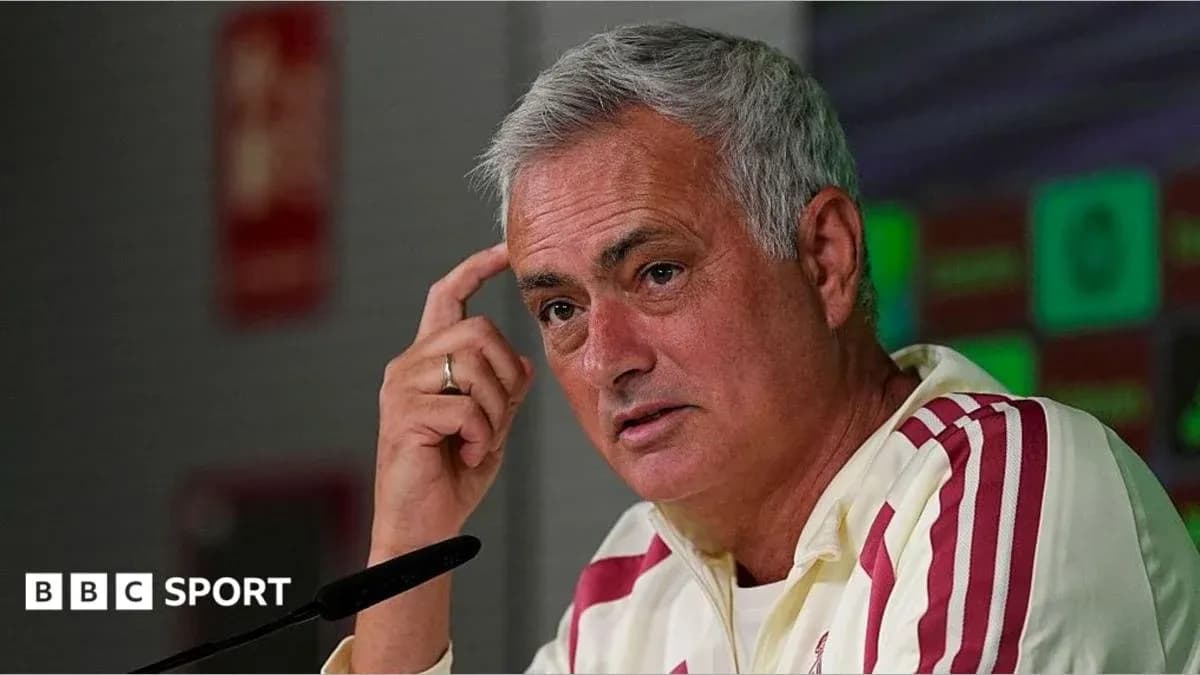
Jose Mourinho didn’t just sit down to talk about Málaga. He walked into the media room at Valdebebas and went straight for one of football’s sacred cows: the Ballon d’Or.
Mourinho’s Ballon d’Or manifesto
Asked the inevitable question about the award, Mourinho gave a response that felt more like a manifesto than a soundbite.
"It's very beautiful individually. You enter into the individual history of a particular player," he began, before widening the lens. He spoke of “a dozen players of a very, very high level,” adding that Real Madrid have “three or four” of them. Ambition is normal, he said. But his criteria are very clear.
"For me, the Ballon d'Or has to go to those players who, when they retire, we miss forever. I miss Maradona, Nazario, Messi, Zidane, Matthäus… You can't give the Ballon d'Or just because they won the Champions League or the World Cup."
Then came the punch: if the prize is about trophies, give it to the coaches.
"If you want to reward the Champions League, give the Ballon d'Or to Luis Enrique. For Spain, De La Fuente certainly deserves it. This is the great tribute. Another thing is the best in the world; it doesn't have to be from PSG or Spain. There are two, three, or four, and we know who they are. We know where they are — here. We know who has made history individually this summer."
Mourinho didn’t hide his distaste for the politics around the award.
"The Ballon d'Or has politics, and if politics gets involved, I don't like it so much. We already know my concept of the Ballon d'Or. We're not going to invent it in Spain or at PSG. There, it's Luis Enrique or De La Fuente. The best player is someone else."
Squad management and Málaga
When the subject turned to Málaga and the state of his squad, Mourinho sounded calm, almost content with the options at his disposal.
"There are players who, I keep saying, have had different preseason experiences. We have a strong squad with solutions to compensate for these issues," he explained.
Then he gave a concrete example: "Tomorrow, Cucurella starts, and Álvaro, who played well against Espanyol and Real Sociedad, will be on the bench. If Cucurella runs out of steam, we have Álvaro to come on. It's the kind of solution a squad like this provides a coach."
Depth, for Mourinho, is not a luxury. It’s a tool.
‘Concentration’ where it really matters
The talk of preparation led to a question about the group’s concentration. Mourinho split the concept in two.
"There are two kinds of concentration. The one you're talking about, being together, sleeping in a hotel, in Valdebebas… The one I'm interested in is the one here," he said, pointing to his head.
"It has nothing to do with sleeping in a hotel, it's here. Sometimes I think, and it saddens me, that all you see is warm-ups and rondo drills. In my other job, there's a lot of concentration. This is what interests me."
He then detailed their routine before Málaga: no overnight camp, but plenty of shared time.
"Sleeping or not sleeping, it depends. We're not sleeping today. The players are together. We have a tactical meeting now, we're eating together. We'll be together a little longer and then we'll see each other in the morning. Espi, Cucurella, and I are sleeping here. The rest are going home."
Diomande’s slow build
On Yan Diomande, Mourinho drew a line: no more individual dissection, but he still gave context.
"I'm not going to say anything more about individual players. Diomande arrived late and had a difficult summer because of the decision. He didn't train with Leipzig; when he arrived, he didn't have a foundation to work with, and he's progressing gradually."
Minutes are his medicine.
"He's already had playing time, which is what he needs to develop. Tomorrow he'll either start or come on as a substitute. He's getting more and more ready."
Bellingham: ‘He’s unique’
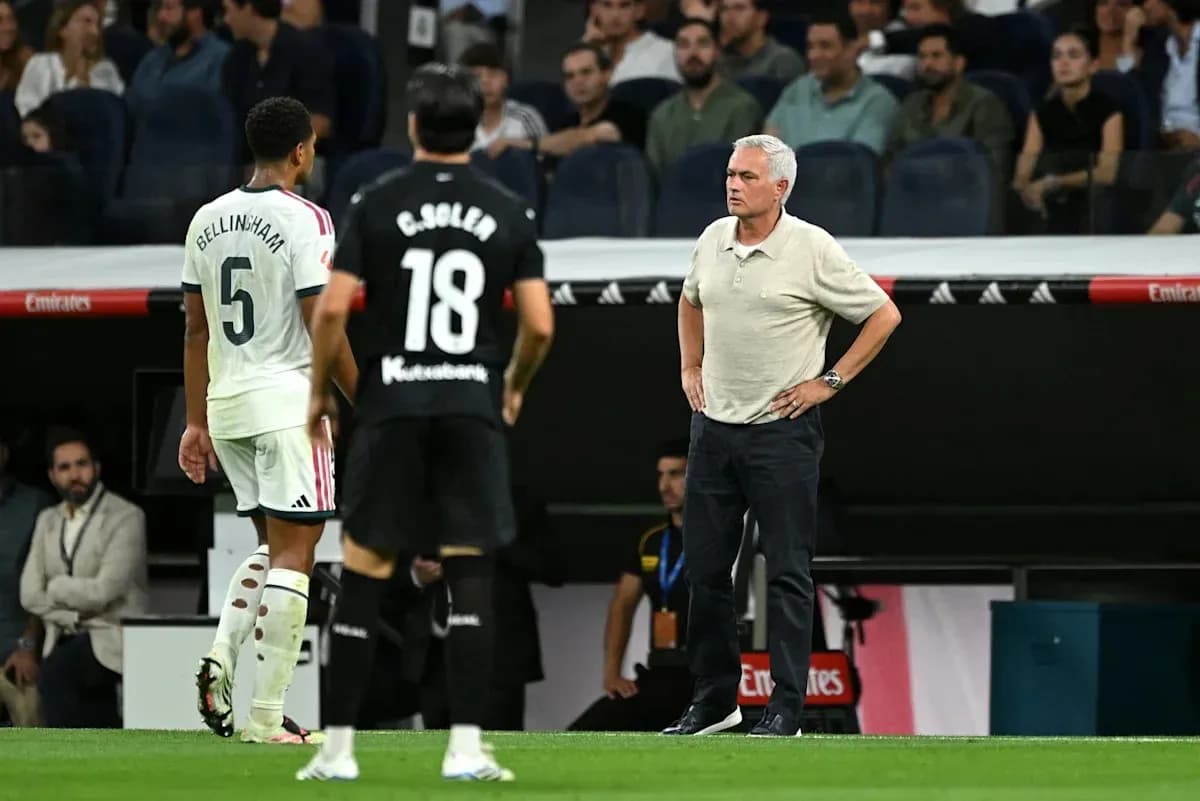
If there was one player Mourinho was happy to linger on, it was Jude Bellingham.
"He's unique. Super important for the team," he said, before listing the tools that make the Englishman such a complete force: "He has different talents: physical, mental, tactical, ball recovery, his goal-scoring ability, his aerial game. He's impressive."
Mourinho admitted he enjoys talking about the stars.
"I really like talking about Kylian, Vini, Jude. I understand the questions. But I'm very happy with everyone. As I said, here we only have great players and truly great players."
Then he brought it back to the collective.
"The team has to function as a team. Real Madrid fans go to the Bernabéu to see these exceptional players, but they also go to see a team play as a team, suffer as a team, face difficulties as a team, and dominate as a team. I'm the coach of that team, and I really like the players I have."
Castilla, Thiago Pitarch and the pathway up
Mourinho also highlighted the work being done just below the first team.
"Arbeloa has done a fantastic job in defense. Up front, the situation is different, and it hasn't been easy. He's done a fantastic job with the players. There isn't a single Castilla player I don't like."
Thiago Pitarch, in his eyes, has already outgrown that level.
"Thiago has shown he's no longer fit for the Castilla division. I like him a lot. He's part of this group of 21 players. We have Ciria, Cestero, and two goalkeepers on the bench because we don't have many options. When he's fit, he'll be part of the group and will get playing time."
Then came a typically blunt Mourinho line.
"I tell him his leg muscles are the same as mine, and he needs to put on a couple of kilos through hard work."
Freedom for the forwards
Asked about the freedom his attackers enjoy, Mourinho gave a small glimpse into the training ground.
"When you have players of incredible quality, they make the coach look like a phenomenon. They do things that go beyond the everyday routine."
He insisted that their flair is built on structure.
"We work on defense and attack. Today, the entire 45 minutes of training were dedicated to offensive organization. We worked on tactical formations and movement. When things get tough, they win matches."
His job is to balance order and imagination.
"We have to give them space for creativity and for their ability to make decisions. We have to be organized. We're improving in that area."
Endrick, Tchouameni and the injury calendar
On injuries, Mourinho was precise. Endrick is closest.
"[Endrick] is the closest to returning. I don't want to take any risks with Betis. Like I said, he could be ready for Betis or for the first Champions League match."
Tchouameni’s case is trickier.
"The other situations are more complicated. With Tchouameni, we have to keep our emotions in check. I don't want him to be in and out, in and out again. I don't want to start the season in August with a situation like this. I hope to have Tchouameni fit again, and I prefer to wait a little longer."
International break concerns
The looming international break clearly sits uneasily with him.
"International matches worry me. It's a long time. I'm less concerned about players who go with their national teams to play than those who are selected but don't play. Those are the ones I worry about the most."
His relationship with Carlo Ancelotti helps when it comes to coordination.
"My relationship with Carlo means I'm aware of the situation, and we'll exchange information. With Carlo, it won't be a problem. With others, where we don't have this level of trust, having players away for three weeks is very complicated."
He called for trust in national coaches, while knowing the risks.
"We're going to have faith in the professionalism of those coaches, in the respect they have for the players and the clubs. I don't want to dramatize it. Often, there are injuries while on international duty, and then when they return to their clubs, they lose the balance of the work they'd been doing for weeks, and then the injury happens. It is what it is, and there's nothing we can do about it."
Problems? ‘Natural’
Asked whether managing the group or working tactically is harder, Mourinho brushed off the premise.
"I don't feel that anything is difficult. I see it as natural. Problems are a natural part of life. We haven't had our first problem yet, but it's going to come. Whether it's tactical or related to team management, it's normal for it to happen. You have to see it as a natural occurrence and manage it as a natural one."
Respect for Ancelotti
On Ancelotti himself, Mourinho kept it short and emphatic.
"Ancelotti is a great man in every way. He doesn't have a weak point. He's a great man at every level."
Lineup leaks and tactical surprises
To close, the conversation turned to a modern obsession: leaked lineups.
"If we go into tomorrow's match and the opposition doesn't know our lineup until an hour and a half before kickoff, I prefer that. But if our lineup starts today, it's not a big deal."
The real issue, he said, is when secrecy hides something truly unexpected.
"The worrying thing is when you make a lot of structural changes. If we played with three centre-backs, with Espi and Kylian together. If we do something that's outside of what the Málaga manager might expect, then yes, it's a concern. But the difference between Carreras and Cucurella isn't a big deal."
Then came one last detail, a small window into the dressing room mood.
"The positive feeling about him not starting is that nobody has spoken about it. Not the players, not the kit men, not the doctors… But if he does start, it's not a big deal."
The message was clear: the noise can swirl around awards, politics, and leaked XIs. Inside Mourinho’s Real Madrid, the focus, at least for now, stays on the pitch — and on the players he believes the game will miss when they’re gone.
Related News
Mourinho's Concerns Over Upcoming International Break
Mourinho’s Views on Ballon d’Or and Squad Management
Michael Carrick Aims for Statement Win Against Tough Opposition
Mourinho Defines Valverde's Role: Only as a Midfielder
Iraola's First Anfield Audition: Liverpool vs Forest Clash
Real Madrid Prepares for Malaga Match with Key Absentees