
Napoli vs Bologna: Tactical Analysis of a 2-3 Defeat
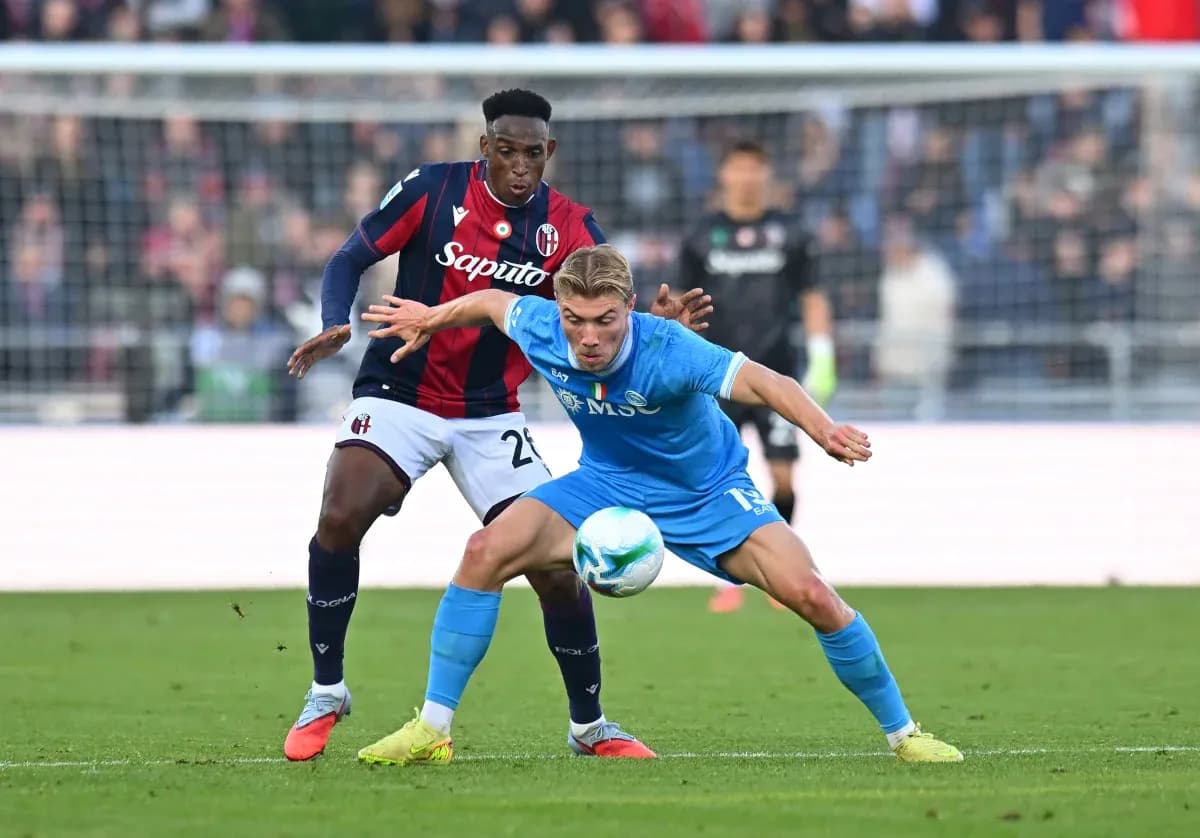
Napoli’s 2-3 defeat to Bologna at Stadio Diego Armando Maradona unfolded as a structural clash between Antonio Conte’s 3-4-2-1 and Vincenzo Italiano’s 4-3-3, where Bologna’s vertical clarity and superior penalty-box efficiency outweighed Napoli’s territorial edge and volume of shots. Despite 52% possession, 14 total shots and a 484-pass circulation, Napoli’s attacking framework rarely translated into truly high-quality chances, reflected in an xG of just 0.75. Bologna, with fewer shots (10) and less of the ball (48%), generated a higher xG of 1.32 and repeatedly accessed the most valuable spaces behind Napoli’s wide center-backs and wing-backs.
I. Executive Summary
The match narrative was defined early: Bologna struck first and consistently exploited transition lanes, while Napoli chased the game from the 10th minute onward. Napoli’s three-center-back build-up, anchored by V. Milinkovic-Savic behind Amir Rrahmani and Alessandro Buongiorno, struggled to control Bologna’s wide forwards. Bologna’s 4-3-3, with R. Orsolini and Federico Bernardeschi flanking S. Castro, pressed selectively, funnelling Napoli into the middle before springing forward through L. Ferguson and R. Freuler.
II. Scoring Sequence & Disciplinary Log
All three Bologna goals showcased different attacking mechanisms. At 10', Federico Bernardeschi (Bologna) finished a Normal Goal, assisted by J. Miranda, capitalizing on early disorganization in Napoli’s back three as the left-back advanced high and Bernardeschi attacked the inside channel. The second Bologna goal came from structural pressure: a Var check at 33' confirmed a penalty for Bologna, and at 34' R. Orsolini (Bologna) converted the Penalty, doubling the lead and punishing Napoli’s difficulty in defending box entries with their wide defenders exposed.
Napoli’s response came right on the 45' mark: Giovanni Di Lorenzo (Napoli) scored a Normal Goal at 45' (no assist), a sequence emblematic of Conte’s wing-back-to-box patterns, with Di Lorenzo stepping high from the right side of the back three to attack the far post and halve the deficit before the interval. Early in the second half, Napoli’s structure finally produced a clean central combination: at 48', Alisson Santos (Napoli) scored a Normal Goal, assisted by R. Hojlund, as Hojlund dropped between Bologna’s lines, combined on the turn and released Santos into the box to make it 2-2.
The decisive moment came at 90', when J. Rowe (Bologna) struck a Normal Goal (no assist). This was a classic Italiano pattern: a late substitute attacking a stretched Napoli defensive block in the closing phase, exploiting the space left by advanced wing-backs and fatigued central defenders.
Disciplinary events were heavily skewed toward Bologna, consistent with their more aggressive defensive posture. The chronological card log:
- 38' João Mário (Bologna) — Foul
- 47' Federico Bernardeschi (Bologna) — Foul
- 58' Eivind Helland (Bologna) — Foul
- 69' Jhon Lucumí (Bologna) — Foul
- 84' Matteo Politano (Napoli) — Foul
Totals: Napoli 1 yellow card, Bologna 4 yellow cards, overall 5 cards.
III. Tactical Breakdown & Personnel
Conte’s 3-4-2-1 used R. Hojlund as the central reference, with Giovane and Alisson Santos as the two advanced forwards operating between Bologna’s lines. The wing-backs, M. Politano on the right and M. Gutierrez on the left, were tasked with providing width and deep crossing zones. Napoli’s 52% possession and 484 passes (425 accurate, 88%) show a structured, ball-dominant plan, but the shot profile (11 of 14 shots inside the box, yet only 5 on target and xG 0.75) indicates that many of those touches came under pressure or from poor angles. Bologna’s compact 4-3-3 mid-block, with T. Pobega, R. Freuler and L. Ferguson screening the half-spaces, forced Napoli to circulate in front rather than penetrate through.
Defensively, Napoli’s three-center-back system was repeatedly stressed by Bologna’s wide forwards. Bernardeschi and Orsolini held wide starting positions, then attacked diagonally into the gaps outside Rrahmani and Buongiorno whenever Politano and Gutierrez advanced. This was most evident on the 10' opener and on the penalty situation leading to Orsolini’s 34' goal, where Bologna accessed the box with a runner arriving from the wing.
V. Milinkovic-Savic’s goalkeeping metrics underline a difficult night: with only 1 Goalkeeper Save and goals prevented at -0.82, he conceded more than the model would expect from the shots faced. That said, Bologna’s 4 Shots on Goal from 10 total attempts were largely from central, high-value zones, reflecting structural defensive issues more than pure shot-stopping failure.
On the other side, M. Pessina in Bologna’s goal produced 3 Goalkeeper Saves and also posted goals prevented of -0.82. Despite that negative figure, his interventions were timely, particularly in the second half as Napoli’s wing-backs and Alisson Santos began to find more crossing positions. Bologna’s back four, with Joao Mario and J. Miranda as full-backs and E. Fauske Helland alongside J. Lucumi centrally, benefited from a compact midfield screen and limited Napoli to relatively modest xG despite conceding 14 shots and 7 corners.
Substitutions were tactically coherent. For Bologna, N. Zortea (IN) came on for Joao Mario (OUT) at 64' to add defensive energy on the flank. J. Rowe (IN) for F. Bernardeschi (OUT) at 73' provided fresh pace and direct running, culminating in the 90' winner. Later, N. Moro (IN) for T. Pobega (OUT) and S. Sohm (IN) for L. Ferguson (OUT) at 81', plus T. Heggem (IN) for E. Fauske Helland (OUT) at 82', were aimed at reinforcing central and wide defensive zones and preserving legs for transitions.
Conte’s response at 76' was double: E. Elmas (IN) for Giovane (OUT) and B. Gilmour (IN) for S. Lobotka (OUT), trading control for more vertical passing and late box arrivals. At 85', L. Spinazzola (IN) for M. Politano (OUT) and at 87' P. Mazzocchi (IN) for M. Gutierrez (OUT) signaled an all-out wide overload, with both flanks pushed extremely high. This, however, increased Napoli’s exposure to counterattacks, directly feeding into the space Rowe exploited for the decisive 90' goal.
IV. The Statistical Verdict
The numbers crystallize the tactical story. Napoli’s 52% possession and superior passing volume (484 passes, 425 accurate, 88%) contrasted with Bologna’s 458 passes (386 accurate, 84%), but Bologna produced the higher xG (1.32 vs 0.75) from fewer shots (10 vs 14). Napoli’s 7 corners to Bologna’s 1 highlight sustained territorial pressure, yet Bologna’s more efficient shot selection and clinical execution – three goals from four shots on target – outweighed Napoli’s volume.
Discipline also reflected style: Bologna committed more Fouls (12 vs Napoli’s 10) and collected 4 yellow cards to Napoli’s 1, consistent with an aggressive, interruption-heavy defensive approach. From a defensive index perspective, both goalkeepers underperformed the model (goals prevented -0.82 each), but Bologna’s back line better protected central spaces, while Napoli’s structural risk in wide areas and high wing-backs left their three-center-back unit repeatedly exposed. The final 2-3 scoreline, with Bologna ahead at half-time (1-2) and winning it late, aligns closely with the underlying chance quality and the tactical risk-reward balance each coach chose.
Related News

David Alaba Poised for Surprising Move to Udinese in Serie A
Milan Dominates Lecce: Tactical Analysis of a 3-0 Victory

Juventus Defeats Atalanta 2-0: Tactical Insights and Key Matchups
Frosinone's Tactical Mastery Shines in 2–0 Victory Over Como
Fiorentina and Napoli Share Points in Serie A Clash
AS Roma vs Inter: Tactical Insights from Serie A Clash