
Neymar Leads Brazil to Olympic Gold: A Historic Moment
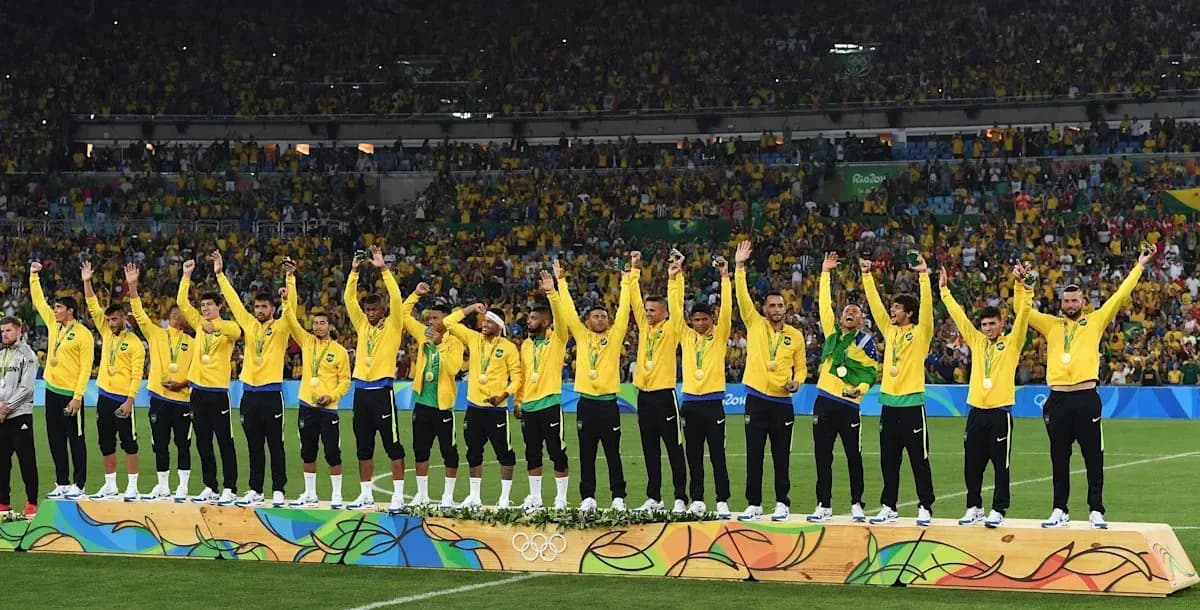
Ten years on, the images still feel fresh: a packed Maracanã, a nation holding its breath, and Neymar walking alone towards the penalty spot with history on his shoulders.
On August 20, 2016, Brazil finally claimed the one title that had always slipped away. Olympic gold. At home. Against Germany. The script could hardly have been written with more tension.
Neymar’s moment, Brazil’s release
The final was tight, nervy, and heavy with context. Every touch felt loaded. Brazil had been chasing this medal since men’s football entered the Olympic programme; Germany carried the shadow of the 7-1 from the 2014 World Cup. Nothing about it felt like just another under-23 tournament match.
Midway through the first half, the stadium erupted. In the 26th minute, Neymar stood over a free kick, just outside the area, slightly to the left. One swing of that left foot and the ball arced over the wall, kissed the underside of the crossbar and dropped in. Maracanã shook. Brazil led.
Germany refused to fold. They grew into the game, pushed higher, and were rewarded after the break. In the 60th minute, Meyer finished off a move that sliced through the Brazilian defence and silenced the stands. At 1-1, the tension returned, thicker than before.
Extra time brought more anxiety than chances. Both teams looked exhausted, physically and emotionally. Nobody blinked. The gold medal would be decided from the spot.
Weverton’s save, Neymar’s exclamation point
The shootout became a test of nerve.
Renato Augusto, Marquinhos, Rafinha and Luan all converted for Brazil. Ginter, Gnabry, Brandt and Süle answered for Germany. Four kicks each. No mistakes. No margin for error.
Then came Petersen, one of the tournament’s top scorers. He stepped up for Germany’s fifth penalty. Weverton guessed right, sprang to his left and pushed the ball away. The save detonated a roar around the Maracanã. Suddenly, the entire weight of the country’s Olympic dream landed at Neymar’s feet.
He walked up slowly, paused, and buried Brazil’s fifth penalty. Gold secured. The captain tore off his armband, dropped to his knees and broke into tears. Around him, Walace, Gabriel Jesus, Gabriel Barbosa, Rafael Alcântara and the rest of the squad sprinted in from the halfway line, engulfing him in a pile of yellow shirts. A decades-long wait had ended in one kick.
A rocky start, then a surge
The road to that cathartic night had not been smooth.
Brazil opened Group A in Brasília under immense pressure and stumbled out of the blocks. A 0-0 draw against South Africa, followed by another goalless stalemate against Iraq, triggered early doubts and criticism. Two games, no goals, and the hosts looked stuck.
Everything changed in Salvador.
Needing a win to top the group and calm the storm, the Seleção thrashed Denmark 4-0 at Arena Fonte Nova. Gabriel Barbosa scored twice, Gabriel Jesus added another, and Luan joined the party. The performance reset the mood. Brazil advanced as group winners, with the attack finally clicking.
From there, the knockout phase felt like a mission.
In the quarterfinals at Arena Corinthians in São Paulo, Brazil met a rugged Colombia side that had emerged from Group B with 2-2 draws against Sweden and Japan and a 2-0 victory over Nigeria. This time, the hosts were efficient. Neymar opened the scoring, Luan struck again, and a 2-0 win carried Brazil into the medal rounds with growing confidence.
Then came the statement performance.
Honduras, who had survived a tough path past Argentina and Algeria in the group stage and then eliminated South Korea 1-0 in the quarterfinals, arrived at the Maracanã for the semifinal. They were blown away. Brazil ran riot in a 6-0 demolition. Neymar and Gabriel Jesus both scored twice, Marquinhos added one, and Luan continued his outstanding tournament with another goal. The final was set. Germany awaited.
The 18 who made history
Eighteen players left Rio with the first Olympic gold in Brazilian football history. One more, Fernando Prass, lived it from a cruel distance. Called up as an overage goalkeeper, he suffered an elbow injury in the warm-up before a friendly against Japan at Serra Dourada in Goiânia and was ruled out before the group stage began. His name still lingers around that achievement as a reminder of how fine the margins can be.
The medal-winning squad:
- Goalkeepers
- Weverton (Athletico-PR)
- Uilson (Atlético Mineiro)
- Full-backs
- William (Internacional)
- Douglas Santos (Atlético Mineiro)
- Zeca (Santos)
- Center-backs
- Rodrigo Caio (São Paulo)
- Luan Garcia (Vasco da Gama)
- Marquinhos (Paris Saint Germain, FRA)
- Midfielders
- Thiago Maia (Santos)
- Rodrigo Dourado (Internacional)
- Rafinha Alcântara (Barcelona, ESP)
- Renato Augusto (Beijing Guoan, CHI)
- Felipe Anderson (Lazio, ITA)
- Walace (Grêmio)
- Forwards
- Neymar (Barcelona, ESP)
- Luan (Grêmio)
- Gabriel Barbosa (Santos)
- Gabriel Jesus (Palmeiras)
A decade later, that night at the Maracanã still stands apart in Brazil’s sprawling football history. World Cups defined eras. Copa América titles filled cabinets. But Olympic gold in 2016 closed a chapter that had hung open for generations.
The question now is simple: will any future Brazilian team handle expectation, pressure and destiny quite like that one did?
Related News
Jamal Musiala Reassures Fans After On-Field Collapses
Matthias Jaissle: Embracing Challenges at Newcastle United

Wolverhampton Wanderers Face Injury Woes with Kieran Trippier and Yerson Mosquera
Jamal Musiala's Health Update: Managing Neurological Episodes
Artificial Intelligence Transforming Football Decisions
Lionel Messi Scores Meaningful Goal Amid Grief