
Orlando Pride vs Portland Thorns: A Harsh NWSL Lesson
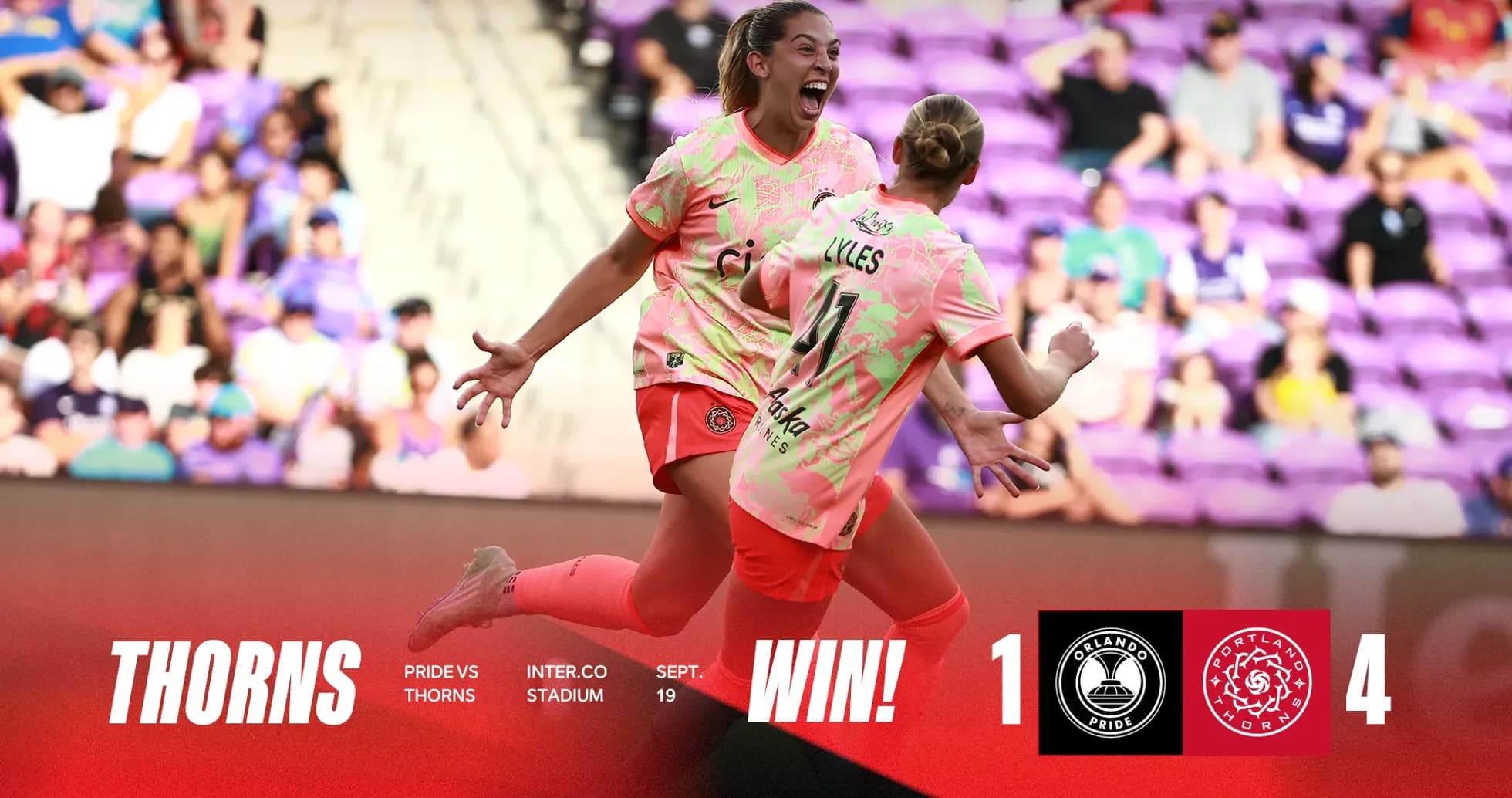
Exploria Stadium emptied under the Orlando night with a harsh lesson etched into the scoreboard: Orlando Pride W 1–4 Portland Thorns W. In a Group Stage clash of the NWSL Women season, a meeting of contrasting identities ended with Portland confirming their status as a playoff-calibre side and Orlando being reminded of the fragility that has underpinned their campaign.
I. The Big Picture – A clash of trajectories
Heading into this game, the table already hinted at the gap. Orlando arrived 11th with 30 points from 25 matches, their overall record a patchwork of inconsistency: 9 wins, 3 draws, 13 defeats, with 32 goals scored and 40 conceded. A goal difference of -8 told the story of a side that can hurt opponents but too often gets hurt themselves. At home, though, they had been more competitive: 6 wins from 13, scoring 20 and conceding 20 at an average of 1.5 goals both for and against.
Portland, by contrast, travelled to Florida in 5th place on 42 points, very much in the promotion conversation with 12 wins, 6 draws and 7 losses. Their overall goal difference of 8 came from 42 scored and 34 conceded. The pattern was clear: a potent attack averaging 1.7 goals per match in total, but a defence that could be stretched, especially away, where they had allowed 26 goals in 13 matches at an average of 2.0 per game.
Yet on this night, the script flipped. Orlando, usually capable of turning Exploria Stadium into a high-variance arena, were outplayed and outpunched. They led early at half-time in terms of hope but trailed 1–2 on the scoreboard, and the second half only deepened the divide as Portland added two more without reply.
II. Tactical Voids – Discipline, risk and the fine margins
The absence list offered no explicit warnings, but the season-long disciplinary trends for both squads shaped the match’s emotional undercurrent.
Orlando have lived on the edge all year. Their yellow card timing is telling: 24.14% of their cautions come between 61–75 minutes and another 24.14% between 76–90, a late-game spike that often coincides with fatigue and chasing games. They have also seen red once, in the 61–75 window, reinforcing the idea of a team whose aggression can tip into recklessness as the pressure rises.
Players like H. McCutcheon, who has collected 5 yellow cards this season, embody that combative edge in midfield. She is a ball-winner and tempo-breaker, but her 25 fouls committed show how fine the line is between breaking up play and inviting danger.
Portland’s disciplinary profile is even more dramatic. They have multiple red-card risks: J. Perry with 6 yellows and 1 red, Reyna Renè Reyes with a red, and C. Bogere with a yellow-red combination. Their yellows cluster heavily in the final half-hour: 20.00% between 61–75 minutes and 23.33% between 76–90, with further cards deep into stoppage time. This is a side that presses aggressively and accepts the cost in cards.
Yet in this fixture, Portland’s discipline held just enough, and Orlando’s structural cracks mattered more than any single caution.
III. Key Matchups – Hunter vs Shield, and the battle for control
The headline duel was always going to be Barbra Banda against Portland’s back line. Banda, with 15 goals and 2 assists in 21 appearances, is one of the league’s most devastating forwards. Her 66 shots with 36 on target, 22 key passes and a rating of 7.65 speak of a player who can create chaos on her own. Orlando’s entire attacking structure in the 4-2-3-1 was built to give her channels: S. Washington, S. Yates and H. McCutcheon operating behind her, with Luana and A. Lemos anchoring.
But Portland’s defensive quartet – Reyes, Carolyn Lisette Calzada, J. Perry and M. Müller – came into this with a clear brief: contain Banda’s runs in behind and deny her clean looks. Perry, who has blocked 5 shots this season, and Reyes, with 7 blocks and 15 interceptions, form a rugged, front-foot pairing. On the night, that aggression was backed by structure. They squeezed the space between lines, forcing Banda into duels she could not consistently win and limiting Orlando’s ability to exploit their usual scoring surges.
Those surges are predictable but powerful: Orlando’s goals peak in the 31–45 and 76–90 minute ranges, each accounting for 25.81% of their total. They also carry a strong punch just after half-time, with 19.35% of their goals between 46–60. But Portland’s defensive weak spot is notoriously late: 31.43% of their goals conceded come in the 76–90 window. On paper, the intersection was obvious – Orlando’s late push versus Portland’s late wobble.
Instead, it was Portland who finished stronger. Their own attacking timing is ruthless: 26.83% of their goals arrive in the opening 15 minutes, and another 19.51% in the final quarter-hour. Orlando, who concede heavily early (17.07% in both 0–15 and 16–30) and again late (19.51% between 76–90), were caught in exactly those danger zones. The 1–2 half-time deficit reflected Portland’s fast start; the final 1–4 exposed Orlando’s inability to weather the late storm.
In the “Engine Room”, Orlando’s double pivot of Luana and Lemos had to cope with J. Fleming and N. Nijstad. Fleming’s intelligence between the lines helped Portland progress play, while further ahead, P. Tordin orchestrated. Tordin is one of the league’s most complete attacking midfielders: 6 goals, 7 assists, 41 key passes, and 35 tackles underline her dual role as creator and first presser. Her presence between Orlando’s lines repeatedly unbalanced the home shape, pulling defenders out and opening lanes for S. Smith.
Smith, with 11 goals and 3 assists, was the “Hunter” in Portland’s 4-2-3-1. Her 75 shots and 44 on target show a striker who never stops asking questions. Against an Orlando defence that concedes an average of 1.5 goals at home and struggles in the 46–60 and 76–90 minute phases, her movement was decisive. She stretched the back four of Oihane Hernández, C. Dyke, H. Anderson and H. Mace, exploiting the spaces left when Orlando tried to step higher in search of an equaliser.
IV. Statistical Prognosis – Why 1–4 felt inevitable
Following this result, the numbers feel less like abstractions and more like prophecy fulfilled.
Orlando’s overall scoring average of 1.3 goals per match, paired with 1.6 conceded, always leaves them walking a tightrope. Their penalty record – 4 awarded, but only 2 scored and 2 missed – underlines their struggle to convert key moments. In a match where margins against a top-five side are razor-thin, such inefficiency becomes fatal.
Portland, meanwhile, embody controlled volatility. They score 1.6 goals on their travels but concede 2.0; they are capable of both blowing teams away and being blown away. Yet their clean sheet record of 9 overall, including 2 away, shows they can lock games down when their structure holds. Here, they married their attacking surges with just enough defensive resilience, and their perfect penalty record this season – 6 taken, 6 scored, no misses – is emblematic of a side that maximises big moments.
From a tactical lens, the 4–2–3–1 mirror formations put individual quality and phase management at the heart of the contest. Portland won both battles. They dominated the critical time windows – early and late – where Orlando are weakest, and their stars in the final third, Smith and Tordin, imposed themselves more consistently than Banda could at the other end.
The 1–4 scoreline is brutal but coherent with the underlying trends: a playoff-chasing side with elite attacking pieces and ruthless timing against a mid-table team whose defensive vulnerabilities and erratic discipline finally caught up with them on a big night in Orlando.
Related News

Racing Louisville W vs San Diego Wave W Prediction: Key Stats and Betting Tips
Bay FC W vs Orlando Pride W: Head-to-Head Stats and Historical Overview
Chicago Red Stars vs Washington Spirit: NWSL Showdown

Portland Thorns W vs Houston Dash W: Head-to-Head Stats and Insights
Washington Spirit W vs Angel City W: Head-to-head Stats and Past Meetings

Kansas City W vs Denver Summit W Stats: Head-to-Head Record Before Match