
Patrick Vieira's Dream Come True as Senegal National Team Coach
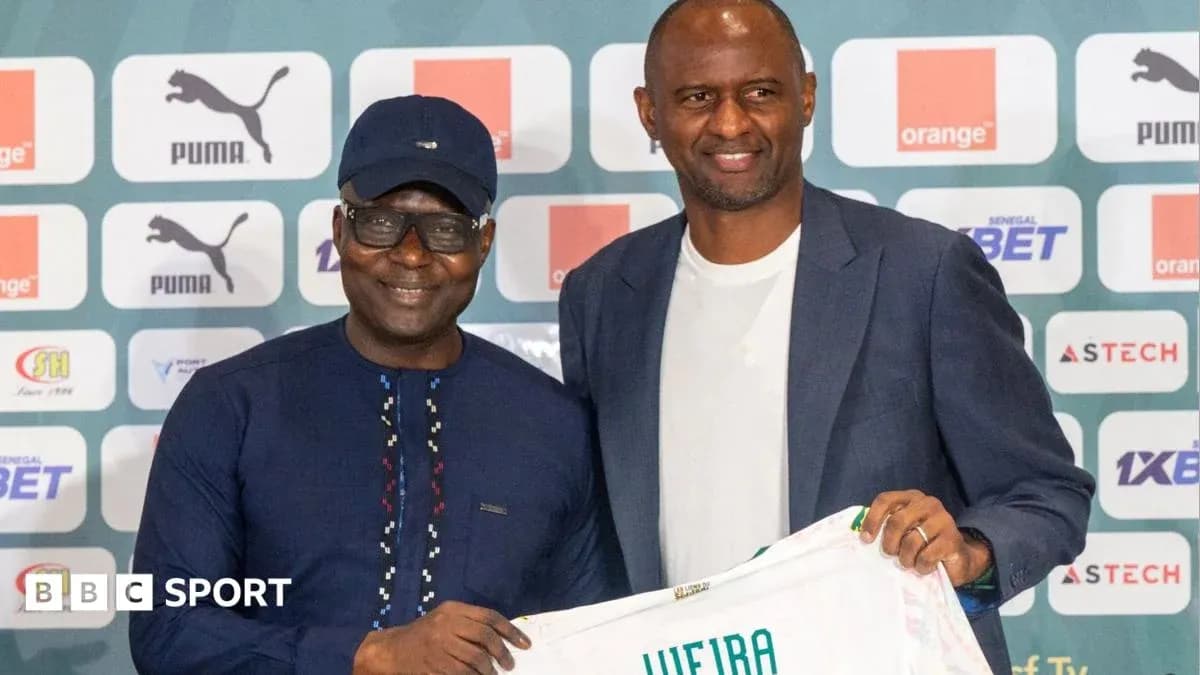
Patrick Vieira stood in Dakar, draped in a Senegal flag, and called it what it was: “an absolute dream”.
For the first time in his coaching career, the World Cup and European Championship winner has taken charge of a national team. Not just any national team, but the country of his birth. For Vieira, this is not a calculated career move. He called it “one from the heart”.
‘Coming back home’
Vieira, 50, was born in Senegal before moving to France and becoming one of Les Bleus’ defining midfielders, lifting the 1998 World Cup and Euro 2000. Now, after club spells with New York City, Nice, Crystal Palace, Strasbourg and Genoa, his path has looped back to where it began.
“Being head coach of the Senegal national team is an absolute dream,” he told reporters in Dakar at his unveiling. “I was born here, my parents were born here, and it really is a homecoming.”
From the first conversations with the Senegalese federation, he barely hesitated.
“From the very first meetings I had with the president, I accepted this challenge straight away, because there was also an exceptional generation of players,” he said.
He knows what he is walking into. A football-mad nation with a population of around 20 million and expectations to match.
“I realise the expectations of the people – all 20 million Senegalese. And I know that with the experience I have, with the determination I have, I’ll be able to see this project through.”
Taking over a heavyweight
Vieira replaces Pape Thiaw, stepping into a job that carries more weight than it did a decade ago. Senegal are no longer outsiders punching up. They are part of the elite.
“Today, Senegal is among the major nations in world football,” Vieira said. “Senegal’s objectives aren’t what they were 10 or 15 years ago. On the back of its recent results, Senegal has moved forward, has reached new levels. The demand for results has also stepped up. We need to lay solid foundations.”
He inherits a team still stinging from a brutal World Cup exit. At the 2026 tournament, Senegal led Belgium 2-0 after 85 minutes in the last 32, only to collapse and lose 3-2 after extra time. It was the kind of defeat that lingers.
Yet this is also a side that, on the pitch at least, won the 2025 Africa Cup of Nations with a 1-0 extra-time victory over Morocco in January. Off the pitch, that triumph remains tangled in legal wrangling. A walk-off protest by some Senegal players and staff over a penalty decision in the final led to the trophy being handed to hosts Morocco in March. The Court of Arbitration for Sport will decide the ultimate destination of the title.
So Vieira steps into a dressing room that has known both glory and grievance in the space of a few months.
‘A new chapter, not a demolition’
If anyone expected sweeping revolution, Vieira quickly pushed back. He spoke instead of evolution.
“What matters to me isn’t starting again from scratch,” he said. “It’s about respecting what the federation has put in place over the last few years and building the next stage, opening a new chapter.
“A new chapter meaning my job isn’t to tear everything down, it isn’t to throw everything out of the window. It’s about keeping this team’s strength: its identity, its unity, its ability to suffer together.”
On the pitch, his ideas are clear. He wants a side with “a very precise structure” that plays with “intensity and aggression”. Off it, he knows he cannot do it alone.
“To make this project work, I’ll need the whole nation united. I’ll work heart and soul to restore the team’s pride.”
A chaotic start
There is no gentle introduction. Vieira is dropped straight into qualifiers for the 2027 Afcon, with two matches in this window, two more in November and the final rounds in March 2027.
Even the schedule has turned awkward. His reign was supposed to start with a home game against Mozambique on Friday, 25 September. Dakar, though, is deep in preparations for the 2026 Youth Olympic Games, and the match has been switched.
“Of course, I’d have preferred to play the first match here in Dakar,” Vieira admitted. “But unfortunately, with the federation, we all felt the best decision was to postpone the match and go and play in Mozambique. Those are difficulties we’re going to accept and deal with.”
So the new era begins on the road: first in Maputo, then away to Ethiopia on 29 September.
Big names missing
Vieira will not have his full arsenal for these opening tests.
Long-time number one Edouard Mendy, 34, has retired from international duty. Sadio Mane, the country’s talisman and still the emotional heartbeat of the team, will miss out with what Vieira described as “a bit of a physical issue”.
Speculation had swirled that Mane, also 34, might follow Mendy into retirement. Vieira shut that down, stressing that, fitness allowing, the former Liverpool and Bayern Munich forward will “surely” be in his next squad.
Right-back Krepin Diatta is absent as he is currently without a club. Forward Ismaila Sarr is also missing; he has yet to play for Crystal Palace this season amid transfer rumours and a groin problem.
The first Senegal squad of the Vieira era will be patched together, then. Not ideal for a coach who talks about structure and intensity. But he has lived with worse.
A coach shaped by scars
Vieira’s playing career was drenched in silverware. His coaching journey has been far more bruising.
He left Crystal Palace in March 2023 with 22 wins from 74 matches in all competitions. After that came Strasbourg, then Genoa, where he first guided the club to safety in Serie A in the 2024-25 season, only to be sacked the following campaign after six defeats in nine league games left them bottom.
He has been out of work since November last year. Those setbacks have not dimmed his belief in what he can offer.
“When you talk about my coaching career, or a certain amount of experience, I’ve always been someone who stays positive,” he said. “That means you learn, and there are always positive things to take from it. I’m a better coach today than I was in my last spell at Genoa, because that experience helped me grow and made me realise certain things.
“Given the experience I have as a manager, I’ve got no doubt about my ability to meet the expectations of fans.”
A nation’s embrace
If he needed any reminder of what this job means, he got it the moment he stepped off the plane.
On Thursday evening in Dakar, fans packed into the airport, phones raised, arms outstretched. Clips on social media showed Vieira lifting the Senegal flag above his head, shaking hands, soaking in the noise.
“I couldn’t have been given a warmer welcome,” he said. “I saw the supporters’ enthusiasm and I thank them for it. Taking charge of this national team isn’t just a new stage in my career – it’s coming back home.”
Now comes the hard part. Can the boy who left Senegal to conquer the world as a player turn his home into a sustained force at the very top of it as a coach?
Related News
Fulham's Arbeloa Faces Premier League Challenge Without Tete
Kulusevski Returns to Tottenham: A Long-Awaited Comeback
Patrick Vieira's Dream Come True as Senegal National Team Coach
Chelsea’s Midfield Gamble Exposed by Reece James Injury
Fabregas: Perfection Needed Against Frosinone
Celtic v Rangers: O’Neill Faces Pressure in Defining Derby