
Raphinha's Transformation: From Ballon d'Or Snub to Barca's Star No.9
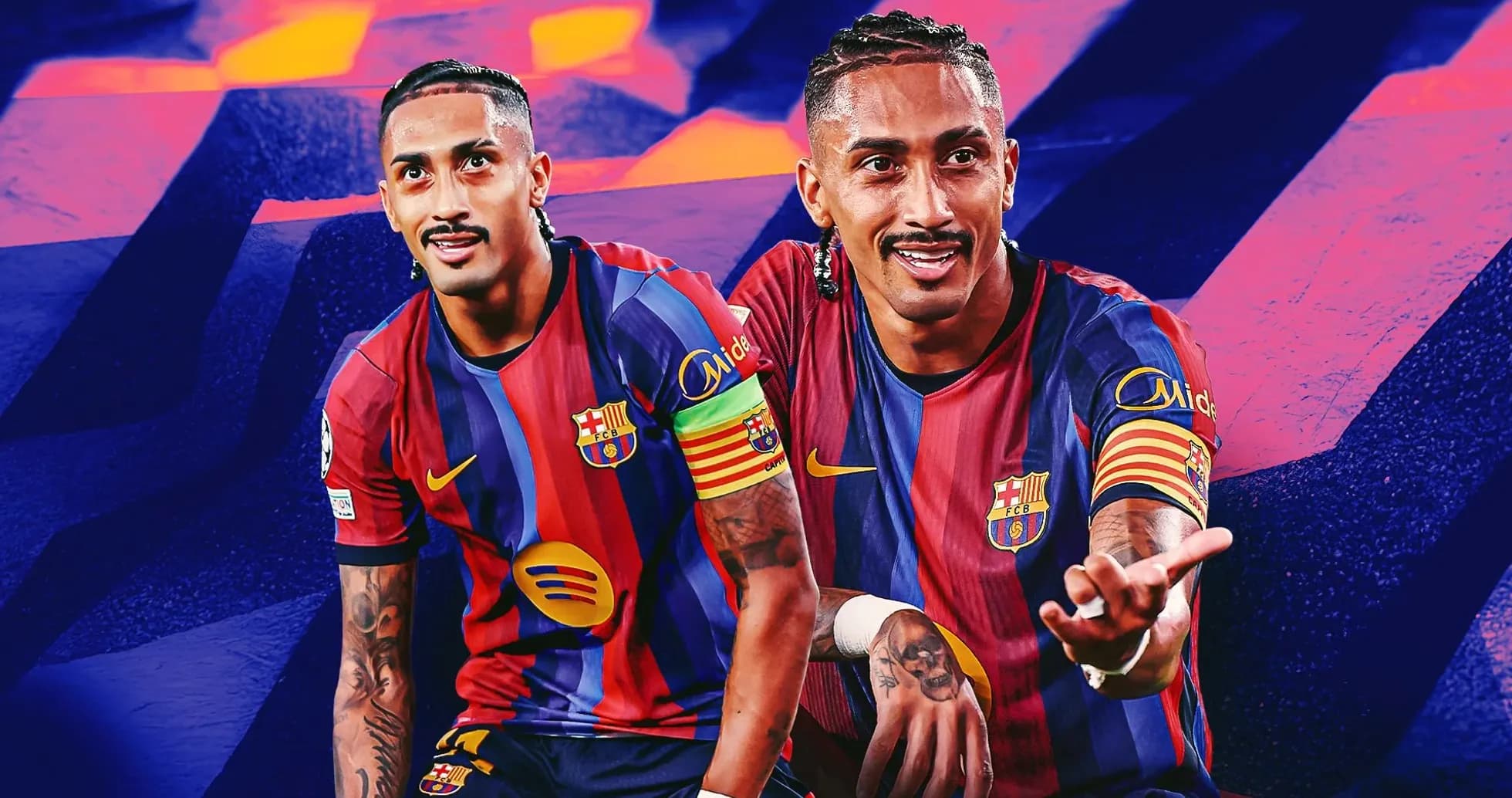
A year ago, Raphinha was limping through a ruined season, his hamstrings betraying him, his World Cup derailed, his Ballon d’Or dream gone.
Now he’s ripping Europe apart as Barcelona’s centre-forward.
Under Hansi Flick, the Brazilian has been pushed inside from the left wing and handed the keys to the attack. The response has been ferocious. Eleven goals already this season – a number no Barca player has ever reached this quickly in the last 60 years.
Lionel Messi never did it. Ronaldo didn’t either. Raphinha has.
From injury-ravaged season to unstoppable start
The contrast is brutal. In 2024-25, Raphinha was a phenomenon: 60 goal contributions and a genuine case for the Ballon d’Or. Then came last term: only 29, 125 days out injured, momentum shattered. His World Cup, the stage he’d waited his whole life for, effectively lost to those same hamstrings.
So when this year’s Ballon d’Or 30-man shortlist dropped without his name, Flick bristled.
“He (Raphinha) is far too good not to be on that list, but we can’t change it,” the Barca coach said, speaking from a position of absolute conviction after watching his captain tear into opponents from a central role.
The message was clear: the award can ignore him. Barcelona won’t.
Champions League statement: Feyenoord feel the full force
The Champions League opener against Feyenoord was the night the rest of Europe was reminded what they’d been missing.
Raphinha’s first goal was pure theatre. He chased a slightly wayward pass from Lamine Yamal, shrugged off one defender, surged into the box and shaped to shoot. Then came the twist: an audacious dummy that sent two more defenders sprawling, opening the angle for a calm, rolled finish. One move, three players left on the floor.
His second was straight from the centre-forward manual. He initially checked towards the ball when Dani Olmo picked it up in the centre circle, dragging his marker with him, then exploded in the opposite direction. Olmo slid a perfectly weighted pass into his path, and Raphinha lashed a low shot across the helpless goalkeeper.
Barca ran out 5-1 winners. Raphinha walked away with Player of the Match and the aura of a man playing the game at his own speed.
“Rapha has played fantastic,” Flick said. “He’s on another level – he’s unbelievable.”
Right now, it feels less like praise and more like a simple description.
A record Messi and Ronaldo couldn’t touch
The numbers back up the eye test. Eleven goals already this term – no Barcelona player in the last six decades has started a season so explosively.
Messi hit 10 in his first seven games of 2012-13, and reached nine at this stage twice more. Ronaldo got to nine in 1996-97. Raphinha has flown past both.
His transformation into the focal point of Flick’s fluid front line has changed everything. Robert Lewandowski was the classic back-to-goal reference. Ferran Torres hurt teams with intelligent runs in behind. Raphinha does both jobs and then some.
At 29, he floats between the lines, drags centre-backs into places they don’t want to go, then punishes the gaps he’s just created. His pace is explosive, his first touch sharp, his technique clean. When he drops off, he links with Olmo, Yamal and Anthony Gordon. When he spins in behind, he becomes a pure finisher.
The wingers are thriving because of him. So is the system.
Hat-trick, high press and a captain who never stops
Racing Santander felt the full storm next. In La Liga, Raphinha hit a hat-trick in a 7-2 demolition, a performance that underlined every facet of his new role.
Two of the goals came from the spot, but the second was the one that stuck. Again, Olmo spotted the run. Raphinha ghosted into the gap between the centre-backs, waited, then met the pass with one touch and a half-volley steered into the corner. No fuss, no wasted movement. Just timing and cold precision.
On the ball, he makes football look easy. Off it, he’s a machine.
Barca’s press begins with him. He charges, harasses, forces hurried clearances and bad passes because he simply refuses to stop. That intensity is exactly what Flick demands from his front line, and it’s why the coach won’t be losing sleep over the club’s failed move for Julian Alvarez. The deal that never happened now looks like a blessing.
The frontline is humming. The money can go elsewhere.
Walking in Ronaldo’s shadow – and closing the gap
Barcelona’s history with Brazilian stars is rich. Romario. Rivaldo. Ronaldinho. Neymar. And towering over all of them in terms of a single season in blaugrana: Ronaldo.
In 1996, Barca paid a world-record $19.5m to bring a 20-year-old from PSV. He responded with 47 goals in 49 games, a Copa del Rey, a UEFA Cup Winners’ Cup, a Supercopa de España, the Pichichi, the European Golden Shoe and the 1997 Ballon d’Or. Week after week, he shredded teams with terrifying strength, raw pace and surgical finishing.
Sir Bobby Robson called him “the most spectacular player I’ve ever seen.” Laurent Blanc said facing him was like being hit by a freight train with a ball at its feet.
Ronaldo – R9 – was a fixed spearhead, a pure No.9. Raphinha roams more, but the instincts are similar. The directness. The readiness to attack space. The ability to dismantle a defence in a few heartbeats.
If he sustains this level, matching Ronaldo’s output over a season no longer sounds like fantasy. The difference is that Raphinha has a shot at driving Barca towards an even more significant haul of trophies in an era where margins are thinner and competition is deeper.
A captain who doesn’t believe in comfort zones
For all the fireworks, his mindset might be his most valuable asset.
“I will never say I am performing well; I always strive to improve everything I can,” he said after the Racing win. “I am happy with the goals, and with the win, and that is the most important thing, but we have to keep improving.”
He insists he feels “comfortable” through the middle and credits Flick with reshaping his game. “He is the coach who changed the way I think and how I see myself. I am extremely grateful.”
That relationship has altered the course of his career. Without Flick, Raphinha might not even be at Camp Nou right now.
His first two seasons under Xavi were underwhelming, full of flashes but short on consistency. He never fully nailed down a starting place and looked a candidate to be sold in 2024.
Flick saw something different. He saw a leader.
Barca’s first Brazilian captain – and standard-setter
When Marc-André ter Stegen left on loan for Ajax in the summer, Flick didn’t hesitate. He gave Raphinha the armband permanently, making him the first Brazilian captain in Barcelona’s history.
The response has been emphatic.
He plays like a man who understands the weight of that responsibility. He chases lost causes, presses like a midfielder, sprints back to help his full-backs. He drags the team up the pitch when the tempo dips. Younger players look at him and see what is required.
He doesn’t just talk about taking games by the scruff of the neck. He does it.
Depth, variety and protection for the new talisman
Flick’s attack has changed shape, but not lost firepower. Lewandowski and Torres are gone. Marcus Rashford has returned to Manchester United. Yet Barca are more dangerous going forward than at any point in recent seasons.
Raphinha is the reference point, but not the only weapon.
Gordon, Karim Adeyemi and Gabriel Jesus have all settled quickly after their summer arrivals. From the academy, 18-year-old Egyptian striker Hamza Abdelkarim has stepped up from Barca B, adding another profile to the mix.
“Raphinha, Gabby and Hamza are three different profiles, but there are other ways we could play,” Flick said. “Anthony and Karim can also play in this position (as striker). Or Dani Olmo. Dani has showed us in last two years he can play there – the same with Fermin [Lopez]. We have a lot of options.”
Those options matter for one crucial reason: Raphinha’s legs. Flick is determined not to repeat last season’s injury nightmare. The Brazilian has been substituted early against Feyenoord, and in league wins over Athletic Club and Racing, with his minutes carefully managed.
The same caution applies to Yamal, whose partnership with Raphinha is fast becoming one of the most devastating in Europe.
A devastating double act – and a dressing room without egos
Yamal, operating closer to the middle, has found a new level. Their understanding is almost telepathic. The moment a centre-back shifts his body towards the teenage winger, the ball is slipped inside. Raphinha is already on the move, darting blind-side into the channel.
Defenders know what’s coming. They still can’t stop it.
What makes it even more dangerous is the lack of ego around it. Yamal seems perfectly content to let Raphinha carry the spotlight as the main man. Flick may have a dressing room packed with star power, but the collective spirit is fierce. No one is bigger than the idea of the team.
And at the heart of that idea stands the captain.
Raphinha is the embodiment of this new Barca: relentless, selfless, ruthless when the chance appears. Ronaldo’s single season remains the gold standard for a Brazilian in blaugrana, but if this form holds, the club’s Hall of Fame might soon need to make room for another No.9 story – one written from the wing, reborn through the middle, and driven by a player who refuses to believe he’s finished improving.
Related News
Sevilla vs Barcelona: Can Sevilla Halt Barcelona's Momentum?
Roma vs Inter: Scudetto Clash at Stadio Olimpico
Tottenham's Goal Drought: De Zerbi's Challenge Ahead
Arteta Faces Right-Back Dilemma as White Struggles with Injury
Tottenham’s Struggles Under De Zerbi: A New Era Begins
Socceroos Squad Changes: Maty Ryan Omitted as New Talents Enter