
Raphinha's Transformation: From Sidelined Star to Central Figure
Raphinha was supposed to be yesterday’s story by now. A winger whose body betrayed him, a nearly man who flirted with the Ballon d’Or and then slipped out of the conversation.
Instead, under Hansi Flick, he has walked straight into the centre of the pitch and grabbed the season by the throat.
From sidelined star to central obsession
Two seasons ago, Raphinha was on the edge of greatness. Sixty goal contributions in a dazzling 2024-25 campaign put him right in the Ballon d'Or debate. He still missed out.
Last season, his body broke. Persistent hamstring problems wiped out 125 days of his year and eventually wrecked his World Cup. His output was slashed to 29 goal contributions. The numbers dipped, the noise around him faded.
This year, he didn’t even make the 30-man Ballon d’Or shortlist. Flick hated that.
“He (Raphinha) is far too good not to be on that list, but we can’t change it,” the Barcelona coach said, speaking with the certainty of a man who already knew what was coming.
Because he’d seen it first-hand: the Brazilian reborn as a central striker, no longer hugging the touchline, now running the whole show.
A Champions League statement
The message to Europe landed on night one.
Against Feyenoord in Barca’s Champions League opener, Raphinha produced the kind of performance that forces people to rewrite their notes. His first goal was pure theatre. He took a slightly wayward pass from Lamine Yamal, skipped past one defender, glided into the box, shaped to shoot, then sold an outrageous dummy that sent two more Feyenoord players crashing to the turf. Only then did he roll the ball into the corner, as if it was the easiest thing in the world.
The second was all about centre-forward craft. He initially moved towards Dani Olmo, dragging his marker with him, then exploded in the opposite direction, took a perfectly weighted pass in stride and whipped a shot across the goalkeeper.
By full-time it was 5-1 to Barca. Raphinha had a brace, the Player of the Match award and, more importantly, a new aura. He looked like the best player on the pitch by a distance. On current form, he looks like the best player anywhere.
“Rapha has played fantastic,” Flick said. “He’s on another level – he’s unbelievable.”
Numbers that echo through history
The numbers are starting to sound like something out of a different era. Raphinha already has 11 goals this term. No Barcelona player in the last 60 years has ever started a season like that.
Not Lionel Messi. Not Ronaldo.
Messi hit 10 in his first seven outings of 2012-13 and reached nine by this point in two other seasons. Ronaldo matched nine in 1996-97. Raphinha has gone past both.
He has done it while learning a new job.
Robert Lewandowski used to be the reference point with his back to goal. Ferran Torres brought sharp runs in behind. Raphinha offers something else again: a roaming spearhead for Flick’s fluid system.
At 29, he drifts between the lines, uses his explosive acceleration and tight control to twist defenders out of shape, links play with one touch, then darts into the space he’s just created. Yamal and Anthony Gordon profit out wide. So does he. He is constantly one step ahead of the back line, always arriving in the gap you didn’t know was there.
Hat-trick and a high press
Racing Santander felt the full force of it in La Liga.
In a 7-2 demolition, Raphinha walked off with the match ball. Two goals came from the spot, but the one in between showed exactly why Flick has rebuilt the attack around him. Again Olmo was the architect. Again Raphinha’s movement decided the move.
He slipped between the two centre-backs, held his run, waited. When the pass arrived, he needed just one touch to set it and then guided a half-volley into the corner. Minimal fuss. Maximum control.
On the ball he makes the game look slow. Off it, he sprints like a man trying to win back a career. Barca’s press starts with him, and he does not cheat the work. He chases, harasses, forces errors. Flick’s demand for intensity and dynamism is written all over his No. 10.
Somewhere in the background, the collapsed move for Julian Alvarez no longer looks like a missed opportunity. It looks like a sliding door that opened a different path. The front line is humming, the goals are flowing, and Barca can now channel funds into other areas in the next windows.
Walking in R9’s shadow
All of this is happening at a club that knows what Brazilian genius looks like. Romario, Rivaldo, Ronaldinho, Neymar – the lineage is ridiculous. Yet the gold standard remains Ronaldo’s single season of chaos in 1996-97.
Ronaldo arrived from PSV that summer for a then-world record $19.5m fee and tore La Liga to pieces: 47 goals in 49 games, Copa del Rey, UEFA Cup Winners’ Cup, Supercopa de España. He bullied defenders with raw strength, electric pace and unerring finishing. He shredded SD Compostela with a solo run that still lives on highlight reels and dragged Barca back from the dead against Atletico Madrid with a hat-trick in a 4-3 Copa comeback.
He took the Pichichi with 34 league goals, the European Golden Shoe, and the 1997 Ballon d’Or. Sir Bobby Robson simply called him “the most spectacular player I’ve ever seen.” Laurent Blanc remembered him as “a freight train” with the ball.
Ronaldo, the original ‘R9’, was a fixed reference point up front. Raphinha is more fluid, but the instincts are similar. Same hunger for goal, same directness, same willingness to slice through teams in a few strides.
If he keeps this level up, the comparison stops being romantic and starts becoming statistical. Matching Ronaldo’s output is no longer a wild fantasy. A treble of major trophies with Raphinha as the central figure suddenly feels like a legitimate target.
The captain who nearly left
None of this was guaranteed. A year ago, Raphinha’s Barcelona career looked like it was drifting towards the exit.
His first two seasons at Camp Nou were underwhelming. Under Xavi, he never fully nailed down a starting place. Injuries, inconsistency, tactical tweaks – it all added up to a player who seemed expendable.
Flick thought otherwise. He saw potential, not problems, and handed him responsibility from day one.
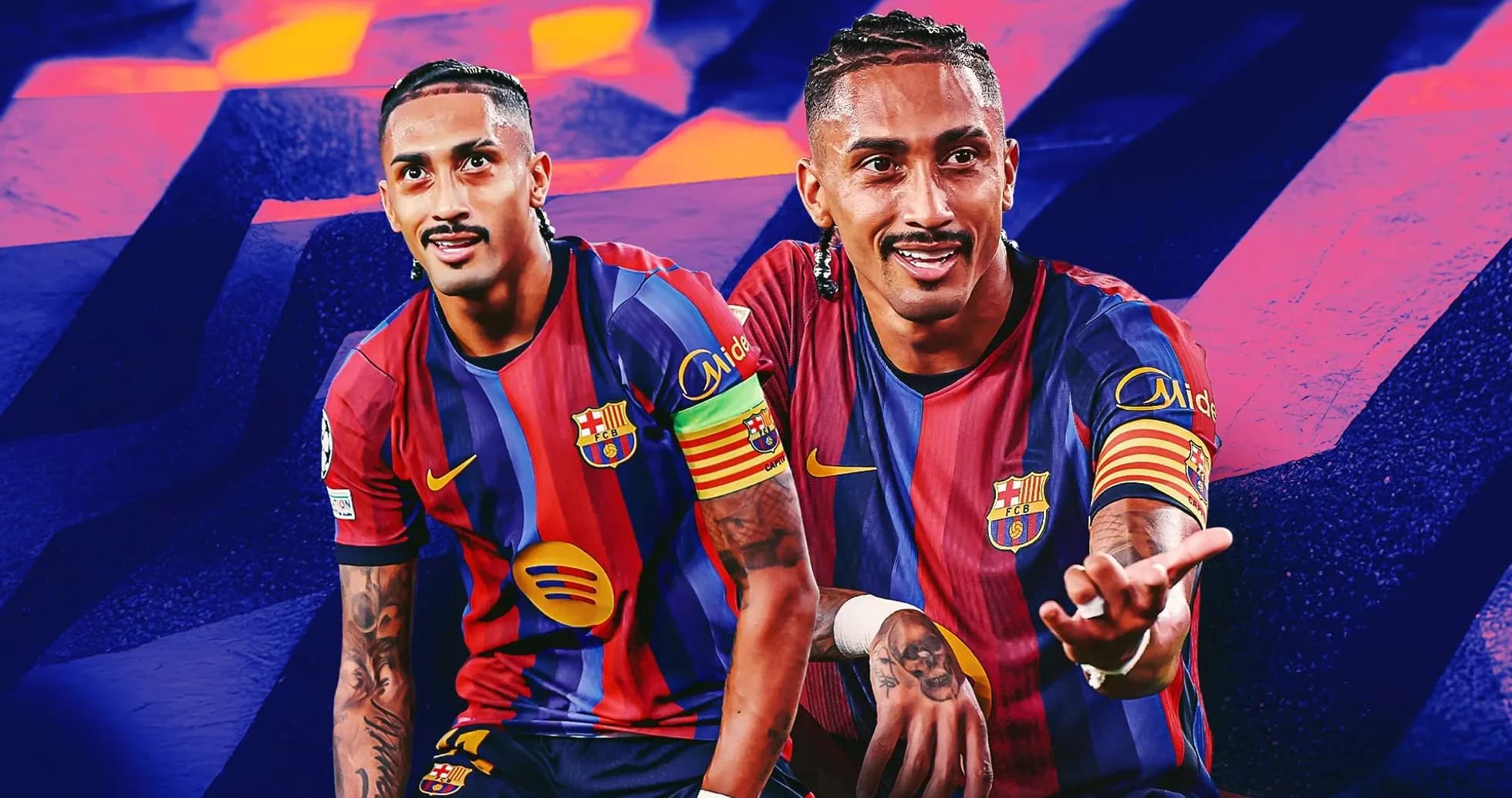
After Marc-André ter Stegen left on loan for Ajax in the summer, Flick didn’t hesitate. He gave Raphinha the captain’s armband. For the first time in the club’s history, Barcelona had a Brazilian as permanent captain in Catalunya.
So far, he is tearing up every expectation that came with it. He leads with work rate, not volume. He presses like a squad player fighting for a contract, then finishes like a superstar. Younger players see the standard and fall in line.
Raphinha doesn’t think he’s arrived either. After the Racing Santander rout, he said: “I will never say I am performing well; I always strive to improve everything I can. I am happy with the goals, and with the win, and that is the most important thing, but we have to keep improving.”
He also stressed how natural the central role now feels and credited Flick with reshaping his outlook: “He is the coach who changed the way I think and how I see myself. I am extremely grateful.”
Without Flick, he might already be gone. With him, he is the face of the project.
A squad built around flexibility, not fear
Raphinha is the focal point, but he isn’t alone. Flick’s attack is built on variety.
Gordon, Karim Adeyemi and Gabriel Jesus have all slotted in smoothly since arriving in the summer. From the academy pipeline, 18-year-old Egyptian striker Hamza Abdelkarim has stepped up from Barca B and given Flick yet another option.
“Raphinha, Gabby and Hamza are three different profiles, but there are other ways we could play,” the German coach has said. “Anthony and Karim can also play in this position (as striker). Or Dani Olmo. Dani has showed us in last two years he can play there – the same with Fermin [Lopez]. We have a lot of options.”
Those options matter. They protect Raphinha from being run into the ground. Flick has already shown he has learned from last season’s injury nightmare. He hooked his captain early against Feyenoord and did the same in league wins over Athletic Club and Racing, guarding his hamstrings like a precious asset.
The same care is being taken with Yamal. The teenager has become even more dangerous operating closer to Raphinha. Their understanding is instinctive. The moment a centre-back shifts his body to track Yamal, the youngster slips a pass into the channel, trusting that Raphinha is already making the blind-side run.
Yamal doesn’t seem bothered about sharing the stage. Raphinha is the main man; the kid looks happy being the co-star for now. Flick, surrounded by attacking talent, has somehow kept egos in check. The dressing room hums with collective ambition, not individual agendas.
Towards the Hall of Fame?
Barcelona’s history with Brazilian brilliance is rich. Yet no Brazilian has truly eclipsed Ronaldo’s single, seismic season.
Raphinha is not there yet. But he is walking the same corridor now, wearing the armband, carrying the goals, and defining the way this team plays.
If this form holds, and if his body does the one thing it didn’t do last year – stay intact – the question stops being whether he belongs in the conversation with Barca’s great Brazilians.
It becomes when his name gets carved into the club’s Hall of Fame alongside R9’s.
Related News
Barcelona Goalkeeper Situation: Hansi Flick's Tough Decision
Chelsea's Reboot Meets Brentford's Rhythm in Premier League
Derby Weekend: Key Storylines in EFL Matches
Raphinha's Transformation: From Sidelined Star to Central Figure
Xabi Alonso's Chelsea XI Decisions for Brentford Match
Sam Hutchinson: From Chelsea Prodigy to Heart Attack Survivor