
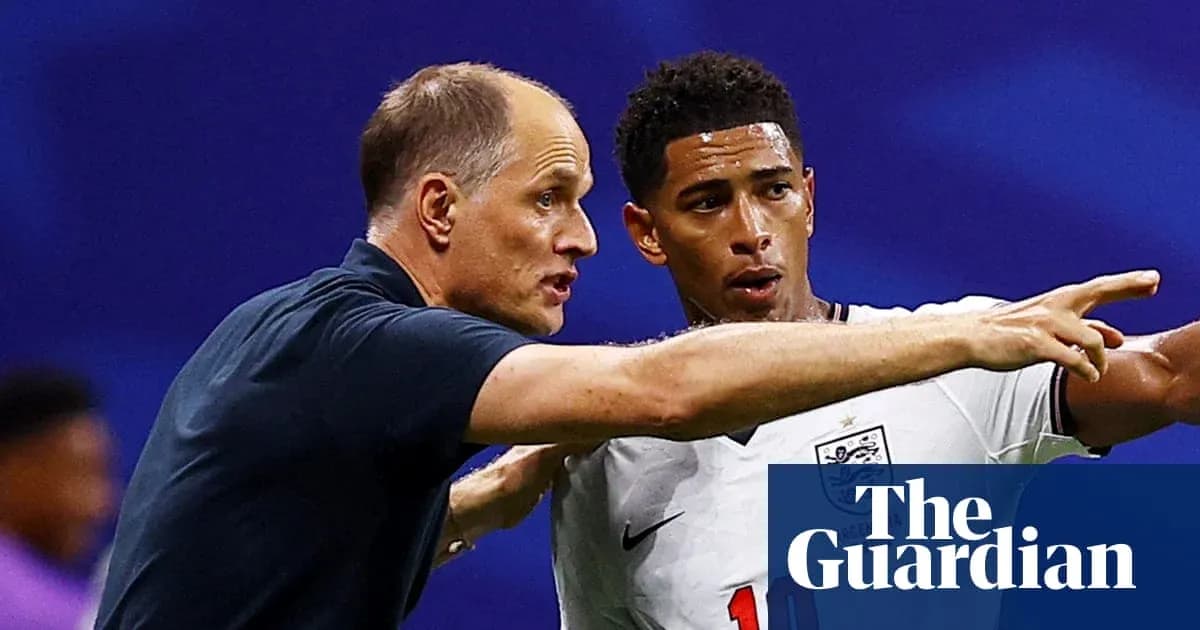
Thomas Tuchel's Challenge After World Cup Heartbreak
Thomas Tuchel has been a familiar face again around Premier League grounds this season, slipping into VIP areas, catching up with old colleagues. One recent exchange has stuck with him.
“People are killing me,” the England manager said.
Still.
Two months on from that 2-1 World Cup semi-final defeat by Argentina in the United States, the emotion has not thinned. It lingers in the air around the national team: heartbreak, anger, disbelief. A late lead thrown away, a final snatched from their grasp. For many, it feels less like a defeat and more like a wound.
And from that point, the country has split.
On one side, there is the fury. A section of the fanbase cannot forgive the collapse from 1-0 up with five minutes to go. They have pinned it squarely on Tuchel – his substitutions, his mindset, his failure to stem the Argentinian storm. In their eyes, he blew a golden chance.
On the other side, there is perspective. England reached a World Cup semi-final for only the fourth time in their history. They did it with personality and moments that will live long in the memory. The last-16 win over Mexico at the Azteca, with 10 men at altitude. The extra-time grind past Norway in Miami in 40C heat. The wild opening win against Croatia. Then the response to the Argentina heartbreak: beating France in the third-place playoff to seal their best World Cup finish since 1966.
Both truths sit side by side. The achievement and the regret.
Tuchel feels the second one less. He remains marked by the first.
He is bruised by the backlash, puzzled by its ferocity. England do not stroll into World Cup semi-finals every four years. The job has long been branded “impossible” for a reason: suffocating expectation, forensic blame after every failure, the way each defeat becomes a referendum on the manager’s entire reign. It is a loop that eats its own tail.
Tuchel now has to walk back into that storm.
A new cycle, the same pressure
The next phase begins on Friday, when he names his squad for four Nations League fixtures: Spain at Wembley, Czechia home and away, Croatia in Zagreb. This is the road to Euro 2028, a tournament England will co-host with Scotland, Wales and the Republic of Ireland. A home Euros, in all but name. The stakes could not be clearer.
Tuchel wants to look forward. So do the Football Association. Both know he has to let the Argentina defeat go, however overblown he considers the criticism, however much it has distorted the view of the wider campaign.
Inside Wembley, the FA’s stance is unambiguous. It stands firmly behind him. The idea he should have resigned or been sacked after finishing third at a World Cup is seen as absurd.
The governing body’s faith was forged not only in the run to the last four, but in the moments when England teetered on the brink. The last-32 tie against the Democratic Republic of the Congo, for instance, still makes pulses race when people inside the camp talk about it. England were 1-0 down with 15 minutes to go. Tuchel himself wondered if this was it, his tournament over before it had really begun.
Then Harry Kane scored twice and dragged them out of the fire. That comeback did more than save a campaign. In some eyes, it saved a regime. The captain has been mentioned as a Ballon d’Or contender on the back of his year; some at the FA half-jokingly argue he deserves it purely for averting an Iceland 2016-style catastrophe.
What mattered to the FA that night was not just Kane. It was Tuchel’s in-game changes, the switches that altered the rhythm, the willingness to be bold under pressure. They had seen that pattern throughout the World Cup. They also saw the brotherhood he fostered in the squad – something he talked about often, but which, behind the scenes, was more than a slogan. It was real, and the FA has clung to that as a cornerstone of this era.
The semi-final that will not go away
Tuchel went to the World Cup talking about “putting a second star on the shirt”. He set the bar at glory. He did row back slightly as the tournament went on, but the message was clear: this was not a sightseeing trip.
Did that rhetoric make the ending harder to take? Probably. But what would have been more acceptable – a manager publicly content with a quarter-final exit?
Privately, the FA always felt a title win would be a stretch. England were seeded fourth. The draw handed them the latest possible start, then a long gap before the second group game, then a crammed schedule. The travel was heavy, the heat relentless. Given all that, the semi-final was seen in-house as a strong overperformance.
The country did not see it that way.
The Argentina game has become the prism through which everything is judged. Tuchel’s explanations for his decisions that night have not cut through. The questions keep coming. Why the defensive switch? Why the passivity? Why couldn’t England get out?
What is not in doubt is that Argentina cranked the dial to maximum after half-time. They went into what one staff member called “all-out fury mode”. England had nothing left. Physically, they were drained – altitude against Mexico with 10 men, 120 minutes against Norway in Miami, the heat, the miles. The tank was empty.
Even so, the tactical choices belong to Tuchel. England started to retreat long before the second-half hydration break. The back line sank, the midfield stopped pressing, the passes forward dried up. They were already in survival mode when Tuchel made his big call: Ezri Konsa on for Anthony Gordon, a shift to a back five.
It was a calculated decision. Clinical, in his eyes. He looked at the data, the legs, the state of the game, and opted to reinforce. It felt like the percentage play, maybe the least bad option.
It failed.
The optics were brutal: a manager who had talked about glory retreating into his shell, inviting pressure, then watching his team concede twice late on. Would more attacking changes have produced a better outcome? Nobody can say with certainty. What is clear is that England were overrun in that second half, and Tuchel could not change the flow. That is on him.
And yet, the campaign as a whole still ended with a bronze medal and a sense, within the camp, of a team that had taken a step forward.
Nations League as a proving ground
Now comes the reset. England are back in Nations League Group A, where the opposition bites. Spain at Wembley next Saturday is as sharp a test as Tuchel could ask for. The FA believes this is exactly what the team needs.
The last Nations League campaign, down in Group B against Ireland, Finland and Greece, did more damage than expected. The fixtures lacked edge, the standards slipped, and even then England managed to lose 2-1 at home to Greece. World Cup qualifying had been similarly gentle. The concern at the FA is that England arrived in the United States undercooked for elite-level pressure.
This time, they want the bruises early.
Tuchel’s squad announcement will be shaped by injuries. John Stones, Dan Burn, Djed Spence and Jordan Henderson are all likely to miss out. That opens doors in defence: Tino Livramento, Levi Colwill, Jarrad Branthwaite and Lewis Hall are all pushing hard for recalls.
Midfield poses a different kind of dilemma. Does Kobbie Mainoo keep his place after a World Cup that never really got going for him? His form for Manchester United has been one of the few bright spots in their poor start. Alex Scott and Myles Lewis-Skelly are in contention to come back into the fold.
Further forward, the No 10 slots are crowded again. Cole Palmer and Phil Foden are both hoping to be restored to central roles. Eberechi Eze and Noni Madueke, by contrast, have not started well at Arsenal, which may count against them. Around the forward line, there is noise and momentum: Josh King and Ryo Ngumoha have energy behind their cases, as do Dominic Calvert-Lewin and Liam Delap.
Selection will be scrutinised. So will something less tangible: Tuchel’s tone.
When he steps in front of the cameras on Friday, every word will be weighed. The FA wants the same conviction, the same ambition, but without the defensiveness that crept in after Argentina. The public wants answers. The players want clarity.
Tuchel cannot change what happened in the United States. The question now is simpler, and far harsher: can he turn a semi-final scar into the start of something, or will Argentina 2026 be the moment that defines his England reign forever?
Related News
Chelsea Enters New Era with Clearlake Capital Control

Vinicius Jr. Faces Competition from Mbappé at Real Madrid
Thomas Tuchel's Challenge After World Cup Heartbreak
Dominik Szoboszlai Silences Critics with Stunning Goal
Wrexham's Challenge: Overcoming Setbacks Against Southampton

Man United Injury Update: Shaw Eyes Fulham Return as Baleba, Amad Await