
Tottenham's 0-0 Draw: De Zerbi's Mixed Feelings on Performance
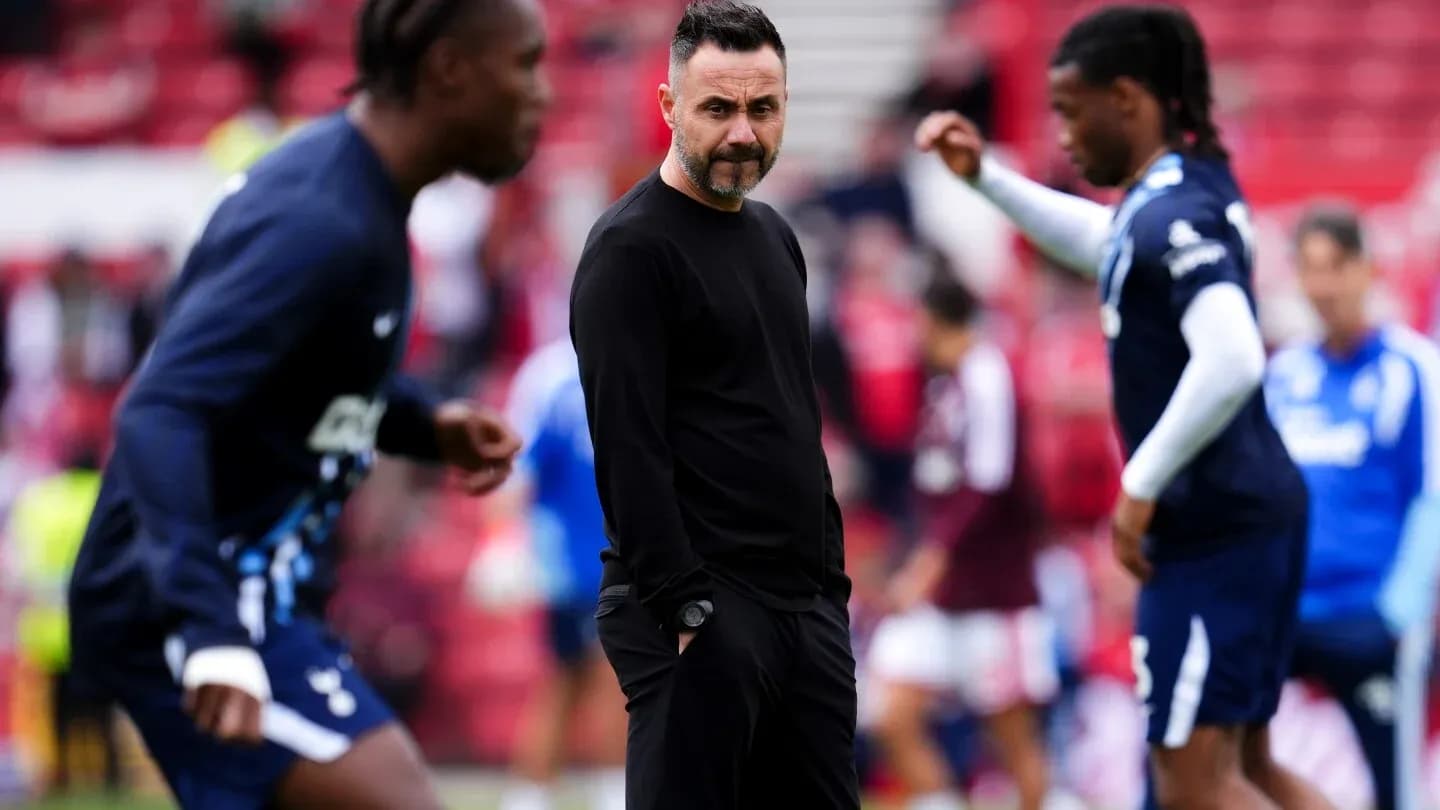
Tottenham finally stopped the bleeding on Saturday. They didn’t win, they still haven’t scored this Premier League season, but they walked out of the City Ground with something they hadn’t felt yet under Roberto De Zerbi: a point.
A 0-0 at Nottingham Forest. Ugly, combative, bitty. And, in its own way, oddly encouraging.
De Zerbi: “Disappointing” result, “very happy” with performance
Roberto De Zerbi cut a conflicted figure afterwards. The scoreboard said stalemate, the performance, in his mind, said progress.
“Disappointing for the result, but for the performance, very happy,” he said. “Considering we started working together on Thursday for the first time, we played well.”
The Italian went straight to the area where Spurs keep breaking down.
“I think we can improve in the last pass. If we improve in the last third, I think we can score many, many goals because we have the players with big qualities. Now it’s a tough moment to accept this result, because I think we played well.”
For De Zerbi, this isn’t about unlocking some mystical attacking code. It’s about basic errors.
“It’s not to unlock [the final third]. It’s the mistakes. We have to work in this part,” he said. “I think we played very well with the ball, we found the solutions because they press [our defenders] with three, but one of our full backs was always alone and we found him always in 90 minutes. So in build-up, we played very well. In the last third, I think we can be… better. Much better.”
The structure worked from deep. Spurs built through Forest’s press, found the spare full back time and again, and advanced. Then everything frayed around the box.
Forced changes, lost balance
The game tilted again on the hour. Not because Forest did anything spectacular, but because Spurs had to listen to their medical staff.
“The second half, I’m sorry because the medical stuff pushed to change Savio and Udogie after 60 minutes,” De Zerbi explained. “Kudus and Robertson played very well, but maybe two substitutions in that moment was not so good. But now we can’t take risk with injuries again. Savio is too important for us, the same Destiny. Maybe we lost some balance, some connection [when they came off].”
That word – connection – keeps following this team around. New faces, new ideas, same old problem knitting it all together.
De Zerbi at least saw a platform without the ball.
“I think today we defended very, very well,” he said. “We have to improve the physical condition [of some players], the connection between the players. We changed, I don’t know how many players in this transfer window. We brought very, very good players, but the team doesn’t adjust like the names on paper or Football Manager.”
Names on paper don’t press, don’t combine, don’t thread that last pass. Spurs are learning that in real time.
Solid at the back, stuck at the front
So where is it breaking down? De Zerbi didn’t dance around it. The problem lives in that white rectangle everyone keeps aiming at and rarely troubling.
Tottenham are functioning in two-thirds of the pitch and failing in the third that matters most.
His system deliberately drags the backline into uncomfortable situations. When it works, the risk pays off with attacking superiority. When it doesn’t, you’re exposing defenders for no real gain.
Right now, Spurs are somewhere in between. Fortunately for them, Micky van de Ven seems built for this. He relishes those one‑v‑one, high-wire moments and has started the season strongly alongside compatriot Jan Paul van Hecke. Even last week’s defeat to Newcastle came not from open-play chaos but from set pieces undoing an otherwise steady display.
Van de Ven, more than anyone else in this side, raises Tottenham’s floor. He makes the bad days less bad.
The ceiling is another matter entirely. At the moment, it’s so low he “can’t even stand up inside Spurs’ house,” to borrow the image. The final third is strangling this team.
De Zerbi knows he has an “impressive attacking group on paper,” but he also knows games aren’t played there. The squad has been heavily reshaped since last season, yet the familiar flaw remains: no true creator in midfield.
A missing creator and a familiar question
Without a natural no. 10, Spurs funnel almost everything wide. That gives opponents time to shuffle across, set their lines and crowd the box. Forest showed the blueprint: press high early, then retreat into a deep block with nine or 10 men packed around the area.
Against that, Spurs looked what they are: a collection of gifted dribblers with nobody to consistently stitch attacks together between the lines.
They had no answer. No one to slide the disguised pass, no one to dictate the tempo around the edge of the box.
Maybe James Maddison returns soon, shakes off a lost year and rediscovers his sharpness. Maybe he doesn’t, at least not quickly enough to transform this attack on his own.
The more likely scenario? More games like this. Controlled build-up, defensive competence, flashes of individual skill, and a nagging question every time they reach the penalty area.
Until Tottenham prove they can score, opponents will keep sitting in that shell, daring them to find a way through. Who, in this new-look side, is going to be the one to finally prise it open?
Related News
Real Madrid Concerned as Ibrahima Konaté Exits France Squad with Knee Injury
Ibrahima Konate Withdraws from France Squad; Man Utd's Leny Yoro Called Up by Zidane
4 Free Agent Strikers Manchester United Could Sign Following Sesko's Injury
Bosnia Coach Sergej Barbarez Criticizes Newcastle United Over Amar Dedic's Hamstring Injury
Kenya to Face Rwanda in Friendly Match During International Window

Mbappé's Flu Disrupts Zidane's First Camp with France