
World Cup Shocks: Predictions Turned Upside Down
Dutch, German and Japanese fans woke to a gut punch. All three nations are out of the World Cup, and in the most brutal ways imaginable.
Germany fell first, squeezed out on penalties by Paraguay. The Netherlands followed, suffering the same fate against Morocco. Japan held on until stoppage time against Brazil, only to see their dream torn apart by an injury-time equaliser. Three proud football nations, three exits that will sting for years.
While giants tumbled on the pitch, one man at the top of the prediction table barely flinched.
Instinct over spreadsheets
Guido de Bruijn of Agrofair still leads the overall standings. He has not built a model, hired a data team or buried himself in form guides. His method is almost old-fashioned.
“I think the longer you think about it, the less likely you are to get it right. Your first instinct is often the best,” he says.
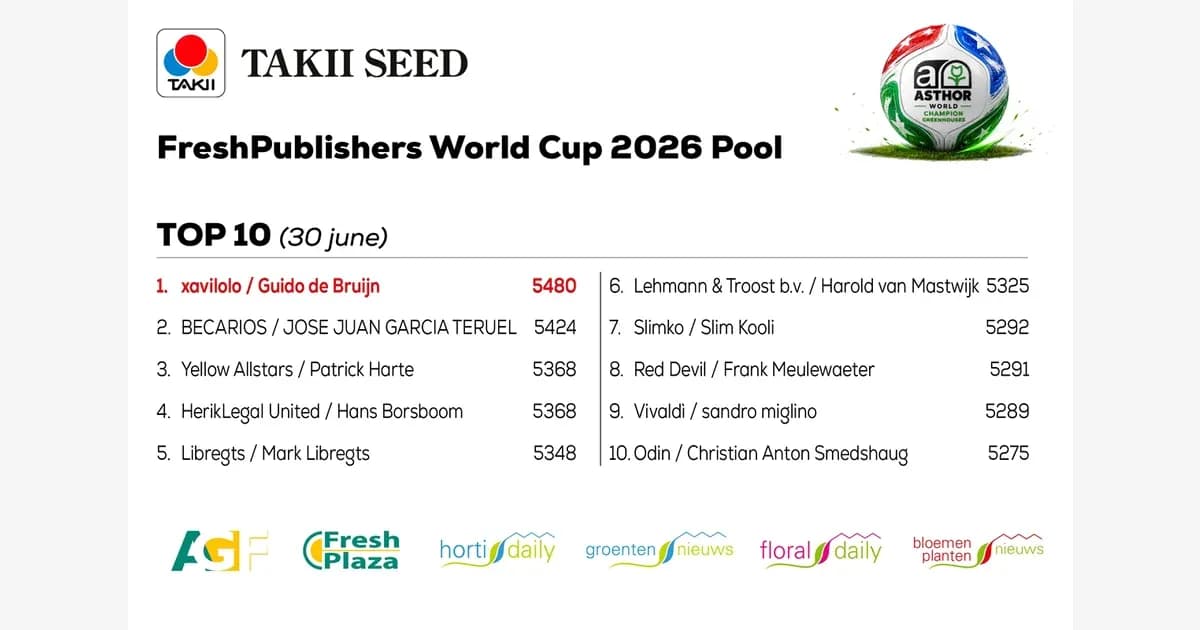
So far, instinct is paying the bills. De Bruijn sits clear at the top of the leaderboard, his total of 5,480 points keeping him out in front as others jostle for position behind him.
The closest challenger is Jose Juan Garcia Teruel of Asetir from Almería, 56 points adrift in second. That gap is not insurmountable, but it is big enough to give the leader breathing room heading into the next round of fixtures.
British horticultural supplier Patrick Harte of CambridgeHOK has surged into third, his steady climb reflecting a run of solid, no-frills calls. Behind them, the pack is tightening.
A crowded chase pack
Fourth, fifth and sixth are now in the hands of Hans Borsboom (Herik Legal), Mark Libregts (JNV Produce) and Harold van Mastwijk (Lehmann&Troost). All three remain within striking distance if the frontrunners finally misread a match.
Just behind, Canadian-based predictor Slim Kooli of Courchesne Larose has pushed himself up to seventh, edging closer to the sharp end of the table.
The top 10 has a fresh look. ‘Red Devil’ Frank Meulewaeter, who works for Beti Ornamental Plants in Ethiopia, has broken into the elite group for the first time, landing in eighth. Italian lettuce and herb specialist Sandro Miglino of Fratelli Cafaro 1989 returns to the top 10 in ninth, while Norwegian chief economist Christian Anton Smedshaug of Landkreditt completes the list in tenth.
The margins are fine. One correct scoreline, one late goal, and the entire order can flip.
Eyes on Ivory Coast, France and Mexico
Next up: Ivory Coast v Norway, France v Sweden, and Mexico v Ecuador. These three games now carry extra weight for the leading contenders.
At the top of the prediction sheet, the frontrunners show their hand:
- Several of the leaders back Norway to edge Ivory Coast, with a cluster of 1–2 and 0–2 calls appearing among the top 10.
- Confidence in France is almost unanimous; 2–0 and 3–1 dominate the forecasts against Sweden.
- Mexico v Ecuador splits opinion more sharply. Some see a tight draw at 1–1, others expect narrow wins – 1–0, 2–0 or 2–1 – that could make or break campaigns.
Every correct result nudges the needle. Every perfect scoreline can be a jackpot. From first place on 5,480 points down to tenth on 5,275, the difference is just a handful of well-called matches.
National pride on the line
There is another race running quietly in the background: the average standings by country. On that front, Costa Rica leads the way, ahead of Guatemala and Switzerland. It is a reminder that this is not just an individual contest; national reputations are also in play.
The prize is clear. The overall winner of the rankings will walk away with €1,000. The path to that payday is anything but clear.
With Germany, the Netherlands and Japan now gone from the World Cup, the emotional landscape has shifted. Tournament brackets are open, favourites are wobbling, and the script is tearing at the edges.
For Guido de Bruijn and the chasing pack, the question is simple: in a World Cup this wild, can instinct keep winning, or is chaos about to cash in?
Related News

Anthony Joshua Names Murat Gassiev as Next Opponent if He Defeats Tyson Fury

UFC 332: Start Time and Fight Highlights for Natalia Silva vs. Wang Cong

Court McGee Opens Up About Choosing UFC 332 as His Final MMA Fight
WBC Orders Lightweight Title Unification: William Zepeda vs Jadier Herrera
BCCI Pension List: Monthly Payments to Retired Indian Cricketers in 2025
Why Fury vs Joshua Is Set for Cardiff, and Dua Lipa’s Unexpected Role