
Ancelotti Reflects on Brazil's World Cup Exit: The Water Break Decision
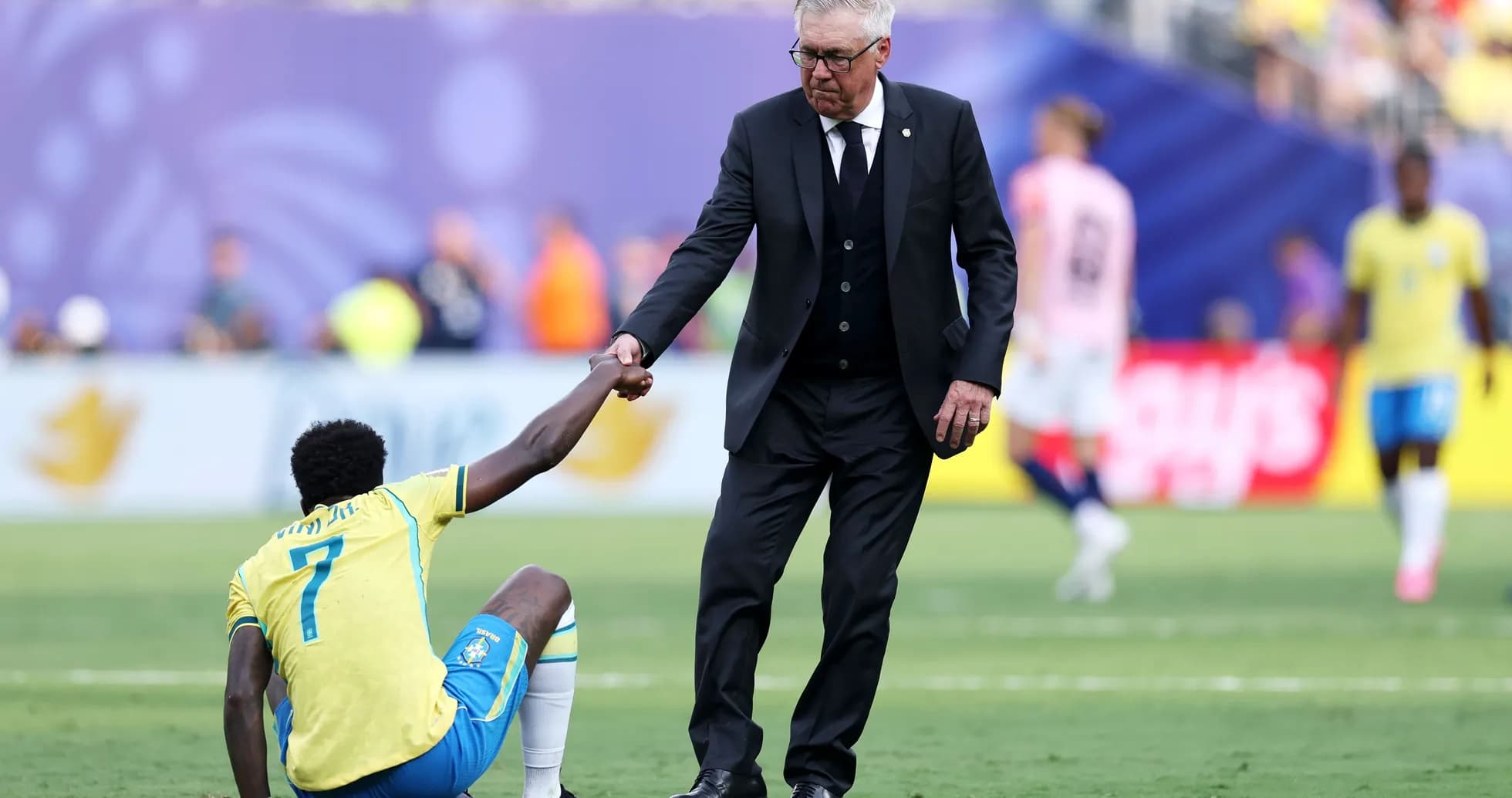
Carlo Ancelotti has lived enough nights at the sharp end of elite football to know that tournaments rarely hinge on one moment. Yet when he looks back at Brazil’s 2026 World Cup exit, he keeps coming back to a pause in play. A water break. Norway. And a decision he now believes tilted the entire tie.
Brazil went out in the round of 16, beaten 2-1 by a disciplined Norwegian side. Another World Cup slips away; the wait stretches on from 2002. For a nation raised on the idea that the trophy is almost a birthright, this one hurts. For Ancelotti, it comes with a very specific regret.
“We lost the World Cup during the water break”
The Italian did not hide behind clichés or bad luck. Speaking to ESPN, he defended the broader work of his first year in charge, then zeroed in on the moment he feels changed everything.
“In general, I think the work done over a year was excellent,” he said. “Logistically, the Brazilian team was very well organised in terms of the hotel, the stadium and the training ground. I think the players' performance throughout the year was positive. I also think the 26 players who were called up were the most suitable to be there.”
The structure was there. The planning, too. Then came the injuries that chipped away at that plan.
“The plan drawn up last year changed slightly because of injuries, because we suffered many injuries in the period between March and the World Cup: Militão was injured, and Rodrygo, then Estêvão, and Wesley was injured before the World Cup, and during the World Cup, Raphinha was injured. So the plan changed a little.”
Even with all that, Ancelotti felt Brazil had control against Norway. Until the second-half water break.
“I think we lost the World Cup during the water break against Norway. Why? Because the team was in control of the flow of the match until that moment.”
The pause gave everyone a chance to breathe. For Norway, it was a reset. For Ancelotti, it became a trigger. Watching his team drop deeper as Norway kept the ball, he read danger where, he now admits, there was still order.
“It is also true that Norway had possession of the ball, and had a lot of it in their own half... Norway played the same way against England. They controlled the match, but in the end, they could have beaten England.”
That was the trap. Possession without incision can look like dominance. From the touchline, it can feel like a storm building.
“Perhaps my mistake was here, when I thought the team had lost control of the match when that was not the case. I made some changes to the line-up, then we had the problem of Erling Haaland's goal. And in the World Cup, when they score a goal against you in the thirtieth minute (of the second half), it is very difficult to recover. But we did have a chance to recover.”
The pressure finally told, but not in the way Brazil wanted. Haaland struck, Norway turned the screw, and a game that had seemed manageable suddenly became a sprint against the clock.
Neymar, the gamble, and the backlash
If the water break framed the tactical turning point, the substitution that followed framed the debate. Ancelotti’s decision to throw on Neymar late on drew fierce criticism, with many arguing that it “upset the balance” of a team still in the contest.
He rejects that idea outright.
No, when Neymar came on at that moment, I took off Ryan and brought on Endrick as a right winger, thinking that Neymar was capable of creating a goal, or showing his skills at that moment, in the 70th minute. That is what I intended to do against Japan.
There was a clear blueprint in his mind, one he had already sketched out in the previous knockout match.
“But why did I bring on Gabriel Martinelli against Japan? Because the team was completely in control of the match. Japan relied only on counter-attacks. The aim was not to score a goal, rather I was thinking of bringing on Neymar in extra time against Japan.”
Against Japan, the idea was to unleash Neymar when legs were heavy and spaces opened. Against Norway, the clock and the flow of the game pushed that plan forward.
“I brought Neymar on a little early to regain control of the match. Then you also have to think about the decisions you have to take... I heard (Thomas) Tuchel say he came in for heavy criticism, and the truth is that you have to make a very difficult decision. It is a moment full of tension, and you do not always get it right.”
This is the reality he underlined: on the biggest stage, choices are made in seconds and judged for years. He is not backing away from the Neymar call, though. Quite the opposite.
“I think Neymar should have been brought on, he had to come on at that moment because he was performing well, trained well, and prepared well. I liked his sporting spirit. I think he helped the team. But, with him coming on, there was no need to change the structure of the team.”
That final line lingers. The regret is not about the player, but about the ripple effect of the changes around him. The water break, the read of the game, the reshuffle, Haaland’s goal. It all connects.
For Brazil, the World Cup is gone. For Ancelotti, the question now is whether this painful, precise self-critique becomes the foundation for something sharper at the next major test—or the defining what-if of his time with the Seleção.
Related News
Carlos Alcaraz Calls for Change After Laver Cup Court Conditions
Alexander Zverev Secures Laver Cup Victory for Team Europe with Straight-Set Win Over Learner Tien
Novak Djokovic Shares Fitness Update Before China Open Return After US Open Upset
Shubman Gill's Captaincy Record Across All Formats: Tests, ODIs, T20Is, and IPL
Kuldeep Yadav Named Player of the Match Over Virat Kohli Despite Century in IND vs WI 1st ODI
India Advances to Asian Games 2026 Cricket Semi-Finals After Rain Washout Against Afghanistan