
Burnley vs Wolves Tactical Analysis: A Draw Defined by Contrasting Strategies
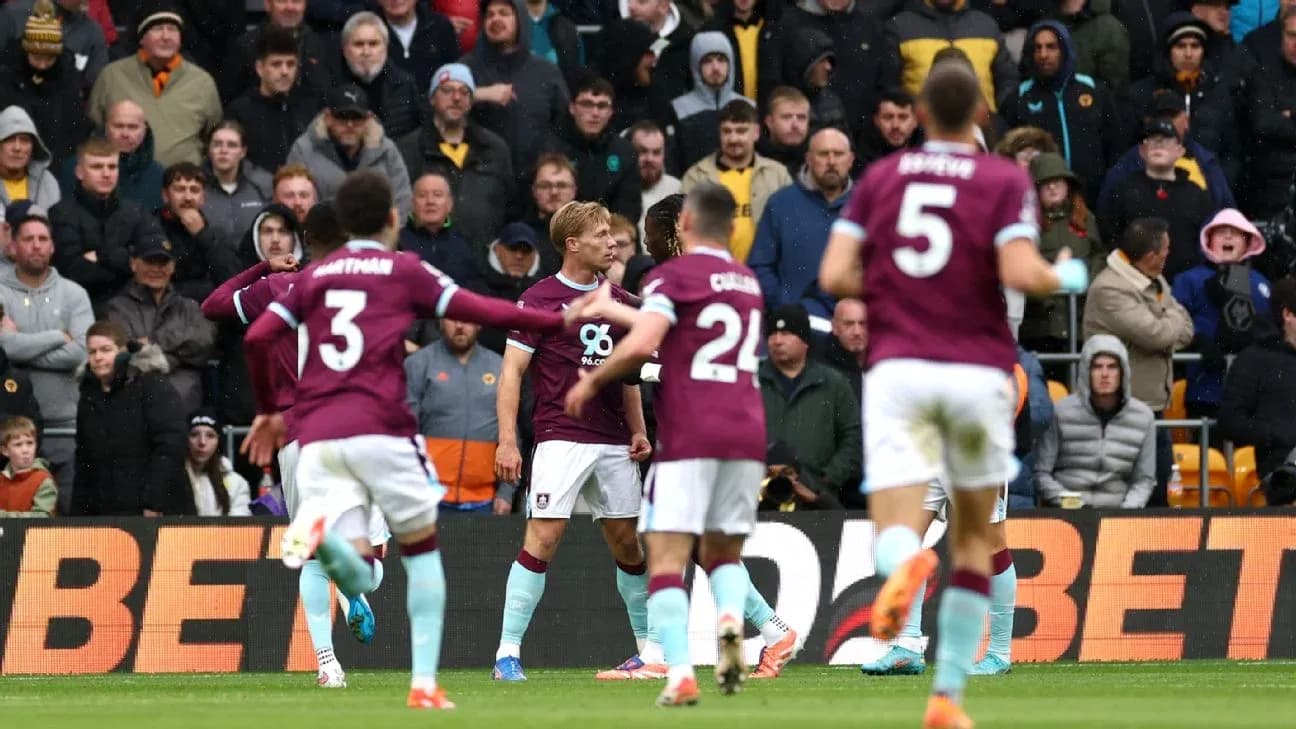
Burnley’s 1-1 draw with Wolves at Turf Moor was tactically defined by contrasting game plans: Burnley’s territorial dominance and structure in a 4-2-3-1 against Wolves’ compact 3-4-2-1 built to break and punish transitions, especially in the early phases.
Burnley, under Mike Jackson, used the double pivot of Florentino and L. Ugochukwu as the platform for a high-possession approach. Their 70% of the ball was not sterile circulation: 558 passes, with 488 accurate at 87%, show a side intent on constructing patiently from the back four of K. Walker, A. Tuanzebe, B. Humphreys and Lucas Pires. The full-backs, particularly Pires, could step high because Wolves’ front line was outnumbered in the first line of Burnley’s build-up, allowing comfortable progression into midfield.
Ahead of the pivot, the trio of L. Tchaouna, Hannibal Mejbri and J. Anthony operated between the lines behind Z. Flemming. Burnley’s shot profile – 16 total attempts, with 8 on goal and 7 from inside the box – underlines how often they managed to access central zones and arrive in good finishing positions rather than settling for speculative efforts. Six blocked shots also indicate sustained pressure around the Wolves area, forcing last-ditch interventions from the back three.
Yet the match state was shaped almost immediately by Wolves’ plan. A VAR check in the 4th minute confirmed a penalty for the visitors, and A. Armstrong converted at 5' to give Wolves a 0-1 platform perfectly suited to their 3-4-2-1. With Andre and A. Gomes in central roles and D. M. Wolfe and R. Gomes providing width from the line of four, Rob Edwards’ side could sit in a mid-to-low block, compress the central lane, and spring forward through Hwang Hee-Chan and M. Mane around Armstrong. Wolves’ 30% possession and 223 passes (164 accurate, 74%) were a function of design, not inability: they willingly ceded the ball to keep their block compact and wait for turnovers.
Crucially, Wolves’ attacking threat remained real despite their limited share of the ball. They matched Burnley’s 16 total shots and actually generated more penalty-box presence, with 10 shots inside the box to Burnley’s 7. Their xG of 2.05, compared to Burnley’s 1.06, confirms that the visitors manufactured the higher-quality chances, even if fewer of their efforts hit the target (4 shots on goal). The gap between Wolves’ xG and their single goal points to wastefulness in the final action and, to a degree, effective last-line interventions from Burnley’s defence.
In goal, M. Weiss (Burnley) had a quieter workload in terms of volume but a concentrated one in quality. He made 3 saves, aligned with Wolves’ 4 shots on goal and 2.05 xG, and his 0.29 goals prevented figure reflects a couple of above-average stops that kept Burnley in touch after the early setback. At the other end, J. Sa (Wolves) was far busier, registering 7 saves against Burnley’s 8 shots on goal. His own goals prevented metric, also 0.29, underscores a high-impact performance: without that level of shot-stopping, Burnley’s territorial control could easily have translated into a decisive second goal.
The equaliser early in the second half encapsulated Burnley’s attacking structure. At 47', Z. Flemming finished a move assisted by L. Tchaouna, the central forward and one of the advanced midfielders combining in the half-space Burnley had been trying to overload all game. It was a reward for their insistence on playing through the thirds and pinning Wolves back rather than resorting to hopeful deliveries. From there, Jackson doubled down on technical control: at 75', J. Ward-Prowse (IN) came on for L. Ugochukwu (OUT), adding range of passing and set-piece threat, while M. Edwards (IN) replaced L. Tchaouna (OUT) to offer fresh energy between the lines. Later, A. Barnes (IN) for Z. Flemming (OUT) and J. Bruun Larsen (IN) for J. Anthony (OUT) at 84' shifted Burnley towards a more direct, penalty-box-focused front line for the closing stages.
Edwards’ substitutions were about preserving the block and refreshing legs in key defensive and transition roles. At 66', T. Arokodare (IN) came on for A. Gomes (OUT) and Toti (IN) for L. Krejci (OUT), adding physicality up front and fresh defensive cover on the left side of the back line. At 74', H. Bueno (IN) replaced D. M. Wolfe (OUT), and J. Abbey (IN) came on for A. Armstrong (OUT), signalling a shift towards protecting the point while still keeping a counter-attacking outlet. Pedro Lima (IN) for R. Gomes (OUT) at 82' further reinforced the defensive flank in the final minutes.
Discipline also reflected the game’s tension. Wolves picked up two yellow cards: Hwang Hee-chan at 41' for an "Off the ball foul", then Yerson Mosquera at 90+4' for "Argument". Burnley mirrored that with two bookings of their own, both for "Argument": Hannibal Mejbri at 45+9' in first-half added time, and Ashley Barnes at 90+4' deep into stoppage time. The clustering of cards around key emotional moments – just before the interval and in the dying minutes – points to the psychological weight of a finely balanced contest where neither side could afford a mistake.
Statistically, Burnley’s profile is that of a possession-heavy, territorially dominant home side that struggled to translate control into clear chances at the same rate as Wolves. Their 7 corner kicks and 0 offsides underline sustained pressure but also a lack of repeated penetrative runs in behind. Wolves, with 3 offsides and 7 corners of their own, were more vertical when they did attack, often pushing the last line aggressively and forcing Burnley’s defence to turn.
The final 1-1 scoreline therefore emerges as a tactical compromise: Burnley’s structure and volume against Wolves’ compactness and chance quality. Burnley controlled where the game was played; Wolves controlled when it became dangerous. On balance of xG and shot locations, Wolves may feel they left an extra goal on the table, but given Burnley’s pressure and J. Sa’s workload, a point each was a fair reflection of two contrasting but well-executed game plans.
Related News
Premier League Managers Facing Potential Sackings During International Break
Arsenal's Myles Lewis-Skelly Names Unexpected Tottenham Rival as Toughest Premier League Opponent
Three Premier League Players Shining Early This Season
Premier League Early Season Reactions: Man City’s Strength, Arsenal’s Flaws, United’s Struggles

Premier League Returns October 10 After Extended September-October International Break

Fulham and Manchester United Share Points in 1-1 Draw