
Diomande: The Vertical Winger Madrid Needs
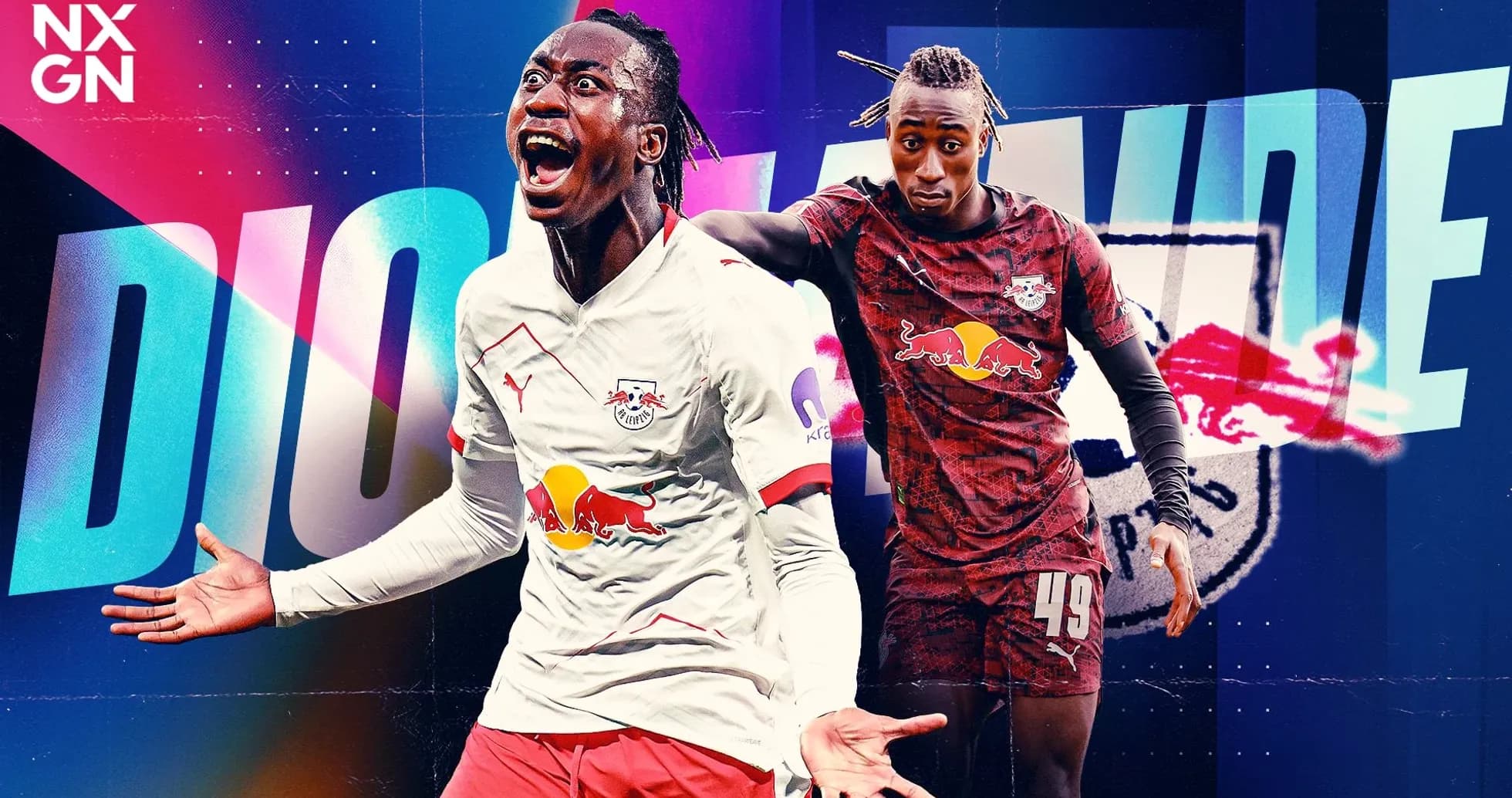
Real Madrid have chased wingers of every shape and style in recent years, but Diomande does not fit the Vinicius Jr template. He is not the pause-and-probe wide man who knits moves together between the lines. His game is more brutal than that. More direct.
His football is vertical.
The Ivorian explodes into space with a clarity that borders on ruthless. At the last World Cup he was clocked at 34.7 km/h – rapid by any standard, even if it still sits behind Kylian Mbappé’s 37.6 km/h. That raw speed is the base layer. The real damage comes when he combines it with the ball at his feet.
In the Bundesliga last season, Diomande was a dribbling machine. He completed 118 successful dribbles from 213 attempts – almost double the tally of the league’s next-best dribbler, Michael Olise, who finished with 65 from 149. That gap is not just a quirk of the numbers. It tells the story of a player who attacks defenders again and again, then comes back for more.
A Right Winger Who Refuses to Stay in One Box
Nominally, Diomande is a right-sided player. In practice, he belongs to both flanks. Leipzig used him far more on the right last season – 1,591 minutes compared to 478 on the left – and that split has allowed a clear picture to emerge of two very different versions of the same footballer.
On the right, he plays like a classic touchline winger. He receives the ball wide, almost on the chalk, and often with his back to the full-back. The first touch is about control, the second about confrontation. He draws his marker in, pauses, weighs up the angles. If the picture is not clear, he resets and goes again.
With his natural right foot, the outside lane is his first instinct. He looks for the space down the wing, aims for the byline, then pulls the ball back. He does not lean on intricate footwork so much as pure physical force: a shove of the shoulder, a sudden change of pace, a burst that leaves the defender grasping at air.
Cutting inside from that side is a different story. His diagonal runs lack the natural, left-footed precision of someone like Olise. His left foot is still more tool than weapon, despite the goals he produced last season by shifting the ball onto it at the last moment on the edge of the area. When he does trust it, it tends to be in those long, winding carries where he uses stride length and balance to unpick a packed defence.
That is where his threat becomes truly awkward to defend. Even without perfect mastery of the inside cut, he has found his own escape hatch against deep blocks that barricade the flank. He drags defenders across, forces them to shuffle, then whips the ball towards the front of the box or the far side with a cross.
The data backs up what the eye sees. On the right wing he is a volume generator. Per 90 minutes he attempts more dribbles (4.41 versus 3.23 on the left), completes more crosses (0.91 versus 0.67) and plays more passes into the area (2.21 versus 1.48). He shoots more often too (1.7 versus 1.48), with higher expected goals (0.21 versus 0.16). The trade-off is obvious: he also loses the ball more frequently (2.21 versus 1.48).
He is a risk machine on that side. But a productive one.
The Left Wing: Where Chaos Lives
Shift him to the left, and something changes. The minutes drop, but the personality of his game flips.
Out there, Diomande looks looser, bolder, more instinctive. He still starts from a wide position, yet he receives the ball less often on the touchline. The difference shows up in the penalty area: he records more touches inside the box on the left, 7.8 per 90 compared to 6.51 on the right.
He no longer obsesses over bulldozing his way down the flank or outmuscling his full-back. The right foot becomes his scalpel. From the left, it lets him cut inside to shoot or cross, and that inside lane gives him a different kind of confidence. He stops asking questions and starts dictating them.
You can see it in the way he dribbles. He attacks defenders more directly, with less hesitation, trusting that once he shifts the ball onto his stronger foot, the goal is in play.
Two numbers leap out. On the left, his expected goals spike to 1.17 (from 0.84 on the right), and his expected assists climb to 0.43 (from 0.21). The right wing turns him into a creator of waves – constant incursions, crosses, dribbles, second phases. The left transforms him into something more dangerous: an agent of chaos who wants to decide games from inside the box.
Even in limited minutes, a pattern keeps repeating. He hunts empty spaces away from the ball. When he receives with his back to goal in tight pockets, or when he feels the contact coming, he uses the simplest solution: a quick lay-off, a one-two, then a sprint in behind. With his acceleration and the space ahead of him, he becomes almost impossible to catch.
This is not a player hiding from his weaker foot. It is one who has learned to weaponise its limitations by forcing defenders into impossible choices.
Relentless Without the Ball
The attacking numbers will grab the headlines, but Diomande’s work without the ball is what makes him such a modern forward. Whether he lines up on the right or the left, his defensive effort barely fluctuates. His game is powered by energy and an aggressive, intelligent press the moment possession is lost.
That intensity has a statistical footprint. Among forwards who played at least 1,000 minutes in the Bundesliga last season, he led the division for ball recoveries with 148. He also ranked second for pass interceptions (16) and fourth for successful tackles (19). Those are midfielder numbers from a winger who lives on the last line.
At set pieces, his role is more reactive. He holds his position, watches the play develop, and waits. The instant his team wins the ball, he springs to life.
On the counter, he often moves into central zones, ready to attack the space behind the defence with or without the ball. When he receives on the run, his dribbling becomes lethal; when he runs off it, he stretches the pitch into strips that defenders struggle to cover.
It is easy to see why memories in Madrid drift back to José Mourinho’s first spell, when Real Madrid ripped teams apart in transition and the open field belonged to Cristiano Ronaldo and Ángel Di María. Diomande has the raw tools to attack those same channels, to turn defence into a sprint relay where he takes the final, devastating leg.
The only real question is the one that will shape his role at the Bernabéu: will he carve up defences from the right, where he piles up actions and volume, or from the left, where every touch seems to tilt a match towards chaos?
Related News
Carlos Alcaraz Calls for Change After Laver Cup Court Conditions
Alexander Zverev Secures Laver Cup Victory for Team Europe with Straight-Set Win Over Learner Tien
Novak Djokovic Shares Fitness Update Before China Open Return After US Open Upset
Shubman Gill's Captaincy Record Across All Formats: Tests, ODIs, T20Is, and IPL
Kuldeep Yadav Named Player of the Match Over Virat Kohli Despite Century in IND vs WI 1st ODI
India Advances to Asian Games 2026 Cricket Semi-Finals After Rain Washout Against Afghanistan