
Dusan Vlahovic: The Standoff of a Top Free Agent
Every summer has its bargains. The free agents snapped up early, the smart deals done before pre-season is even properly underway. By late July, most of the good ones are gone.
And yet the most valuable of the lot is still standing on the touchline, waiting.
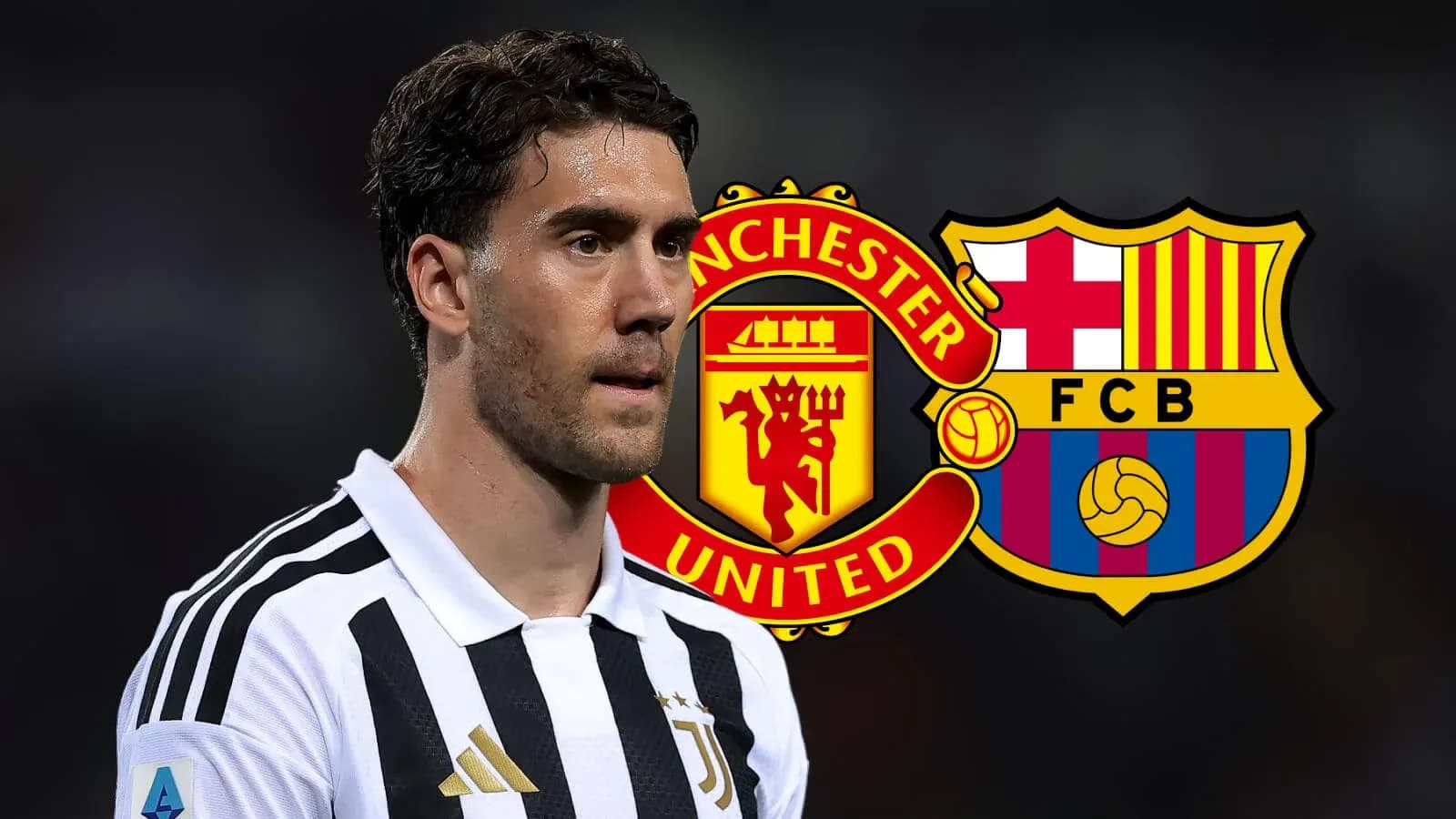
Dusan Vlahovic, 26 years old, eight full seasons of Serie A behind him, double figures in each of the last six campaigns, is without a club as August looms. On paper, this should be his moment. In reality, he’s stuck in neutral.
Transfermarkt’s algorithm pegs him at around £30 million in value, the priciest free agent on the market. But a number on a website is one thing. A club willing to build its attack around you – and pay you like a star – is something else entirely.
Right now, there’s a vacuum where concrete interest should be. Manchester United have been mentioned. Barcelona too. His name is drifting around the rumour mill, but there are no agreements, no medicals, no leaked photos of him grinning with a new shirt in hand. Just noise.
The Player He Is, The Player He Was Meant To Be
Vlahovic remains a compelling package. A big, aggressive centre-forward who can finish with either foot, attack crosses, threaten from free kicks and carry the ball through the lines. He offers presence. He offers goals. He offers a focal point.
But he is not the finished article. His link-up play can be clunky, his pressing sporadic, his form streaky. The raw materials are there, yet the final product has never quite matched the early hype.
That is where the tension lies: between the player he is, the player he was supposed to become, and the player he might still turn into.
At Fiorentina, he looked like the next great No 9 off the European production line. Arsenal circled. Juventus pounced, convinced enough to commit up to €80m for a 22-year-old. That kind of fee comes with an expectation: you’re not just a good striker; you’re the striker.
The explosion never truly came. His best full-season return for Juventus was 18 goals in 2023-24. Last season he finished with 10. Across his time in Turin he averaged roughly 15 league goals a year – respectable, certainly, but not what Juventus thought they were buying.
They paid for a 20-goal-a-season certainty. They got a good forward who flirted with that level rather than lived there.
The Clock, And The Wage Slip
There is still time for Vlahovic to climb that final step, but the window is narrowing. He needs games, rhythm, a team built to use his strengths. At the moment, he has none of that. He doesn’t even have a training base.
The biggest obstacle isn’t his talent. It’s his payslip.
Last season he was not only Juventus’ highest earner; he was the top-paid player in Serie A. Twenty-two players on smaller salaries scored more than he did. The numbers on his contract reflected the elite striker he was forecast to become. His output did not.
That gap between wage and performance is scaring off the very clubs he once expected to lead. When he was offered to Barcelona – a side openly searching for a striker – hesitation followed. Not because they don’t need goals, but because they’re wary of overpaying for a player who hasn’t consistently delivered them.
Just below that level sit the likes of Manchester United: huge clubs, huge expectations, but not quite at the top of the European food chain right now. For them, Vlahovic is intriguing. He fits the profile of a classic centre-forward they lack. Yet the risk is obvious. Commit big wages and you’re locked in. Get it wrong, and you’re stuck with another expensive almost.
Even Juventus might have kept him under different circumstances. But with reports of him holding out for around €8m a year – roughly £132,000 per week – the numbers simply didn’t add up for a club trying to reset its finances. Giorgio Chiellini, now a Juventus director and once Vlahovic’s teammate, was blunt about it: at those figures, he wasn’t staying in Italy.
The Market’s Standoff
Premier League money changes the equation. For several English clubs, that salary band is manageable. The question is no longer “Can we afford him?” but “Is he worth it?”
Until that doubt disappears, the standoff continues.
There is a straightforward escape route. Vlahovic can lower his demands. Reports suggest he is prepared to, but only for the right badge. The idea is simple enough: take less for a Barcelona, ask for more from a Besiktas. From his side, it’s a logical hierarchy. From the clubs’ perspective, it prompts another worry – if they compromise on wages, are they also compromising on quality?
That’s the paradox of this market. There are only so many truly elite strikers in world football, and even fewer that their clubs are willing to sell. In theory, that should make someone like Vlahovic – good, proven, but not quite top tier – extremely attractive, especially as the window ticks toward its final weeks and panic starts to creep in.
He has one extra card in his hand: as a free agent, he can sign after the deadline. But that’s a safety net, not a strategy. A striker who has been doubted, questioned and judged against an €80m fee should be desperate to get going early, to plant himself in a new dressing room and start rewriting the narrative.
Instead, the new season is almost here and he looks on course to watch the opening weekends from the sofa, not the pitch.
For a forward who once seemed destined to dominate the penalty area for a decade, that’s not just a curious twist. It’s a stark, uncomfortable question about where his career goes next – and who, if anyone, is willing to bet that the best of Dusan Vlahovic is still to come.
Related News
Carlos Alcaraz Calls for Change After Laver Cup Court Conditions
Alexander Zverev Secures Laver Cup Victory for Team Europe with Straight-Set Win Over Learner Tien
Novak Djokovic Shares Fitness Update Before China Open Return After US Open Upset
Shubman Gill's Captaincy Record Across All Formats: Tests, ODIs, T20Is, and IPL
Kuldeep Yadav Named Player of the Match Over Virat Kohli Despite Century in IND vs WI 1st ODI
India Advances to Asian Games 2026 Cricket Semi-Finals After Rain Washout Against Afghanistan