
England's Tactical Mastery in 2-1 Comeback Against Congo DR
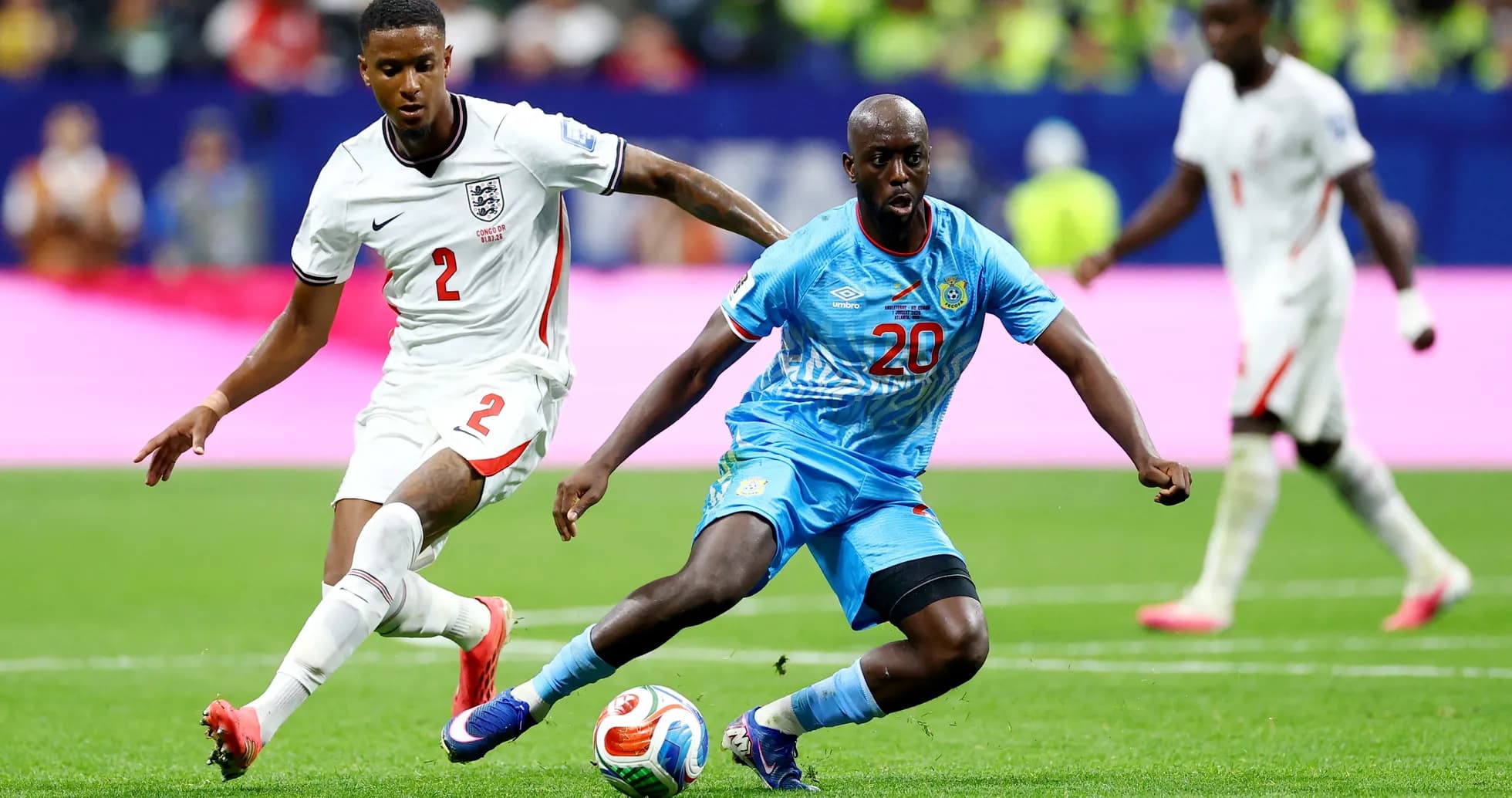
England’s 2-1 comeback win over Congo DR at Mercedes-Benz Stadium was a tactical arm-wrestle defined by England’s territorial control and Congo DR’s early punch and later fatigue. Thomas Tuchel’s side needed patience and structural tweaks to break down Sébastien Desabre’s compact 4-3-3, eventually translating their 60% possession and 16 shots into a deserved turnaround in this World Cup Round of 32 tie.
Congo DR struck first through Brian Cipenga on 7 minutes, a goal that validated Desabre’s plan: a narrow, hard-working midfield three screening a disciplined back four, inviting England into central congestion and then springing quickly into the channels. With only 7 total shots and 0.8 xG, Congo DR were extremely selective but initially efficient, using Yoane Wissa’s movement and Cipenga’s diagonal runs to target the space behind England’s advanced full-backs.
Tuchel’s 4-2-3-1 had a clear positional structure from the outset. Declan Rice and Elliot Anderson formed the double pivot, with Jude Bellingham as the high central midfielder linking to Harry Kane. Noni Madueke and Marcus Rashford held wide starting positions but consistently inverted, leaving Djed Spence and Nico O’Reilly to provide width from full-back. This produced heavy central occupation but also congestion, particularly as Congo DR’s trio of Noah Sadiki, Samuel Moutoussamy and Ngal’ayel Mukau (before his substitution) stayed compact between the lines.
England’s dominance of the ball was reflected in their 517 passes, 468 of them accurate at 91%. The circulation was methodical rather than explosive in the first half, often funnelling through Rice as the primary distributor. However, the tempo was initially too slow to unbalance Congo DR’s back line of Aaron Wan-Bissaka, Chancel Mbemba, Axel Tuanzebe and Arthur Masuaku, who defended their box aggressively and restricted England to a lot of touches in front of them rather than behind.
Turning Point
The turning point in the game’s tactical story came around the hour mark with Tuchel’s double substitution: Bukayo Saka (IN) came on for Noni Madueke (OUT) and Anthony Gordon (IN) came on for Marcus Rashford (OUT) at 60'. This altered both the intensity and the geometry of England’s attack. Saka offered more direct 1v1 threat on the right, staying wider and forcing Masuaku to defend the flank rather than tucking in. Gordon, operating from the left, attacked the half-space more aggressively and made penetrative runs beyond Kane rather than simply receiving to feet.
These changes had two immediate effects. First, they stretched Congo DR horizontally, opening interior lanes for Bellingham to receive between the lines. Second, they gave Kane more support in the box, which became critical as England began to deliver more dangerous final balls. England’s shot profile—13 of 16 efforts coming from inside the box—shows how effectively they eventually managed to occupy the penalty area.
Desabre tried to refresh his front line with Meschak Elia (IN) for Nathanaël Mbuku (OUT) at 64' and later Théo Bongonda (IN) for Brian Cipenga (OUT) at 76', plus Edo Kayembe (IN) for Ngal’ayel Mukau (OUT) in midfield at the same moment. The intent was to preserve counter-attacking threat while adding fresh legs centrally. However, Congo DR’s inability to maintain longer possession phases—365 passes, 299 accurate at 82%—meant that their substitutions were mostly reactive, defending deeper and deeper as England’s pressure mounted.
Equaliser
The equaliser on 75' encapsulated the new dynamic. Anthony Gordon’s introduction had already tilted the game; here he provided the assist for Harry Kane, who finally exploited the loosened marking in the box. The pattern repeated on 86', Gordon again supplying Kane for the decisive 2-1 goal. In both cases, England’s structure—full-backs high, double pivot securing rest defence, Bellingham occupying central defenders—created overloads that Congo DR’s tiring back line could no longer absorb.
Defensively, England’s rest defence was largely solid after the early concession. With Ezri Konsa and Marc Guéhi holding a high line and Rice screening in front, Congo DR were limited to just 2 shots on target. Jordan Pickford (England) was rarely tested, making 1 save; the negative goals prevented figure for England (-0.04) suggests he conceded roughly in line with the quality of chances faced. The key defensive adjustment was psychological as much as structural: after the early goal, England reduced risky vertical passes through the middle and focused on more controlled progression, limiting transition opportunities for Wissa and Cipenga.
Congo DR’s attacking fade was also physical and structural. Their front three had to cover wide distances to press England’s back four and double pivot, and as their intensity dropped, England’s centre-backs and Rice could step in with little pressure, compressing the game into Congo DR’s half. The visitors’ 12 fouls and 1 yellow card to Noah Sadiki for “Foul” reflect a growing reliance on breaking rhythm rather than proactive pressing.
In goal for Congo DR, Lionel Mpasi Nzau had a far busier evening. With England registering 7 shots on target and Mpasi Nzau making 5 saves, the negative goals prevented value (-0.04) indicates he broadly performed to expectation, beaten twice by high-quality finishes from close range. His shot-stopping kept Congo DR in the contest deep into the second half, particularly during England’s surge after the hour.
Tuchel’s late substitution of John Stones (IN) for Declan Rice (OUT) at 90' was a clear game-management move, adding aerial presence and defensive security as England protected their lead. Desabre’s own late changes—Fiston Mayele (IN) for Samuel Moutoussamy (OUT) and Joris Kayembe (IN) for Arthur Masuaku (OUT) at 89'—were attempts to add directness and fresh energy, but by then Congo DR were pinned too deep to build sustained pressure.
Statistical Overview
Statistically, the outcome aligns closely with the underlying numbers. England’s xG of 2.04 versus Congo DR’s 0.8 mirrors the 2-1 scoreline, underlining that the comeback was rooted in chance creation rather than pure narrative momentum. England’s 5 corners to Congo DR’s 3 further illustrate their territorial advantage, while the blocked shot counts (3 for England, 2 for Congo DR) show both defences willing to protect the box aggressively.
In tactical terms, this match was a case study in a possession-heavy favourite gradually solving a compact underdog: England’s structural control, bench impact and sustained box occupation eventually overwhelmed Congo DR’s disciplined but increasingly passive 4-3-3.
Related News
FIFA Dismisses COO Kevin Lamour After Criticizing Infantino’s World Cup Investment Plan
PSG Near €55m Deal to Sign World Cup Star Ferran Torres from Barcelona

Qualified Teams for the 2027 Women’s World Cup in Brazil: Complete List

Premier League 2026-27 Season Preview: Arsenal's Title Defense, Fresh Faces, and What Lies Ahead
Carlo Ancelotti Supports Neymar’s World Cup Selection as Brazil Legend Retires

Leandro Paredes Returns to Action Just Days After World Cup Final Controversy