
Gianni Infantino's $20 Billion FIFA Plan Sparks Global Backlash
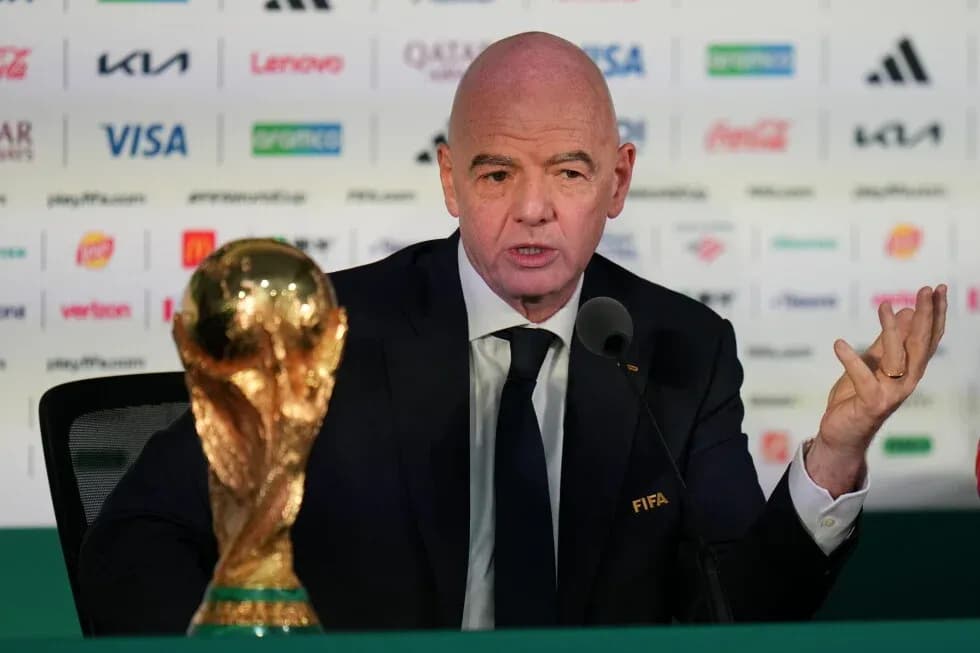
Gianni Infantino has put world football on the clock.
From FIFA’s headquarters in Geneva, the president has handed all 211 member federations a stark choice: sign up by September 19 to a one-off $20 million payout, or walk away from a plan that would effectively sell a slice of the World Cup to private investors — and accept far less money over the next decade.
At the heart of the storm is a proposed $20 billion FIFA subsidiary, tentatively called FIFA Forward Enterprise, that would be 20% owned by private equity. The vehicle would run FIFA’s competitions and events, including the World Cup and Club World Cup, for 12 years. The anchor investor: Thrive Capital, the firm founded by Joshua Kushner, brother of Jared Kushner.
The backlash has been instant and ferocious.
UEFA leads the revolt
UEFA, already blindsided by the revelation of the project, moved quickly. The European body is pushing its 55 member associations into an emergency online meeting, likely on Thursday, and made its stance brutally clear in a statement.
“The World Cup is not FIFA’s to sell,” it said, warning that the rushed deadline for federations to claim an initial $20 million “says everything you need to know about this plan.”
UEFA also made sure to remind Zurich of a weapon it has used before: the threat of a boycott. In 2021, European resistance helped kill Infantino’s push to stage the men’s World Cup every two years. The idea never even reached a vote.
This time, the stakes are higher. This is not just about the calendar. It is about ownership, control, and the direction of the sport’s most powerful institution.
A president in his own orbit
Infantino framed the deal in a letter to FIFA’s members as a “singular and unique funding opportunity,” presenting himself as a custodian of the game’s financial future.
“It is my duty and responsibility as FIFA president to present such game-changing opportunities to you, our members,” he wrote in the letter seen by The Associated Press.
But the project is the latest in a series of grand, top-down schemes that have defined his 11-year tenure. From the aborted $25 billion private equity proposal in 2018 to create new men’s competitions, to the creation of a FIFA Peace Prize — awarded to then-U.S. President Donald Trump at the World Cup draw — Infantino has repeatedly pushed aggressive commercial and political plays with limited consultation.
The current plan deepens his alignment with figures close to Trump’s orbit. After allowing Trump to intervene in the process that cleared United States forward Folarin Balogun to play at the World Cup, Infantino is now seeking to lock in Joshua Kushner’s Thrive Capital as a long-term partner in FIFA’s commercial core.
For many in the game, the pattern is becoming impossible to ignore.
Asia and CONCACAF bristle
This is not just a European rebellion.
The Asian Football Confederation, based in Kuala Lumpur, expressed its dismay at how the proposal emerged.
It was “disappointed that a matter of such significance entered the public domain before the AFC family had been afforded the opportunity to examine and discuss it,” the confederation said.
CONCACAF, representing North and Central America and the Caribbean, went further, warning of governance alarm bells.
“We are deeply concerned by the lack of due process,” it said in a statement.
The message from both regions was blunt: this is too big, too secretive, and moving far too fast.
Clubs and competitions under threat
The unease stretches well beyond national associations.
The European Football Clubs group — representing 850 clubs and working in joint venture with UEFA to manage the Champions League — said it “learned about this proposal in the same way as most global football stakeholders — without warning and through the media.”
For clubs and confederations that run their own competitions — the Champions League, European Championship, Copa America and others — the fear is obvious. A turbocharged FIFA, driven by private investors chasing returns, would have every incentive to expand World Cups and Club World Cups, for both men and women, and to stage them more often.
More games. More teams. More commercial inventory.
And, potentially, less space and prestige for continental tournaments that currently dominate the calendar and the balance sheets.
Sports governance expert Antoine Duval put a sharper edge on it, warning that private equity involvement could “incentivize FIFA to further commodify the World Cup,” pointing to things like more hydration breaks and dynamic ticket pricing as examples of how every second and seat could be monetized.
The money on the table
The numbers are designed to be irresistible, especially to smaller federations that live hand-to-mouth on FIFA funding.
If the FIFA Forward Enterprise plan is approved by a majority of the 211 members, each federation is promised $20 million from the four-year commercial cycle tied to the men’s 2030 World Cup. Over 12 years, the total uplift for each member is pitched at about $86 million, compared with roughly $36 million under existing funding promises if they reject the deal.
The process, Infantino wrote, will be “led by J.P. Morgan,” with Thrive as anchor investor and “a pool of diverse international investors” expected to join.
If the plan is voted down, the offer shrinks sharply. Members will revert to the previously promised $10 million over the next four years.
For dozens of federations with no realistic prospect of qualifying for a World Cup and few players in elite club competitions, this is not a philosophical debate. It is survival. FIFA’s one-member, one-vote system means those same federations hold the balance of power — and can easily outvote the traditional giants of Europe and South America.
UEFA, though, is not buying the pitch.
“FIFA cannot continue to use our sport to enrich themselves and their friends,” it said, in one of the most direct attacks on the Zurich leadership in recent memory.
Political fire from Britain
The resistance is not limited to football’s corridors of power.
British Prime Minister Andy Burnham, a long-time football supporter whose government is preparing to back a joint bid by England, Scotland, Wales and Ireland to host the 2035 Women’s World Cup, moved swiftly to condemn the plan.
“Football does not belong to investors,” he said in a video message on Instagram. “Once you have sold a piece of (the World Cup), you have sold out. Football belongs to the fans. It always has, and it always will.”
British lawmakers have form in this arena. In 2021, political pressure from Westminster — including threats of legislation by then-Prime Minister Boris Johnson — helped crush the European Super League, a project that threatened UEFA’s Champions League and which Infantino had discreetly supported. J.P. Morgan, notably, was also the bank behind that failed Super League venture.
The echoes are hard to miss.
Infantino’s power play and future
Until this week, Infantino looked to be gliding toward a fourth and final term as FIFA president, unopposed, through 2031. His electoral base has been built on one clear promise: more money for member associations.
That pledge underpinned his initial election speech in February 2016 and was central again at his uncontested reelections in 2019 and 2023. The new private equity plan fits the same logic: supercharge revenues, increase distributions, lock in loyalty.
But there is another layer. Some observers have long suspected that Infantino sees himself not just as a term-limited president, but as a long-term executive figure in the sport — something closer to a CEO or commissioner. A powerful role at a semi-autonomous FIFA subsidiary such as FFE, with a 12-year mandate and private investors on board, would be a natural landing spot.
By forcing a rapid decision on a project of this scale, he has triggered rare, open frustration from far beyond the usual European critics. The rest of the world has almost four months to decide how far it is willing to follow him.
The deadline to register candidates for the FIFA presidency is November 18. The election is set for March 18 in Rabat, Morocco — a key Infantino ally and co-host of the 2030 World Cup.
Between now and then, every federation must weigh the same question: take the money and accept a World Cup part-owned by investors, or reject the deal and risk standing in the way of a president who has built his power on promising them more.
Related News
Carlos Alcaraz Calls for Change After Laver Cup Court Conditions
Alexander Zverev Secures Laver Cup Victory for Team Europe with Straight-Set Win Over Learner Tien
Novak Djokovic Shares Fitness Update Before China Open Return After US Open Upset
Shubman Gill's Captaincy Record Across All Formats: Tests, ODIs, T20Is, and IPL
Kuldeep Yadav Named Player of the Match Over Virat Kohli Despite Century in IND vs WI 1st ODI
India Advances to Asian Games 2026 Cricket Semi-Finals After Rain Washout Against Afghanistan