
Mexico Dominates Ecuador 2-0: Tactical Mastery on Display
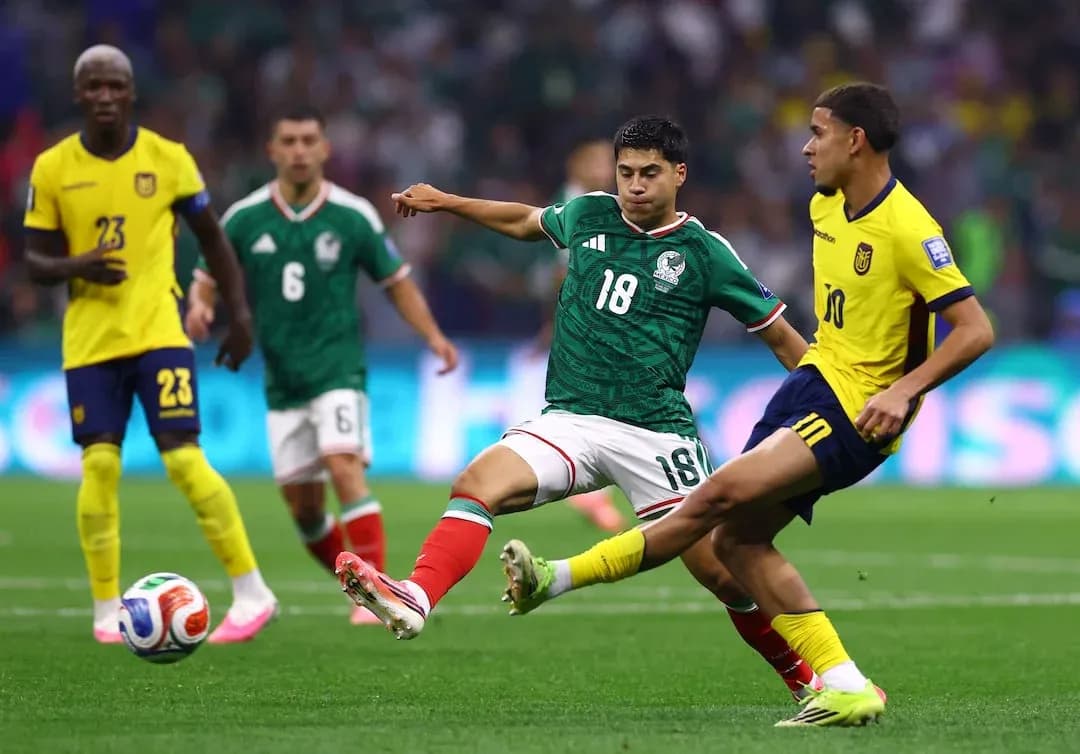
Mexico’s 2-0 win over Ecuador at Estadio Banorte was a clinic in game-state control: an aggressive, vertical first half built on their 4-3-3, followed by a compact, low-risk block that protected the lead despite ceding the ball. Ecuador’s 4-4-2 had more of the possession (57%) and a higher pass completion rate (84%), but they were largely pushed into sterile circulation, finishing with only one shot on goal and an xG of 0.73 against Mexico’s 1.02.
Javier Aguirre’s structure was clear from the opening minutes. In possession, Mexico’s nominal 4-3-3 morphed into a 2-3-5. Full-backs Jorge Sánchez and Jesús Gallardo pushed high and wide, while Erik Lira anchored the midfield as the single pivot, allowing Gilberto Mora and Luis Romo to step into the half-spaces. Julián Quiñones and Roberto Alvarado held wide starting positions but constantly attacked inside channels, leaving Raúl Jiménez to pin the centre-backs. The effect was to stretch Ecuador’s back four horizontally and repeatedly isolate their full-backs.
First Goal
The first goal on 22 minutes encapsulated this plan. With Mexico building through the right, Romo and Sánchez created a short-passing triangle that drew Ecuador’s midfield line across. As Ecuador’s wide midfielder was dragged inside, Alvarado found a pocket between the lines, received, and slipped a vertical pass into the left channel. Quiñones, attacking the inside-left lane from a wide start, finished the move, with Alvarado officially credited with the assist. It was a classic third-man pattern: pivot to full-back, inside to winger, then a diagonal into the weak-side runner.
Second Goal
The second goal at 31 minutes showed the complementary threat of Jiménez’s movement. Again Mexico manipulated Ecuador’s block, this time with quicker circulation through Lira. As the ball progressed, Quiñones dropped off the front line into the left half-space, drawing a centre-back with him. Jiménez curved his run into the vacated central lane, and Quiñones’ assist exploited the disorganisation: a simple but devastating vertical pass that Jiménez converted. Mexico’s 10 shots inside the box (out of 15 total) underline how consistently they managed to play into dangerous central areas rather than settling for speculative efforts.
Defensive Strategy
Out of possession, Mexico’s 4-3-3 pressed selectively rather than relentlessly. The front three screened passes into Moisés Caicedo and Pedro Vite, forcing Ecuador wide, where the full-backs could press aggressively with cover from the nearest midfielder. The foul count (Mexico 10, Ecuador 14) suggests Mexico controlled duels without excessive desperation. Importantly, Mexico’s mid-block compactness meant Ecuador’s forwards Enner Valencia and Gonzalo Plata were often isolated; Ecuador managed only seven shots and had just one effort on target.
After half-time, both coaches adjusted. Sebastian Beccacece’s double change at 46 minutes — Yaimar Medina (IN) came on for Alan Franco (OUT) and Ángelo Preciado (IN) came on for Joel Ordóñez (OUT) — aimed to add thrust from full-back and improve Ecuador’s wide progression. Later, Kevin Rodriguez (IN) came on for Enner Valencia (OUT) at 59', and at 79' Jordy Caicedo (IN) replaced John Yeboah (OUT) while Kendry Páez (IN) came on for Nilson Angulo (OUT), effectively refreshing the front line and adding a more creative midfielder between the lines.
Those changes did tilt territory and possession towards Ecuador, but Mexico’s response was pragmatic. Aguirre’s first substitution at 58' — Brian Gutiérrez (IN) came on for Gilberto Mora (OUT) — injected fresh legs into midfield, while Obed Vargas (IN) for Luis Romo (OUT) at 73' further solidified central zones. In attack, Santiago Giménez (IN) for Raúl Jiménez (OUT) at 74' and Orbelín Pineda (IN) for Julián Quiñones (OUT) at 80' signalled a shift from aggressive front-foot play to energy and pressing from the front. The final change, Israel Reyes (IN) for Roberto Alvarado (OUT) at 80', effectively locked in a more conservative shape, with an extra defensive profile helping to manage Ecuador’s late pressure.
Goalkeeper Performance
Goalkeeper usage and defensive management were telling. Raúl Rangel (Mexico) officially made 1 save, which, combined with Ecuador’s single shot on target, underlines how well the Mexican back four protected their box. The centre-back pairing of César Montes and Johan Vásquez dealt calmly with aerial balls and direct passes, while Gallardo and Sánchez balanced their early attacking roles with disciplined second-half positioning. Mexico’s goals prevented figure of -0.57 indicates Rangel conceded fewer goals than the model expected from the shots faced, though the small shot volume limits the sample.
On the other side, Hernán Galíndez (Ecuador) also recorded 1 save, but the context was very different. Mexico generated 3 shots on goal and 10 inside the area; Ecuador’s defensive structure was repeatedly punctured in the first half. Their -0.57 goals prevented suggests Galíndez conceded more than the model would expect from the chances faced, but the broader issue was structural: the midfield line, with Caicedo and Vite, struggled to protect the half-spaces, leaving the back four exposed to direct combinations.
Discipline
Discipline played a quiet but significant role in the closing stages. All cards went to Ecuador, reflecting their chasing of the game and occasional tactical fouling: Alan Franco’s yellow for Tripping at 45+1' came just before half-time, then in added time Kendry Páez (Tripping at 90+3'), Piero Hincapié’s red for Unsportsmanlike conduct at 90+5', and Moisés Caicedo’s yellow for Tripping at 90+9' further disrupted Ecuador’s structure when they most needed clarity. Playing with ten men in the final minutes essentially ended any realistic chance of a late comeback.
Statistical Overview
Statistically, Ecuador’s 57% possession and 407 passes (340 accurate, 84%) paint a picture of control, but Mexico’s 319 passes with 249 accurate (78%) were far more vertical and purposeful. Mexico outshot Ecuador 15–7, with a 3–1 advantage in shots on goal and a 10–5 edge in shots inside the box. The xG split — 1.02 for Mexico against 0.73 for Ecuador — aligns closely with the 2-0 scoreline when combined with Mexico’s superior shot quality and territorial advantage in the decisive first half.
In synthesis, Mexico’s win in this World Cup Round of 32 tie was built on a sharp, pattern-driven attacking plan early on and a disciplined, structurally sound defensive block once ahead. Ecuador’s later possession and flurry of substitutions could not compensate for their inability to protect central spaces or to translate their passing superiority into genuine chances. Mexico advanced by winning the tactical battle in both phases: proactive and incisive before the break, controlled and mature afterwards.
Related News
FIFA Dismisses COO Kevin Lamour After Criticizing Infantino’s World Cup Investment Plan
PSG Near €55m Deal to Sign World Cup Star Ferran Torres from Barcelona
Qualified Teams for the 2027 Women’s World Cup in Brazil: Complete List

Premier League 2026-27 Season Preview: Arsenal's Title Defense, Fresh Faces, and What Lies Ahead
Carlo Ancelotti Supports Neymar’s World Cup Selection as Brazil Legend Retires
Leandro Paredes Returns to Action Just Days After World Cup Final Controversy