
Nottingham Forest vs Bournemouth: Tactical Insights from the 1-1 Draw
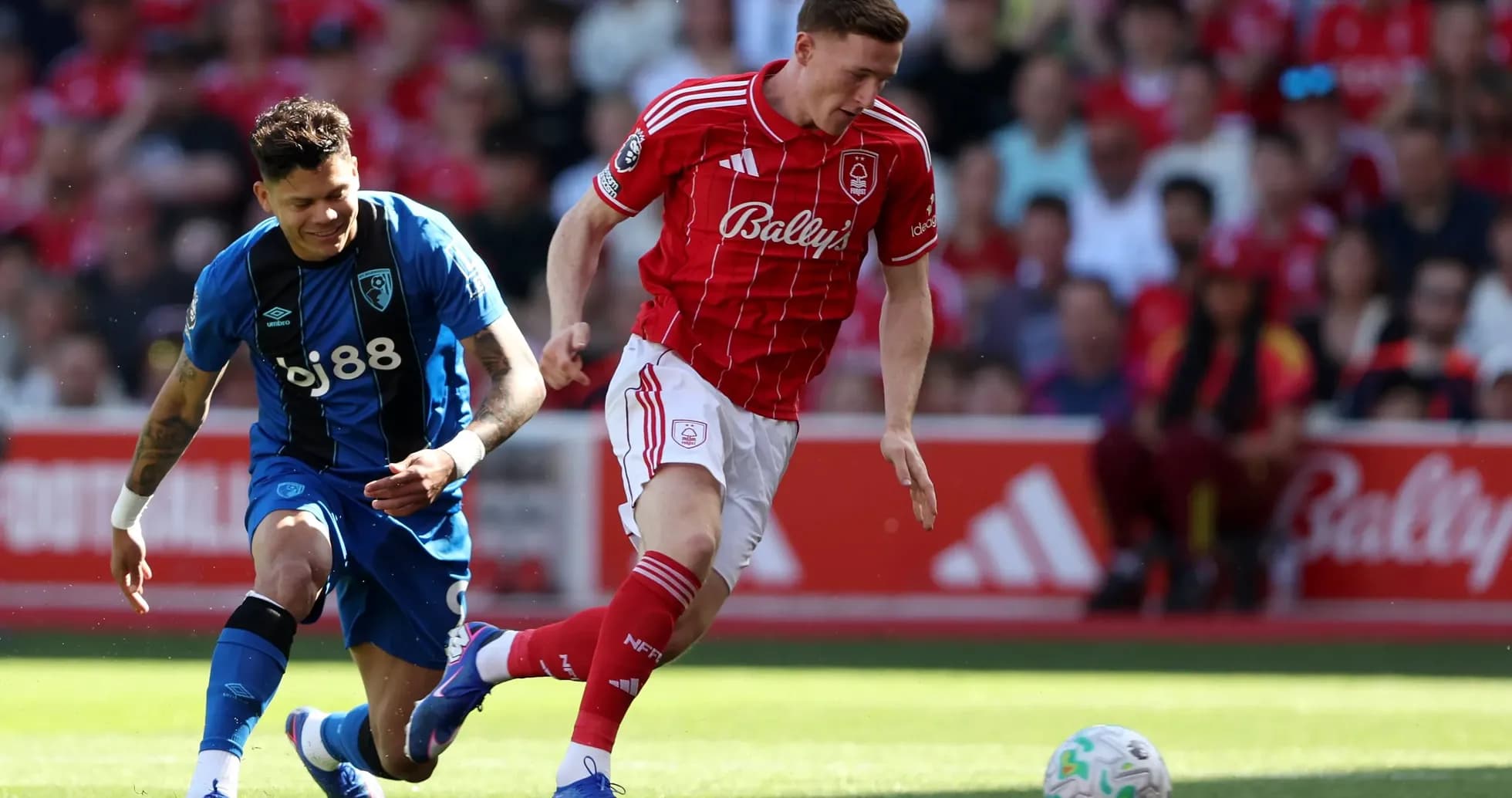
Nottingham Forest and Bournemouth closed their Premier League seasons at City Ground with a 1-1 draw that neatly reflected the tactical balance of the contest. Forest, under Vitor Pereira, leaned into a direct 4-4-2 with an emphasis on verticality and second balls, while Andoni Iraola’s Bournemouth imposed more of the ball in a 4-2-3-1 built around structured possession and wide overloads. The statistical profile – 45% possession and 1.87 xG for Forest versus 55% and 1.0 xG for Bournemouth – underlined a game where Forest created the better chances from fewer attacks, but Bournemouth’s control of territory and tempo allowed them to wrestle back a point after the interval.
Forest's 4-4-2 Structure
In Forest’s 4-4-2, the structure was clear. The back four of N. Williams, Morato, N. Milenkovic and Cunha stayed relatively narrow, inviting Bournemouth to play in front of them while protecting the central lane. Ahead of them, a flat but aggressive midfield line of O. Hutchinson, I. Sangare, E. Anderson and M. Gibbs-White was tasked with compressing the middle third and springing quickly in transition. Up front, C. Wood and Igor Jesus offered a classic pairing: Wood as the reference point for long balls and crosses, Igor Jesus running channels and attacking space behind Bournemouth’s defensive line.
Forest’s attacking pattern revolved around early deliveries and quick combinations around the box. Their 15 total shots, with 10 from inside the area and 5 on target, show how effectively they turned limited possession into high-quality looks. The 6 corners and 5 blocked shots also point to sustained pressure in phases rather than constant dominance. Technically, Forest were solid but not expansive: 396 passes, 307 accurate at 78%, consistent with a game plan that accepted lower volume in exchange for more direct progression. The 11 fouls and a single yellow card indicate an assertive but controlled out-of-possession approach, using tactical contact to break Bournemouth’s rhythm without tipping into chaos.
Bournemouth's 4-2-3-1 Approach
Bournemouth’s 4-2-3-1 had a different logic. The double pivot of T. Adams and A. Toth sat underneath an attacking band of M. Tavernier, E. J. Kroupi and Rayan (with Evanilson leading the line), giving Iraola a clear structure for building from the back. The back four of A. Truffert, M. Senesi, James Hill and A. Smith pushed relatively high, particularly the full-backs, to sustain pressure and keep Forest pinned deeper for long stretches. Their 55% possession, 483 total passes and 405 accurate (84%) underline a more patient, circulation-heavy approach, looking to shift Forest laterally and find gaps between the lines.
Despite that control, Bournemouth’s chance quality lagged behind Forest’s. Seventeen total shots yielded only 6 from inside the box and 4 on target, reflecting how often Forest managed to keep them at arm’s length and force attempts from distance. The 7 blocked shots speak to Forest’s compactness and willingness to defend their box in numbers. Bournemouth committed only 7 fouls and collected one yellow card, consistent with a strategy that prioritised regaining the ball via structure and counter-pressing rather than heavy challenges.
Goalkeeper Performance
In goal, M. Sels (Nottingham Forest) and D. Petrovic (Bournemouth) had almost mirrored workloads. Each side’s statistics show 3 goalkeeper saves, underscoring that while Forest generated the better xG, both teams were able to work the opposition keeper at key moments. The goals prevented metric at -0.5 for both teams suggests that each goalkeeper conceded slightly more than the underlying shot quality might have predicted, hinting that finishing, rather than elite shot-stopping, defined the scoreboard. Still, Sels’ role in marshalling a back line that faced 17 shots, and Petrovic’s steadiness behind a higher defensive block, were central to keeping the game level.
Touchline Battle
The touchline battle was equally instructive. Pereira’s substitutions – T. Awoniyi for C. Wood, L. Netz for Cunha, R. Yates for E. Anderson, N. Dominguez for I. Sangare, and J. McAtee for O. Hutchinson – gradually shifted Forest from a pure 4-4-2 into something closer to a 4-2-3-1/4-4-1-1 hybrid. Awoniyi offered more depth running than Wood, stretching Bournemouth’s centre-backs and creating space for M. Gibbs-White between the lines. The introduction of Netz at left-back and fresh legs in central midfield via Yates and Dominguez aimed to stabilise the flanks and maintain intensity in the press as Bournemouth pushed for control. McAtee replacing Hutchinson late on injected a more technical profile on the right, better suited to exploiting tired legs in transition.
Iraola’s changes for Bournemouth were more about refreshing the attacking structure without abandoning the core 4-2-3-1. E. Unal for Evanilson altered the reference point up front, offering different movement patterns between Forest’s centre-backs. J. Kluivert for E. J. Kroupi and A. Adli for Rayan rotated the attacking midfield band, keeping the press and counter-press sharp. L. Cook for A. Smith in the final minutes added control and passing from deeper areas, with a full-back sacrificed to tilt the team slightly more towards ball retention and central stability as the game wound down.
Statistical Summary
Statistically, the draw feels like a meeting point of contrasting game models. Forest’s higher xG (1.87 to 1.0), superior shot quality and greater volume inside the box suggest their chance creation mechanisms – direct play into the forwards, aggressive wide work from Hutchinson and Williams, and late arrivals from midfield – were more incisive. Bournemouth’s edge in possession and passing accuracy reflects a more stable overall form in their build-up and territorial control, but their lower xG and heavier reliance on shots from outside the box point to a Forest defensive block that largely held its shape.
Discipline remained manageable: one yellow card per side, both for “Foul”, with 11 fouls by Forest and 7 by Bournemouth. That balance reinforces the picture of a tactically intense but not reckless contest. In the end, City Ground saw two clear identities on show: Forest’s vertical, chance-focused 4-4-2 and Bournemouth’s possession-oriented 4-2-3-1. The 1-1 scoreline, and the underlying metrics, suggest neither coach decisively imposed their model over the other, but both left with enough in the data to validate their approaches heading into the next campaign.
Related News

Premier League Managers Facing Potential Sackings During International Break

Arsenal's Myles Lewis-Skelly Names Unexpected Tottenham Rival as Toughest Premier League Opponent

Three Premier League Players Shining Early This Season

Premier League Early Season Reactions: Man City’s Strength, Arsenal’s Flaws, United’s Struggles

Premier League Returns October 10 After Extended September-October International Break

Fulham and Manchester United Share Points in 1-1 Draw