
Qatar vs Switzerland: Defensive Masterclass in 1-1 Draw
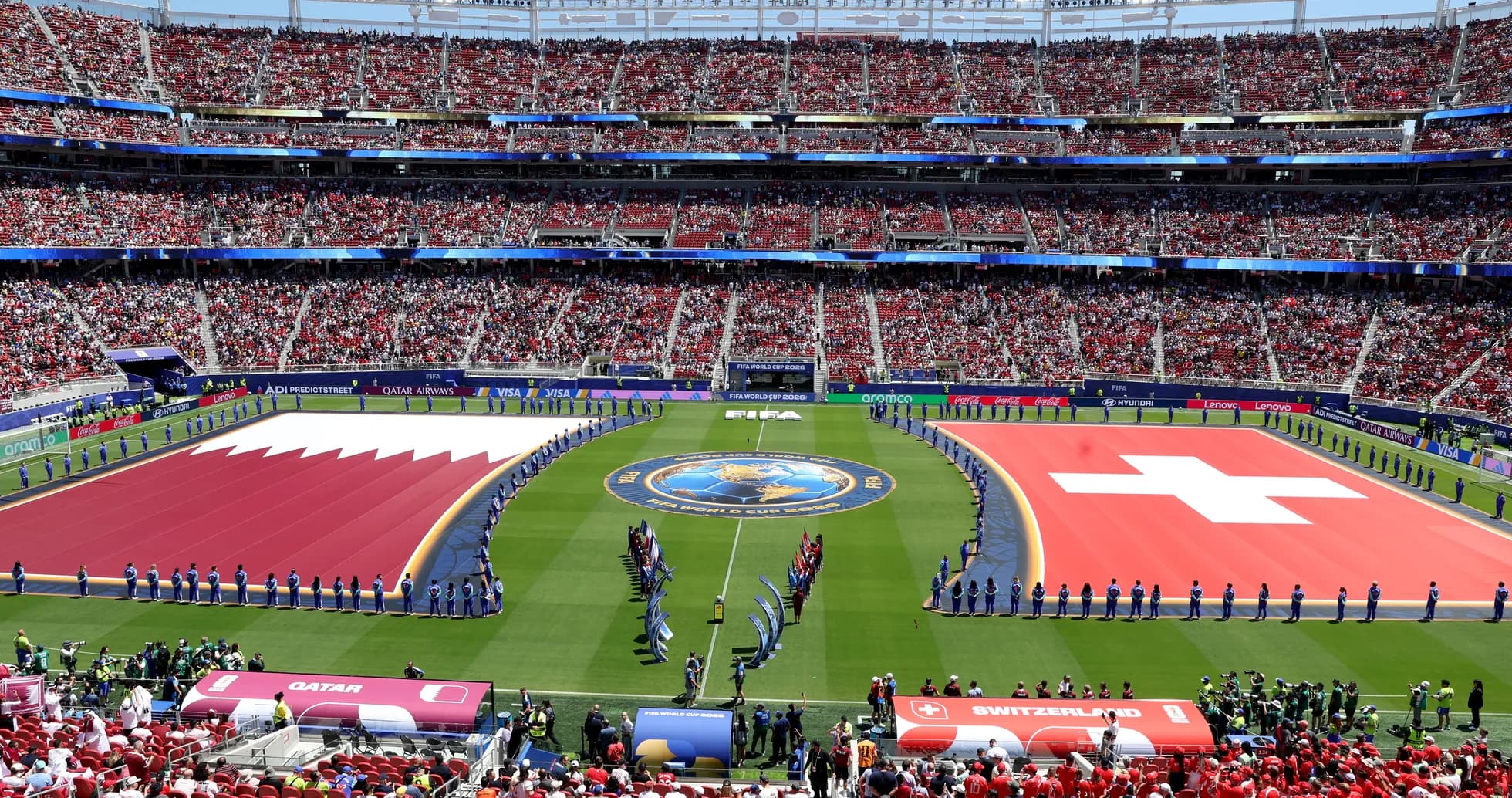
Qatar’s 1-1 draw with Switzerland at Levi's Stadium was a classic example of defensive survival meeting attacking profligacy, shaped by contrasting structures and execution in both boxes.
Julen Lopetegui kept Qatar in a clear 4-3-3, but in practice it functioned as a deep 4-5-1 without the ball. Homam Al-Amin and Ayoub Al Oui stayed narrow to protect the half-spaces, while the midfield trio of Jassem Gaber Abdulsallam, Assim Madibo and Issa Laye collapsed towards their own box. The statistical profile underlines the intent: just 32% possession and only 275 passes, but a relatively high proportion of their 7 total shots came from inside the box (5), suggesting that Qatar were willing to wait for high-value counters rather than trade volume with Switzerland.
Switzerland’s 4-3-3 under Murat Yakin was the opposite: expansive, possession-heavy and relentlessly front-foot. With 68% of the ball and 575 total passes (522 accurate, 91%), they controlled territory and rhythm. Granit Xhaka, Remo Freuler and Michel Aebischer formed a technically secure midfield triangle that allowed the full-backs, especially Ricardo Rodríguez, to step high and pin Qatar deep. The 26 total shots, 18 from inside the box, show that the structure consistently generated penetration rather than sterile circulation.
Key Sequence
The early key sequence came from that Swiss territorial dominance. At 16', under pressure and already being pushed back, Qatar’s goalkeeper Mahmud Abunad was booked for Time wasting, an early sign of how much defending they expected to do. Moments later, a VAR intervention confirmed a penalty for Switzerland after Remo Freuler’s involvement in the box. Breel Embolo converted at 17', rewarding Switzerland’s aggressive positioning between Qatar’s centre-backs and full-backs.
From there, Switzerland’s attacking pattern was clear: Embolo operating off the shoulder, Rubén Vargas tucking inside to overload the left half-space, and Dan Ndoye stretching the right flank. Xhaka and Freuler repeatedly found diagonal lanes into the channels, which explains the volume of shots inside the box. Yet despite 7 shots on goal, Switzerland lacked the final ruthlessness and occasionally overplayed instead of taking clearer shooting options.
Qatar's Adjustment
Qatar’s adjustment was less about changing shape and more about personnel and intensity. The double booking pattern in the first half — Jassem Gaber Abdulsallam’s Yellow Card for Foul at 23' after an earlier Time wasting caution for Abunad — underlined how often they were defending late and reactive. Denis Zakaria’s Yellow Card for Foul at 42' for Switzerland, by contrast, came higher up the pitch, a product of counter-pressing after loss rather than last-ditch box defending.
The second half became a game of whether Qatar could survive the Swiss waves long enough to steal something. Lopetegui’s triple substitution on 60' was a clear tactical pivot: Ahmed Alaaeldin (IN) came on for Yusuf Abdurisag (OUT), Karim Boudiaf (IN) came on for Jassem Gaber Abdulsallam (OUT), and Ahmed Fathi (IN) came on for Ayoub Al Oui (OUT). This refreshed the legs in wide and central zones, with Boudiaf adding more physical presence and positional discipline in front of the back four. The effect was to slightly raise Qatar’s block and give them a bit more ability to contest second balls.
Switzerland responded with their own changes at 65': Johan Manzambi (IN) came on for Dan Ndoye (OUT), and Fabian Rieder (IN) came on for Michel Aebischer (OUT). Rather than altering the structure, these substitutions aimed to maintain intensity and add fresh creativity between the lines. Later, Zeki Amdouni (IN) replaced Rubén Vargas (OUT) at 79', Miro Muheim (IN) replaced Ricardo Rodríguez (OUT) at 89', and Ardon Jashari (IN) came on for Remo Freuler (OUT) at 89', keeping the same 4-3-3 framework but with new profiles in the same roles.
Goalkeeping Performances
The goalkeeping performances were pivotal. Mahmud Abunad (Qatar) made 5 saves and, crucially, his numbers are backed by a goals prevented figure of 0.43 against a Swiss xG of 3.24. That combination tells a clear story: Switzerland created enough to win comfortably, but Abunad’s shot-stopping and positioning significantly narrowed the gap between xG and the actual 1-1 scoreline. Gregor Kobel (Switzerland), by contrast, faced only 4 shots on goal and made 3 saves, with Qatar’s xG at just 0.76. His evening was quieter, but the single late concession — Boualem Khoukhi’s 90+4' equaliser from a Homam Al-Amin assist — punished Switzerland’s inability to kill the game at the other end.
That late goal encapsulated the tactical arc. As Switzerland pushed to protect territory rather than extend their lead, their defensive line remained high but concentration dipped. Qatar, who had introduced Mohamed Naceur Almanai (IN) for Assim Madibo (OUT) at 79' and Hassan Al Haydos (IN) for Edmilson Junior (OUT) at 88', finally had enough technical quality and fresh energy to piece together a decisive move. Homam Al-Amin’s delivery and Khoukhi’s timing in the box were the payoff to a game plan built on suffering and opportunism.
Discipline and Statistics
Discipline also reflects the tactical identities. Qatar finished with 2 Yellow Cards (Mahmud Abunad for Time wasting at 16', Jassem Gaber Abdulsallam for Foul at 23'), both rooted in defensive stress. Switzerland’s single Yellow Card — Denis Zakaria for Foul at 42' — came from an aggressive defensive action in midfield, consistent with a side playing on the front foot.
Statistically, the verdict is stark. Switzerland’s 68% possession, 575 passes with 91% accuracy, 26 total shots and 10 corner kicks point to overwhelming control. Their xG of 3.24 versus just one goal scored exposes a finishing problem and, to a degree, outstanding goalkeeping from Abunad. Qatar’s 32% possession, 275 passes (196 accurate, 71%), 7 total shots and 3 corners are numbers of a side largely penned in. Yet their xG of 0.76 and a single goal scored suggest they extracted almost maximum value from limited attacking phases.
In tactical terms, Switzerland’s overall form and attacking structure were superior, but their defensive index in late-game management — allowing a 90+4' equaliser despite dominating — will be a concern. Qatar, meanwhile, showed that a compact 4-3-3, disciplined box protection and an in-form goalkeeper can bend but not break under sustained pressure, turning a statistically lopsided match into a valuable group-stage point.
Related News
Brazil's First Post-World Cup Friendly: What Should the Lineup Be?
Harry Kane Calls England’s World Cup Exit to Argentina His Deepest International Pain
Estevao Opens Up on World Cup Heartbreak and His Unexpected Return to Brazil Under Ancelotti
Thomas Tuchel Shares Unusual Regret After England's 10-Man World Cup Victory Over Mexico
South Korea Names Robert Moreno as Interim Coach After World Cup Exit
Jude Bellingham Returns to Form at Real Madrid Following World Cup Success