
Saudi Arabia vs Uruguay: Tactical Analysis of the 1-1 Draw
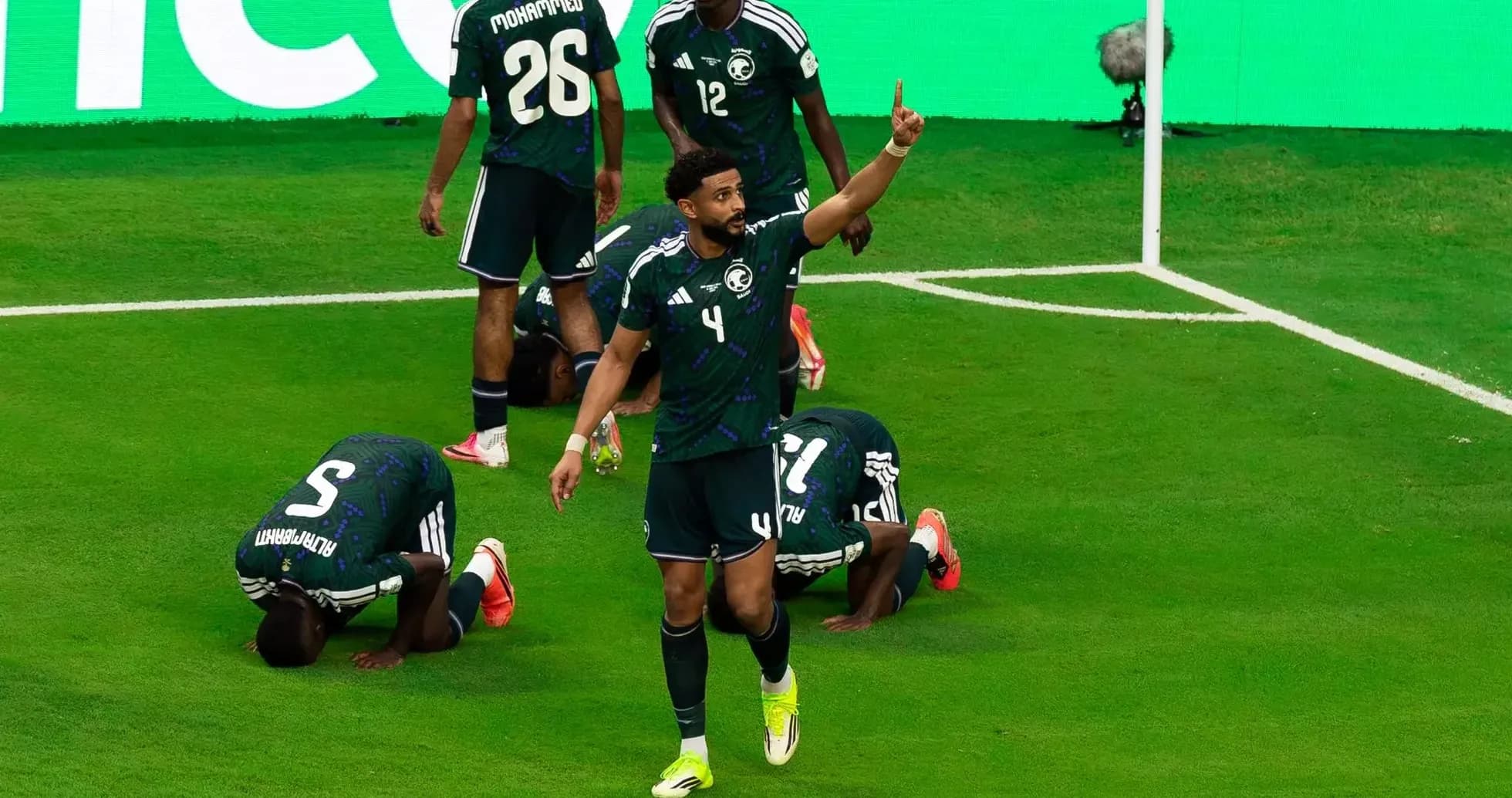
Saudi Arabia’s 1-1 draw with Uruguay at Hard Rock Stadium was a classic clash of styles: compact 4-4-2 low-to-mid block against an expansive 4-2-3-1 possession machine. The statistical profile is stark: Uruguay owned 67% of the ball, fired 27 shots (10 on goal), and forced Saudi Arabia deep for long stretches, yet left with only a point. Saudi Arabia, with 33% possession and just 7 shots (3 on goal), leaned on defensive structure, set spacing, and an outstanding performance from Mohammed Al-Owais (Saudi Arabia) to survive a sustained siege.
Uruguay's Dominance
Uruguay’s 4-2-3-1 under Marcelo Bielsa was textbook territorial dominance. With 612 total passes and 540 accurate (88%), they built patiently through Manuel Ugarte and Rodrigo Bentancur as the double pivot, using full-backs Guillermo Varela and Matías Viña to stretch Saudi Arabia’s narrow 4-4-2. The high volume of shots inside the box (16) shows that this wasn’t sterile circulation; Uruguay repeatedly managed to access the penalty area, especially via wide overloads and cutbacks.
Saudi Arabia's Structure
Saudi Arabia, set up by Georgios Donis in a 4-4-2, accepted a deep block from early on. The back four of Saud Abdulhamid, Abdulelah Al-Amri, Hassan Altambakti and Moteb Al-Harbi stayed compact, with the wide midfielders Salem Al-Dawsari and Mohammed Abu Al-Shamat (before his substitution) dropping to form a flat line of four. The midfield pair Mohamed Kanno and Abdullah Al-Khaibari focused on screening central lanes rather than pressing high, which explains Uruguay’s comfortable passing metrics but also why many of Uruguay’s 11 shots from outside the box came under limited pressure but from less dangerous zones.
Efficiency vs. Volume
The game’s key tactical hinge was Saudi Arabia’s efficiency versus Uruguay’s volume. Saudi Arabia generated 0.66 xG from 7 total shots, while Uruguay produced 1.72 xG from 27 attempts. This reflects Uruguay’s ability to create repeated, moderate-quality chances rather than a few clear one-on-ones. Saudi Arabia’s single goal from Abdulelah Al-Amri came from one of their few structured attacking moments, capitalizing on a rare spell of territory rather than sustained pressure.
Saudi Arabia's Direct Play
In possession, Saudi Arabia were direct and selective. With only 322 total passes and 236 accurate (73%), they rarely tried to build through Uruguay’s press. Instead, they used Firas Al-Buraikan and Musab Al Juwayr as vertical outlets, often looking for early balls into the channels. The low offside count (0) underlines how they preferred to receive in front of the Uruguayan line rather than gamble on runs behind, prioritizing ball security and rest-defense shape over transition risk.
Uruguay's Attacking Structure
Uruguay’s attacking structure tilted strongly to the flanks. With 14 corner kicks and 7 blocked shots, they repeatedly forced Saudi Arabia into last-ditch interventions in and around the box. Federico Valverde’s positioning between the lines and Maximiliano Araújo’s wide-left starting points stretched the Saudi midfield four, opening diagonal lanes into Darwin Núñez. However, the final-third execution never fully matched the volume of entries; many of the 10 shots on goal were from less-than-ideal body positions or under pressure.
Defensive Discipline
Defensively, Saudi Arabia’s discipline without the ball was central. They committed 11 fouls to Uruguay’s 6, an acceptable trade-off for disrupting rhythm. The back line rarely stepped out aggressively, preferring to defend the edge of the box and allow controlled shots from distance. Uruguay’s 7 blocked shots show how often Saudi defenders were in position to contest shooting lanes inside the area, even when the first line was broken.
Goalkeeping Contrast
The goalkeeping contrast is decisive in understanding the tactical outcome. Mohammed Al-Owais (Saudi Arabia) made 9 saves, repeatedly bailing out a defensive unit that, while structurally sound, was under near-constant pressure. His shot-stopping effectively raised the ceiling of what a deep 4-4-2 can withstand against a high-possession side. On the other end, Fernando Muslera (Uruguay) faced only 3 shots on goal and made 2 saves, largely acting as a sweeper behind a high line rather than a heavily tested shot-stopper.
Negative Goals Prevented
The negative goals prevented figure for both teams (-0.35 each) suggests that each goalkeeper conceded slightly more than the post-shot xG model expected, but context matters: Al-Owais (Saudi Arabia) was exposed to 10 shots on target versus Muslera’s (Uruguay) 3, amplifying the importance of his interventions within Saudi Arabia’s game plan.
Substitution Patterns
Substitution patterns also reveal tactical intent. Uruguay’s early second-half changes — Agustín Canobbio (IN) came on for Darwin Núñez (OUT) and Juan Sanabria (IN) came on for Matías Viña (OUT) at 46' — pointed to fresh wide energy and a desire to keep stretching a tiring block rather than changing the structural 4-2-3-1. Later, Nicolás de la Cruz (IN) for Manuel Ugarte (OUT) at 72' further tilted the balance toward creativity and final-third passing, as Uruguay chased the equaliser and then a winner through even more aggressive positioning of their midfield line.
Saudi Arabia’s substitutions were more about defensive maintenance and energy than tactical reinvention. Nasser Al-Dawsari (IN) for Musab Al Juwayr (OUT) at 63' added work rate and ball-winning in midfield to protect the lead. Nawaf Boushal (IN) for Mohammed Abu Al-Shamat (OUT) at 81' and Ali Lajami (IN) for Saud Abdulhamid (OUT) at 90' freshened the back line and wide defensive cover, while Ala'a Al-Hejji (IN) for Firas Al-Buraikan (OUT) and Abdullah Al-Hamdan (IN) for Moteb Al-Harbi (OUT), both at 90', were late-game moves to add legs and hold territory rather than to chase further goals.
Statistical Verdict
Statistically, the verdict is clear: Uruguay’s 67% possession, 612 passes, and 27 shots with 1.72 xG describe a side that controlled virtually every macro aspect of the match. Saudi Arabia, with 33% possession, 322 passes, and 7 shots for 0.66 xG, played a minimalist, resilience-based game. Yet the final 1-1 scoreline underscores how, in tournament football, defensive structure, concentration, and elite goalkeeping can neutralize superior overall form and attacking volume. Uruguay’s high-tempo, wing-focused 4-2-3-1 produced pressure but not a decisive edge; Saudi Arabia’s compact 4-4-2 and Al-Owais’s (Saudi Arabia) 9 saves turned a statistical mismatch into a tactically coherent and valuable point.
Related News
The Rose Bowl Southampton Pitch Analysis for ICC Women's T20 World Cup 2026
Inter's Josep Martinez Confident in Italy’s Potential to Bounce Back After World Cup Setbacks

Dean Huijsen Reflects on World Cup Snub After Spain’s 4-1 Win Over Croatia

Ivan Rakitic Reveals He Still Avoids Watching Croatia’s 2018 World Cup Final Loss to France
Francesco Totti Claims Italy's 2006 World Cup Win Owed to Him
Brazil's First Post-World Cup Friendly: What Should the Lineup Be?