
World Cup 2026: Iran Faces Protests and Political Tension in Los Angeles
The World Cup has seen political flashpoints before. Nothing like this.
In Los Angeles tonight, Iran face New Zealand in their opening game of 2026 with a surreal, volatile backdrop: a host nation at war with one of the competing teams, a fanbase split and angry, and a national coach reportedly under orders from his own government to halt the match if dissent spills too far.
This is not just another group fixture. It is a test of how much football can absorb before it finally breaks.
Taremi’s warning: “It undermines the joy”
Mehdi Taremi has been to enough tournaments to recognise tension. This feels different.
The Iran captain laid bare the strain of a campaign warped by geopolitics and security fears, from the moment his squad touched down in North America. Iran have been forced to move their base to Mexico. Visa problems have dogged members of the delegation. Some travelling supporters have seen their match tickets stripped away.
“I have felt the tension from the first moment we arrived at this World Cup,” Taremi said. “This kind of tension, it undermines that joy and it undermines the message of Fifa and our people, which is that football brings about peace. I feel like this World Cup could have provided a better atmosphere than it has.”
For a senior player to speak that bluntly on the eve of a tournament opener is telling. The message is clear: Iran are not simply preparing for New Zealand. They are bracing for everything around it.
“We’re going to make it hell”
Outside the camp, anger is building in the opposite direction.
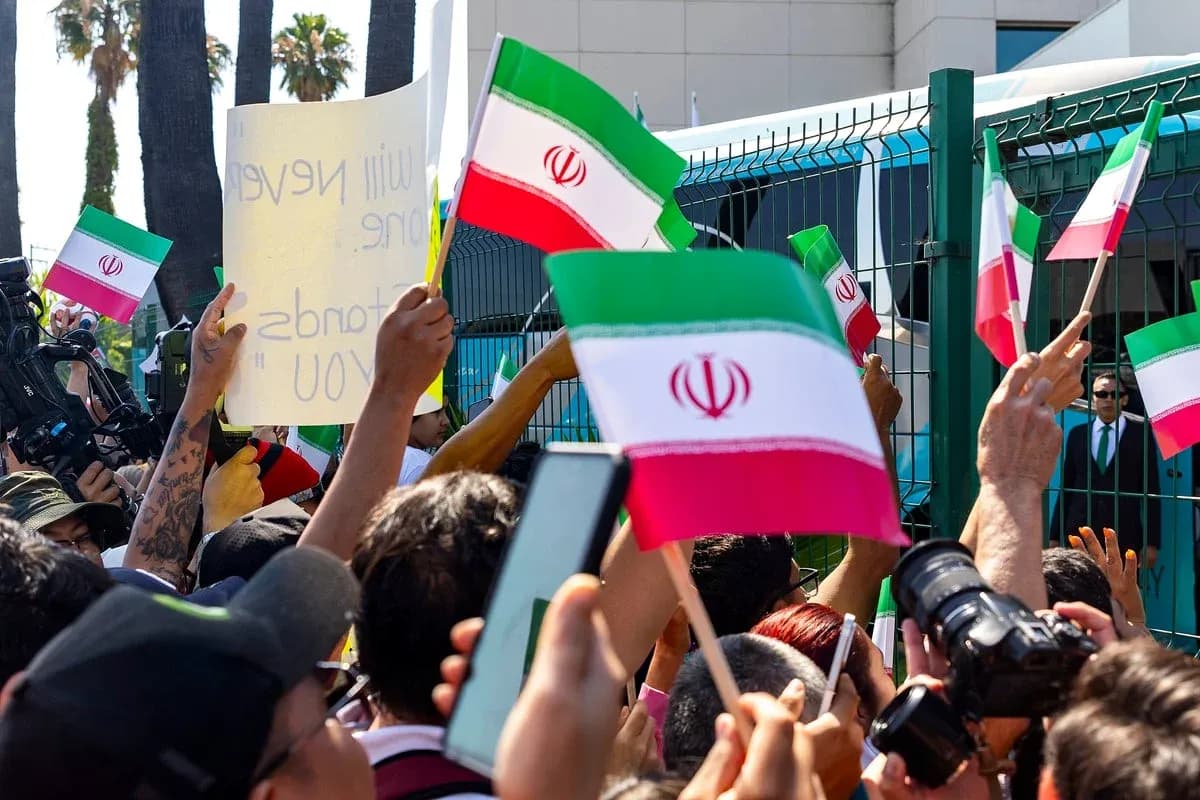
Iranian protesters in the United States have promised to turn SoFi Stadium into a stage of defiance against the ruling regime, using the World Cup spotlight to broadcast their fury over the government and its war with the US.
They have organised buses from San Diego, Orange County and across Los Angeles. They have a plan. Boo the anthem. Turn their backs. Unfurl the pre-revolutionary Iranian flag that Fifa has banned from stadiums.
“We’re going to make it hell,” one activist told the Daily Mail. “We’re going to boo the anthem that is going to play. We're going to turn our backs during the anthem so we will have our flags showing.
“I know Fifa banned it [the flag] but we will make a way to get it in. So we're going to see this flag, not the terrorist regime’s flag.”
That is the atmosphere in which Iran will attempt to play a football match. New Zealand, caught in the middle, will simply try to navigate the noise.
Orders from Tehran
The most extraordinary element hangs over the technical area.
Iran head coach Amir Ghalenoei has, according to reports, been given explicit instructions by the Iranian government: if pre-revolutionary flags appear or if negative chanting against the regime is clearly audible, he is to stop the game.
The very idea cuts against everything the World Cup has tried to project for nearly a century. Yet it is part of the reality in Los Angeles tonight – the possibility of a coach, acting on political orders, intervening in a match not for tactical reasons but to protect the image of his government.
Ghalenoei, for his part, tried to push the storm away in public. Speaking on Friday, he insisted he and his players would not be distracted by the protests swirling around them.
“We don’t pay attention to any of the hype and anything that goes on around us,” he said. “We are here to represent the respectful people of Iran, be it the Iranians inside Iran or the Iranian diaspora.
“We are not political people... football is separate from politics.”
The words land with a certain irony. Nothing about Iran’s campaign is separate from politics. Not the base in Mexico. Not the visa rows. Not the ticket issues. Not the threat of a game being halted by a coach following instructions from the state.
A World Cup first: host at war with a participant
Strip away the slogans and this is the hard fact: in the World Cup’s 96-year history, this is the first time a host nation has been at war with one of the competing countries.
That single detail colours everything. Security planning. Stadium access. Fan movements. The mood in the streets around SoFi. The tone of the questions in every Iran press conference.
Protests are expected both inside and outside the ground. Fifa’s regulations on political messaging will be stretched to their limit. Stadium stewards and security teams will face a near-impossible task: uphold the rules, avoid escalation, and keep a lid on a crowd that includes organised, determined activists.
The match itself – Iran vs New Zealand – risks becoming secondary theatre.
Footballers in the crossfire
Inside the dressing room, players are asked to live with contradictions that would crush most workplaces.
They are told, as Ghalenoei put it, that “football is separate from politics.” They walk out into a venue where their own compatriots plan to boo their anthem and turn their backs on the flag under which they are registered to play. They know the host country is at war with their government. They know cameras will search for any flicker of dissent.
For Taremi and his teammates, the World Cup’s usual promise – a month to escape, to live in a bubble of tactics and training sessions – has evaporated. Every training run, every media appearance, every bus ride to a stadium in the US carries political weight.
And yet they must still deal with the usual demands: beat New Zealand, manage the game, handle the pressure of an opener that could shape their group.
A night loaded with risk
SoFi Stadium will host one of the most charged fixtures the World Cup has seen.
On the pitch, Iran need a result. Off it, protesters want a spectacle. The regime wants control. Fifa wants a smooth show. The US wants security. New Zealand want points. The collision of those interests will play out in real time, under the lights, with the world watching.
The surreal possibility looms over it all: that this contest could be halted not by a floodlight failure or a storm, but by a coach responding to chants and flags in the stands.
If that happens, the 2026 World Cup will cross a line the tournament has never approached before. And if it does not, if the match somehow runs its course amid boos, banners and a war in the background, a different question will linger: how long can this World Cup keep pretending that football and politics occupy separate worlds?
Related News
Anthony Joshua Names Murat Gassiev as Next Opponent if He Defeats Tyson Fury

UFC 332: Start Time and Fight Highlights for Natalia Silva vs. Wang Cong
Court McGee Opens Up About Choosing UFC 332 as His Final MMA Fight
WBC Orders Lightweight Title Unification: William Zepeda vs Jadier Herrera
BCCI Pension List: Monthly Payments to Retired Indian Cricketers in 2025
Why Fury vs Joshua Is Set for Cardiff, and Dua Lipa’s Unexpected Role