
Arsenal Dominates Burnley in 1-0 Victory at Emirates Stadium
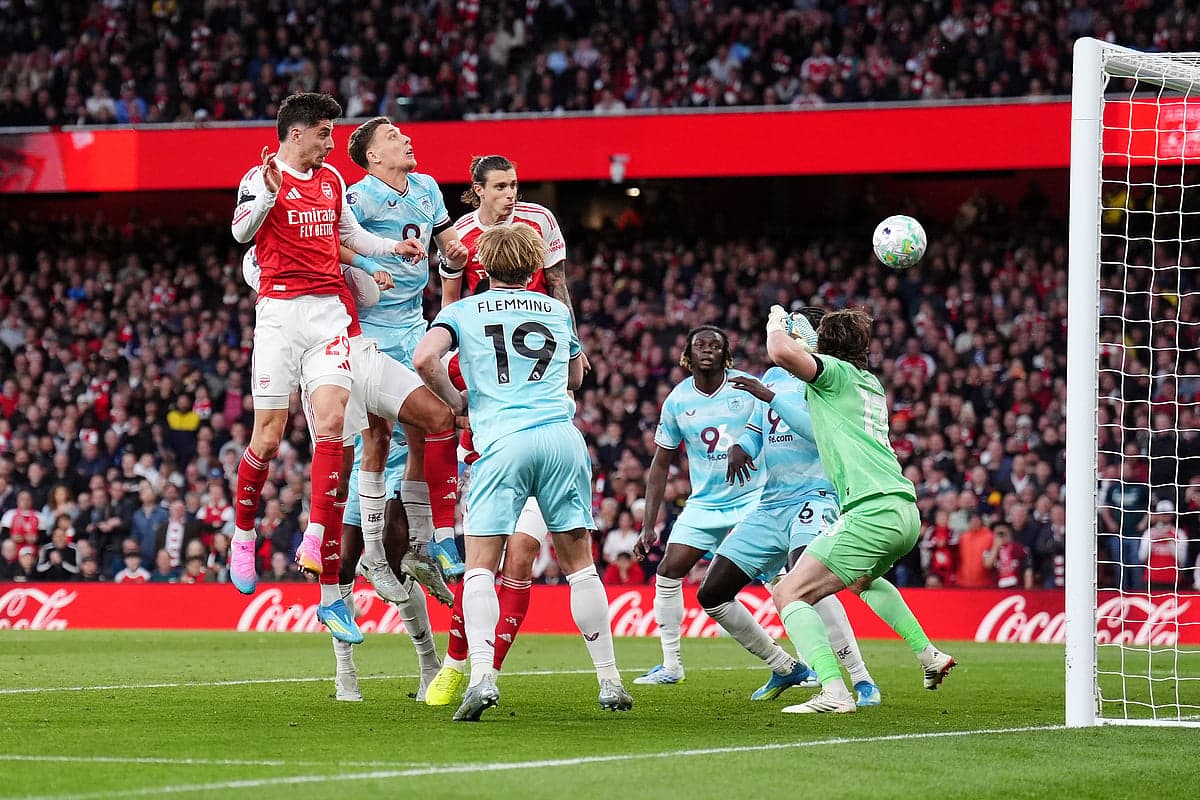
Arsenal’s 1-0 win over Burnley at Emirates Stadium was a control-first performance built on structure more than volume. Mikel Arteta’s 4-3-3 dominated territory and tempo, translating 61% possession and a 1.03 xG profile into a single decisive moment from Kai Havertz. Mike Jackson’s 4-2-3-1 for Burnley stayed compact and reactive, but a near-total lack of penetration (0.21 xG, 0 shots on target) meant their defensive discipline never converted into attacking threat. Arsenal’s passing superiority and pressing control suffocated transitions, while Burnley’s resistance relied heavily on their goalkeeper and back line defending their box under repeat circulation rather than proactive ball progression.
The game’s only goal arrived on 37 minutes and encapsulated Arsenal’s positional play. With Arsenal settled in their 4-3-3 structure, Bukayo Saka held a wide-right starting point before timing his involvement to exploit Burnley’s back line. His assist for K. Havertz came from Arsenal’s ability to pin Burnley deep, recycle possession, and then find a vertical gap at the right moment. Havertz’s movement from the central forward zone into a finishing pocket was decisive: he broke Burnley’s last line at the exact moment their block shifted laterally, giving Arsenal the 1-0 that would define the night.
Discipline and Tactical Role
Discipline played a clear tactical role. Burnley collected three yellow cards, Arsenal one, and the sequence underlined the pressure patterns of the match:
- 28' Hannibal Mejbri (Burnley) — Time wasting
- 67' Kai Havertz (Arsenal) — Foul
- 90+1' Zian Flemming (Burnley) — Foul
- 90+4' Lucas Pires (Burnley) — Foul
Mejbri’s early booking for Time wasting at 28' was a clear indicator of Burnley’s intent to slow rhythm even before going behind. Havertz’s yellow at 67' reflected Arsenal’s aggressive counter-press from the front, while Flemming and Lucas Pires were punished late as Burnley chased the game and were forced into riskier defensive actions.
Arsenal's Formation and Distribution
Arteta’s starting 4-3-3 was extremely stable in its distribution: David Raya behind a back four of C. Mosquera, William Saliba, Gabriel, and Riccardo Calafiori, with Declan Rice anchoring midfield between Martin Odegaard and Eberechi Eze. Saka, Havertz, and Leandro Trossard formed the front three. The structure allowed Arsenal to build with a broad base: Rice frequently dropping to connect Saliba and Gabriel, while Calafiori and Mosquera provided width in deeper zones. Arsenal’s 510 passes, with 440 accurate (86%), show how effectively they circulated to probe Burnley’s 4-2-3-1 block.
Burnley’s defensive plan hinged on a double pivot of Florentino and Lesley Ugochukwu shielding a back four of K. Walker, Axel Tuanzebe, Maxime Esteve, and Lucas Pires. Ahead of them, L. Tchaouna, Hannibal Mejbri, and Jaidon Anthony supported Zian Flemming. Their 325 passes, 254 accurate (78%), underline a more conservative, safety-first approach: shorter sequences, fewer risky verticals, and a reluctance to commit numbers forward.
Shot Profile and Goalkeeping
The shot profile reinforces the tactical balance. Arsenal generated 13 total shots to Burnley’s 5, with 9 inside the box against Burnley’s 2. Yet Arsenal put only 3 on target, reflecting Burnley’s capacity to get bodies between ball and goal (3 blocked shots) and force lower-quality final actions. Burnley, by contrast, failed to register a single shot on goal; their 5 attempts (4 off target, 1 blocked) highlight how rarely they accessed dangerous central spaces.
In goal, D. Raya had a paradoxical evening: Arsenal’s defensive control meant he recorded 0 goalkeeper saves, but his goals prevented figure of 0.85 indicates he dealt well with the few moments of genuine danger that did arise, positioning and anticipation rather than shot-stopping defining his contribution. For Burnley, M. Weiss made 2 saves and posted 0.85 goals prevented, a strong indication that he outperformed the xG conceded and kept the scoreline respectable despite territorial inferiority.
Substitutions and Game Management
Substitutions were used more to manage energy and game state than to alter shape. For Burnley:
- 70' Z. Amdouni (IN) came on for H. Mejbri (OUT)
- 71' J. Laurent (IN) came on for L. Ugochukwu (OUT)
- 78' J. Ward-Prowse (IN) came on for Florentino (OUT)
- 82' J. Bruun Larsen (IN) came on for L. Tchaouna (OUT)
- 82' B. Humphreys (IN) came on for M. Esteve (OUT)
These moves nudged Burnley towards a slightly more progressive midfield with J. Ward-Prowse and J. Laurent, and added fresh attacking legs in Z. Amdouni and J. Bruun Larsen. However, Arsenal’s control of possession and rest-defense structure meant Burnley’s late attacking reshuffle never translated into sustained pressure.
Arsenal’s changes were about locking the game down:
- 72' P. Hincapie (IN) came on for R. Calafiori (OUT)
- 73' V. Gyökeres (IN) came on for K. Havertz (OUT)
- 73' M. Lewis-Skelly (IN) came on for E. Eze (OUT)
- 90+3' G. Martinelli (IN) came on for L. Trossard (OUT)
- 90+3' M. Zubimendi (IN) came on for M. Odegaard (OUT)
Hincapie’s introduction maintained defensive balance on the left, while Gyökeres offered fresh pressing and depth running to threaten in transition. Lewis-Skelly and, late on, M. Zubimendi added legs and security in midfield, ensuring Arsenal could continue to circulate under pressure and close the match without ceding control.
Statistical Overview
Statistically, the 1.03 vs 0.21 xG split mirrors the eye test: Arsenal were not rampant, but they were clearly superior in chance quality and control. Their 3-0 edge in shots on goal and overwhelming passing volume point to a team comfortable managing a narrow lead. Burnley’s 16 fouls to Arsenal’s 7 and their three yellow cards underline how much defensive strain they were under, particularly as they pushed late and became more stretched.
In tactical terms, this was a mature, low-chaos home performance from Arsenal: structured buildup, aggressive counter-pressing, and a defensive block that protected Raya so effectively he was rarely called into visible action. Burnley’s compact 4-2-3-1 succeeded in limiting the scoreline but never truly threatened to overturn it, their lack of penetration and reliance on slowing the game ultimately leaving them short of the tools needed to disrupt Arsenal’s control.
Related News

Premier League Managers Facing Potential Sackings During International Break

Arsenal's Myles Lewis-Skelly Names Unexpected Tottenham Rival as Toughest Premier League Opponent

Three Premier League Players Shining Early This Season

Premier League Early Season Reactions: Man City’s Strength, Arsenal’s Flaws, United’s Struggles

Premier League Returns October 10 After Extended September-October International Break

Fulham and Manchester United Share Points in 1-1 Draw