
Burnley and Aston Villa Share Points in Tactical Clash
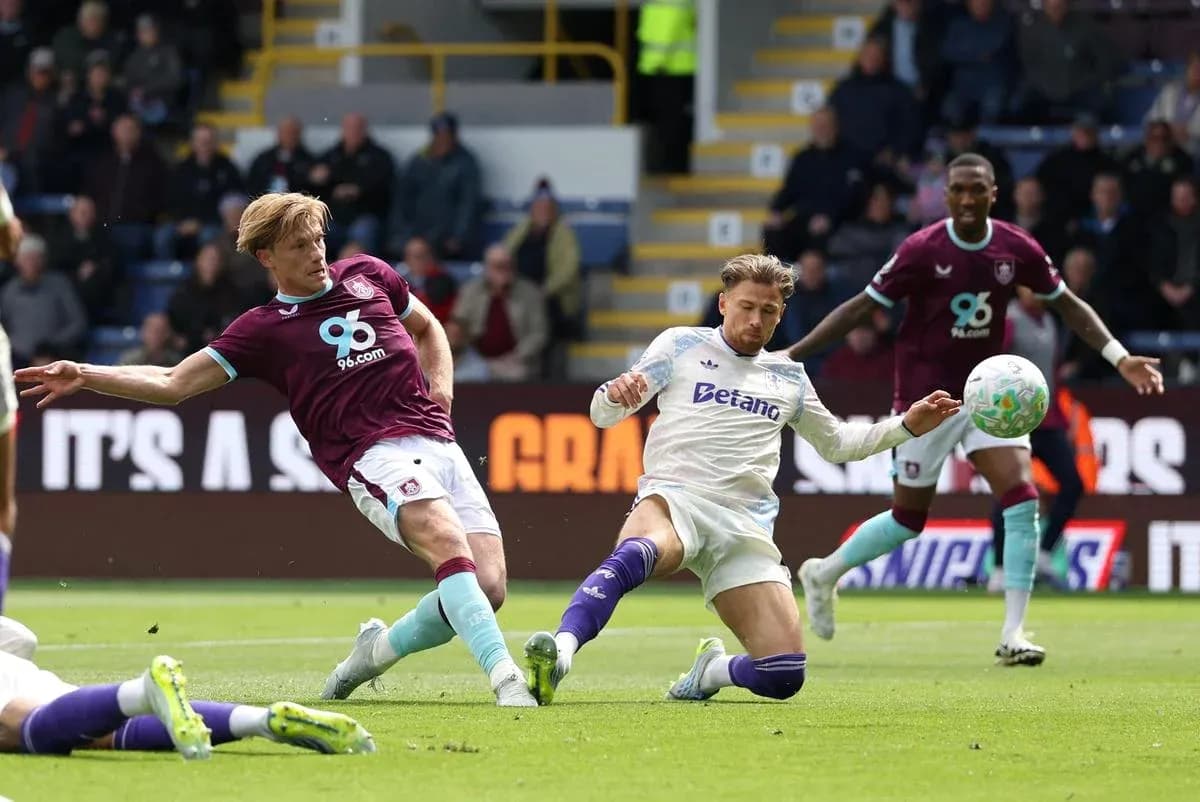
Burnley and Aston Villa shared a 2-2 draw at Turf Moor in Round 36 of the Premier League, a match that neatly reflected contrasting game models. Burnley, under Mike Jackson, leaned into a compact 4-2-3-1 and direct transitions; Aston Villa, coached by Unai Emery, controlled territory and tempo with the same base shape but far more of the ball. The scoreline matched the underlying metrics: Burnley’s 1.77 xG versus Villa’s 1.42 xG underscored a contest where the hosts created slightly better chances despite Villa’s territorial dominance, and both sides ultimately took a point that their tactical approaches broadly merited.
The scoring opened early and framed the tactical battle. In the 8th minute, Jaidon Anthony struck for Burnley, capitalising on the hosts’ intent to attack quickly once possession was won. That early lead allowed Burnley to sink into their mid-to-low block, with the double pivot of Florentino Luís and Lesley Ugochukwu screening central spaces while the wide trio tracked Villa’s full-backs. Villa thought they had levelled on 40 minutes, but a potential goal by Ollie Watkins was disallowed by VAR at 40'. Emery’s side immediately reasserted control, and at 42' Ross Barkley equalised, assisted by John McGinn, rewarding Villa’s patient occupation of Burnley’s half.
Second Half
After the interval, Villa’s territorial superiority was converted into a lead. At 49', Tyrone Mings (Aston Villa) — Foul — collected a yellow card, a rare disciplinary note in what was largely a controlled game. Then at 56', Ollie Watkins finally did get his goal, finishing a move initiated by a direct contribution from Emiliano Martínez, whose assist highlighted Villa’s willingness to bypass lines from the back when Burnley’s press jumped. Burnley responded immediately in structural and emotional terms. At 58', Zian Flemming, fed by Hannibal Mejbri, made it 2-2, reasserting Burnley’s threat from quick vertical combinations.
Discipline remained minimal but significant in terms of tempo control. At 60', Zian Flemming (Burnley) — Persistent fouling — was booked, a direct consequence of Burnley’s need to disrupt Villa’s rhythm between the lines. The final card count, locked from the events data, was: Burnley: 1, Aston Villa: 1, Total: 2. No reds were shown, and the referee Anthony Taylor managed a match where tactical fouls were present but not excessive.
Substitution patterns underlined the tactical adjustments. At 69', Lyle Foster (IN) came on for Hannibal Mejbri (OUT), shifting Burnley’s attacking reference towards more vertical runs in behind and adding a more traditional forward presence to complement Flemming. Villa’s response came on 74': Lucas Digne (IN) came on for Ian Maatsen (OUT), and Emiliano Buendía (IN) came on for Victor Lindelöf (OUT), a double change that rebalanced the left flank and added creativity in the half-spaces. Burnley countered with fresh legs in midfield and attack at 79': Josh Laurent (IN) came on for Lesley Ugochukwu (OUT), and Zeki Amdouni (IN) came on for Zian Flemming (OUT), signalling a desire to maintain pressing energy and keep a mobile front line for transitions.
Villa continued to refresh their attacking structure. At 80', Douglas Luiz (IN) came on for Ross Barkley (OUT), adding a deeper playmaking profile, while Lamare Bogarde (IN) came on for Matty Cash (OUT), a move that preserved defensive balance while maintaining width. At 85', Leon Bailey (IN) came on for John McGinn (OUT), injecting pace and 1v1 threat on the flank against a tiring Burnley back line. Burnley’s final changes at 87' were about set-piece quality and wide threat: James Ward-Prowse (IN) came on for Florentino (OUT), and Jacob Bruun Larsen (IN) came on for Jaidon Anthony (OUT), giving Burnley a late-game delivery specialist and fresh wide runner to chase counters and dead balls.
Structurally, both teams nominally used a 4-2-3-1, but the interpretations diverged. Burnley’s back four of Kyle Walker, Axel Tuanzebe, Maxime Estève and Lucas Pires stayed relatively narrow and compact, inviting Villa to circulate in front. The double pivot protected the central lane, with Loum Tchaouna, Hannibal Mejbri and Jaidon Anthony working back to form a 4-4-1-1 without the ball, Flemming often the lone presser. In possession, Burnley looked to hit early into Flemming’s feet or the channels, then flood the box with the second line.
Villa’s shape was far more expansive. With Matty Cash and Ian Maatsen high and wide, Youri Tielemans and Victor Lindelöf (used as a midfielder) formed a deep platform to recycle possession. McGinn and Barkley occupied the half-spaces, with Morgan Rogers tucking inside to overload central areas and Watkins stretching the last line. The 66% possession and 510 passes, 439 accurate (86%), show a side comfortable in long spells of circulation, probing for gaps rather than forcing the issue.
Goalkeeper realities and defensive profiles added nuance. Max Weiss faced 7 shots on target and made 5 saves, with his goals prevented figure at -0.16, suggesting he conceded slightly more than the average keeper might from the quality of chances faced. Burnley’s 17 fouls and a single yellow for Persistent fouling underline a strategy of controlled disruption rather than reckless aggression. Villa, by contrast, committed only 8 fouls with one yellow for a Foul to Mings, consistent with a team defending more in structure than in emergency transitions.
Statistically, Villa’s 18 total shots (7 on target) to Burnley’s 15 (6 on target) align with their territorial advantage, as do their 8 corners to Burnley’s 2. Yet Burnley’s xG edge (1.77 to 1.42) indicates that the hosts generated slightly higher-quality opportunities, largely through quick, direct attacks once Villa’s structure was stretched. Burnley completed 255 passes, 186 accurate (73%), reinforcing their more vertical, risk-tolerant style. The 2-2 scoreline, with both sides slightly underperforming or overperforming xG only marginally, reflects a match where contrasting tactical identities produced a balanced outcome: Villa’s control met Burnley’s punchy transitions, and neither could quite tilt the contest decisively.
Related News
Premier League Managers Facing Potential Sackings During International Break
Arsenal's Myles Lewis-Skelly Names Unexpected Tottenham Rival as Toughest Premier League Opponent

Three Premier League Players Shining Early This Season
Premier League Early Season Reactions: Man City’s Strength, Arsenal’s Flaws, United’s Struggles

Premier League Returns October 10 After Extended September-October International Break

Fulham and Manchester United Share Points in 1-1 Draw