
Napoli Dominates Pisa 3-0 in Serie A Clash
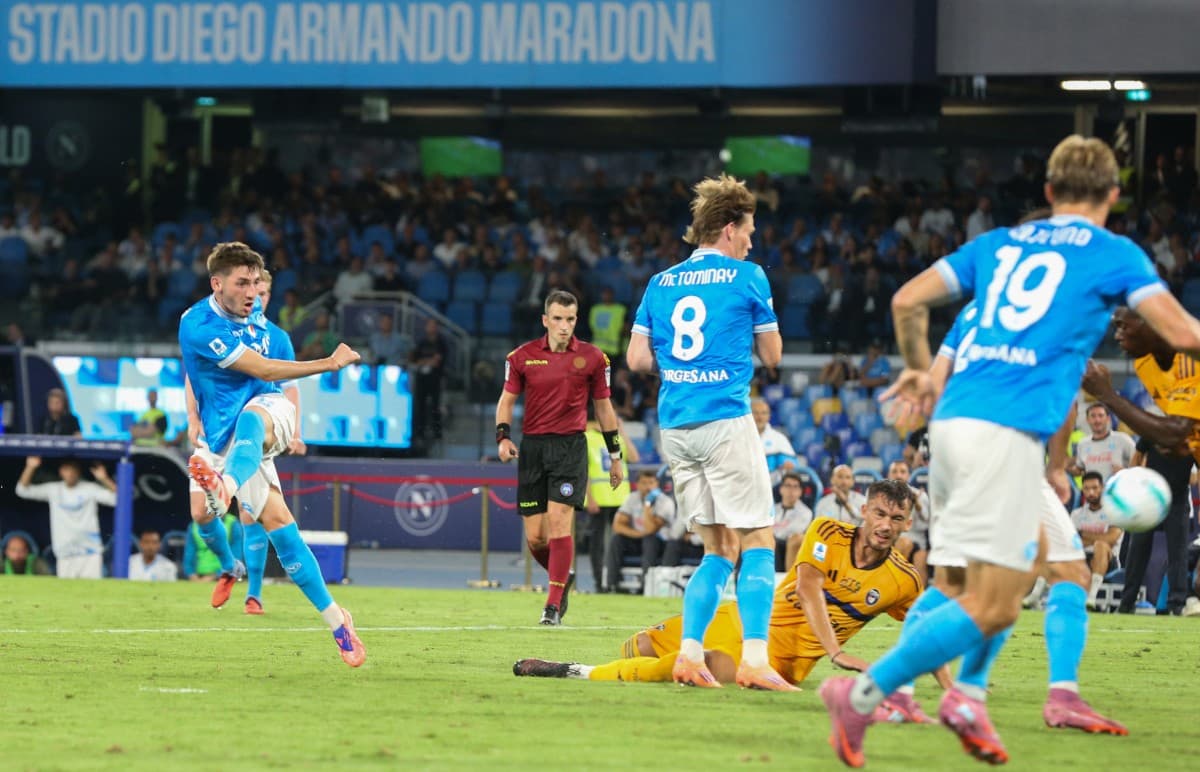
The afternoon at Arena Garibaldi – Stadio Romeo Anconetani ended with the scoreline that many had feared and few in Pisa could truly contest. Napoli, chasing the final polish on a Champions League–bound campaign, dismantled the bottom side 3–0, a result that neatly mirrored the gulf already etched into the Serie A table.
Following this result, the numbers still tell the same blunt story. Pisa sit 20th with 18 points, their overall goal difference of -44 a stark product of 25 goals scored and 69 conceded in 37 matches. Napoli, by contrast, remain 2nd on 73 points, with an overall goal difference of 21 from 57 goals for and 36 against over the same 37-game span. One side has spent the season learning to suffer; the other has learned to manage games with ruthless economy.
I. The Big Picture – Structures and Season DNA
The tactical shapes on the teamsheet captured both clubs’ identities. Pisa went with their most-used structure, a 3-5-2 under Oscar Hiljemark, leaning into congestion in central areas and hoping to shield a fragile back line. Across the halfway line, Antonio Conte’s Napoli deployed a 3-4-3, a variant that has underpinned much of their success this season, blending a back three’s solidity with wing-based width and a central striker who can both finish and link.
The season’s statistical DNA framed the narrative even before kick-off. Heading into this game, Pisa had played 19 times at home, winning 2, drawing 4 and losing 13. They had scored just 9 goals at home and conceded 26, averaging 0.5 goals for and 1.4 against per home match. The home crowd has become accustomed to long spells of defending and too many afternoons where the scoreboard never budges in their favour.
Napoli’s away profile was the mirror image. On their travels, they had played 19 games, winning 10, drawing 3 and losing 6. They had scored 25 away goals and conceded 18, an away average of 1.3 goals for and 0.9 against. This is an elite away side: not always spectacular, but consistently efficient, underlined by 8 away clean sheets overall.
The half-time score of 0–2 and the full-time 0–3 simply extended those trajectories: Pisa failed to score again, one of 21 such failures overall this campaign, while Napoli added another clean sheet to a season built on control.
II. Tactical Voids – Absences and Discipline
Pisa entered this fixture with a bench already thinned by misfortune and misjudgment. R. Bozhinov and F. Loyola were both missing due to red cards, while F. Coppola and M. Tramoni were sidelined by muscle injuries, and D. Denoon by an ankle problem. Lorran was listed as inactive. For a side that has leaned on defensive density to survive, the absence of additional options in rotation mattered: it reduced Hiljemark’s ability to alter the rhythm or reinforce tiring legs in the second half.
Napoli had their own absentees, but from a position of strength. David Neres (ankle injury) and R. Lukaku (hip injury) were ruled out, while M. Politano served a suspension for yellow cards. On paper, those are significant creative and finishing weapons; in practice, Conte’s squad depth and the presence of R. Højlund and S. McTominay in the XI softened the blow.
The disciplinary profiles of both clubs also coloured the tone of the contest. Pisa are one of Serie A’s most card-prone sides. Their yellow card distribution peaks at 76–90 minutes, where 25.97% of their yellows arrive, a late-game surge that often coincides with fatigue and desperation. Their red cards cluster earlier, with 40.00% shown between 31–45 minutes, underlining how quickly pressure can boil over.
Individually, A. Caracciolo embodies that edge: he has collected 10 yellows this season, while M. Aebischer has added 8 more. On the bench, I. Touré – absent from the XI here – has already seen red once, alongside 4 yellows. Napoli are more controlled but not immune; their yellow peak is between 61–75 minutes at 30.61%, with both of their red cards coming late between 76–90 minutes, a reminder that Conte’s intensity can tip over when closing out tight games.
III. Key Matchups – Hunter vs Shield, Engine Room
The headline duel was always going to be R. Højlund against Pisa’s back three. Højlund’s Serie A campaign with Napoli has yielded 11 total goals and 5 assists in 32 appearances, supported by 44 shots, 23 of them on target. He is not just a finisher but a reference point, with 498 total passes and 31 key passes reflecting his role in linking play.
Across from him, Caracciolo has been Pisa’s defensive anchor. Over 35 appearances he has made 71 tackles, 24 successful blocked shots and 51 interceptions, while engaging in 261 duels and winning 139. Yet those numbers sit inside a defensive unit that, overall, concedes 1.9 goals per match in total and 1.4 at home. The structural weakness – not the individual – has been the problem all season.
In midfield, the “Engine Room” confrontation pitted S. McTominay and S. Lobotka against Pisa’s central trio of M. Hojholt, Aebischer and E. Akinsanmiro. McTominay’s season with Napoli has been quietly devastating: 10 total goals, 3 assists, 71 shots, 34 on target, and 1262 total passes at 88% accuracy. Defensively, he has added 28 tackles, 13 blocks and 21 interceptions, plus 164 duels won out of 312. He is both enforcer and late-arriving scorer, a profile Pisa have struggled to contain all year.
Aebischer, Pisa’s most complete midfielder, has tried to carry a similar two-way load. In 34 appearances he has 1 goal and 1 assist, 1490 total passes at 85% accuracy, 33 key passes, 64 tackles, 6 blocked shots and 35 interceptions. He has also committed 44 fouls and taken 8 yellows, a sign of how often he has been forced into firefighting. Against Napoli’s three-man central axis of McTominay, Lobotka and G. Di Lorenzo stepping inside from the right, Pisa’s midfield was always likely to be stretched horizontally and vertically.
IV. Statistical Prognosis – xG Logic Without the Numbers
Even without explicit xG values, the season-long data sketch the expected shape of this match. A home side averaging 0.7 goals in total and 0.5 at home, failing to score in 21 games overall, facing an away team averaging 1.3 goals for and 0.9 against on their travels, with 8 away clean sheets: the most probable script was always a Napoli win to nil.
Napoli’s clean defensive structure in a 3-4-3, backed by an overall average of 1.0 goals conceded per match and only 18 goals allowed away, was primed to smother Pisa’s limited attacking threat. On the other side, the combination of Højlund’s movement, McTominay’s late runs and the width of L. Spinazzola and Di Lorenzo targeted a Pisa defence that concedes 1.9 goals per game overall and has already suffered heavy defeats, including a 5-0 away loss in their “biggest loses” profile.
Following this result, nothing about those trajectories has changed. Pisa’s 3-5-2 remains a system built to survive rather than to thrive, overburdening stalwarts like Caracciolo and Aebischer. Napoli’s 3-4-3, meanwhile, continues to look like a system designed for the Champions League: compact without the ball, vertical and direct with it, and powered by a spine – from A. Meret through A. Rrahmani and A. Buongiorno to McTominay and Højlund – that rarely gives opponents a second invitation.
The 3–0 scoreline in Pisa was less an isolated story than the latest chapter in a season-long pattern of dominance versus struggle, written in formations, in duels, and in the unforgiving arithmetic of goals for and against.
Related News

David Alaba Poised for Surprising Move to Udinese in Serie A

Milan Dominates Lecce: Tactical Analysis of a 3-0 Victory

Juventus Defeats Atalanta 2-0: Tactical Insights and Key Matchups

Frosinone's Tactical Mastery Shines in 2–0 Victory Over Como

Fiorentina and Napoli Share Points in Serie A Clash
AS Roma vs Inter: Tactical Insights from Serie A Clash