
Brighton Dominates Wolves 3–0 in Premier League Clash
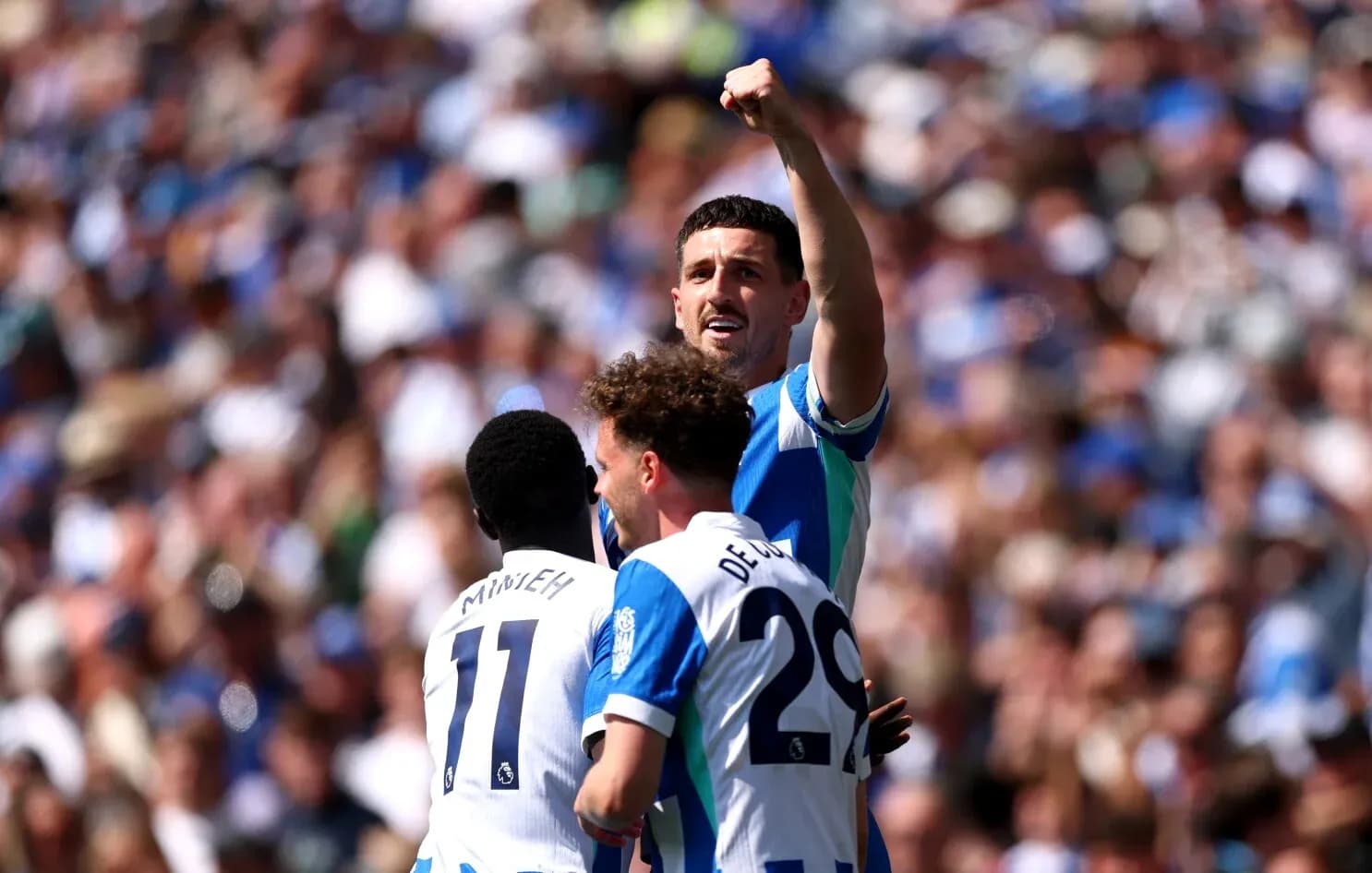
Brighton dismantled Wolves 3–0 at the Amex Stadium in Premier League Round 36, a performance defined by early vertical incision and then total possession control. Jack Hinshelwood and Lewis Dunk struck inside five minutes to effectively decide the contest before Wolves had settled, with Yankuba Minteh adding a late third. Fabian Hurzeler’s side dominated the ball (72% possession) and territory, restricting Rob Edwards’ Wolves to a single shot on target and an xG of just 0.49. Brighton’s 1.62 xG underlines that the scoreline reflected a steady stream of quality chances rather than pure finishing variance.
Scoring Pattern
The scoring pattern was front‑loaded and brutally efficient. At 1', Brighton exploited Wolves’ loose defensive spacing immediately: Maxim De Cuyper advanced from left-back and delivered into the half-space, where Jack Hinshelwood arrived from midfield to finish for 1–0. Four minutes later, De Cuyper again attacked the same corridor, this time finding Lewis Dunk, who had stayed high after a set-piece phase, to make it 2–0 at 5'. With Wolves’ back line disorganised and narrow, Brighton repeatedly targeted the left channel for cut-backs and second balls.
Discipline
Discipline was limited but clear in its timing and pattern. Card log:
- 24' Kaoru Mitoma (Brighton) — Foul
- 49' Hwang Hee-chan (Wolves) — Foul
- 68' André (Wolves) — Foul
Totals are therefore: Brighton: 1, Wolves: 2, Total: 3.
Mitoma’s yellow on 24' came as Wolves tried to break through the right, a rare early transition that highlighted Brighton’s aggressive counter-press. After the interval, Hwang Hee-chan’s 49' caution reflected Wolves’ increasing desperation to disrupt Brighton’s circulation high up the pitch. André’s 68' booking again came from a foul, symptomatic of a midfield unit perpetually half a step late to Brighton’s rotations.
Substitution Patterns
Substitution patterns underlined the tactical arc. Wolves moved first at 46', with David Møller Wolfe (IN) coming on for Hugo Bueno (OUT), a like-for-like wide change aimed at stabilising their left flank. Brighton responded on 58', Joël Veltman (IN) came on for Kaoru Mitoma (OUT), shifting the balance slightly more conservative on the right while maintaining structural security. Wolves then made a double change on 67': Rodrigo Gomes (IN) came on for Pedro Lima (OUT) and Jean-Ricner Bellegarde (IN) came on for Mateus Mané (OUT), an attempt to refresh their wide and central lanes simultaneously.
Brighton’s own 76' double switch was pre-emptive game management: Yasin Ayari (IN) came on for Carlos Baleba (OUT) to add fresh legs and secure central control, while Georginio Rutter (IN) came on for Danny Welbeck (OUT) to maintain a pressing reference up front. The third goal at 86' was individual and transitional: Yankuba Minteh struck unassisted to make it 3–0, punishing Wolves as they stretched. Late on, Hurzeler rotated further: Charalampos Kostoulas (IN) came on for Jack Hinshelwood (OUT) and Solly March (IN) came on for Maxim De Cuyper (OUT), both at 88', protecting key contributors. Wolves’ final response at 89' — Angel Gomes (IN) came on for Hwang Hee-chan (OUT) and Tolu Arokodare (IN) came on for João Gomes (OUT) — had no time to alter the pattern.
Tactical Analysis
Tactically, Brighton’s dominance was rooted in a clear territorial plan and superior structure in possession. With no formation data in the JSON, the functional picture emerges from roles: Bart Verbruggen acted as a low-usage goalkeeper (only 1 save required), protected by a back four of Ferdi Kadıoğlu, Jan Paul van Hecke, Lewis Dunk, and Maxim De Cuyper. Their average positions were high and compact, enabling Brighton to sustain attacks and immediately counter-press. The 578 total passes at 86% accuracy show a team comfortable circulating under minimal pressure.
In midfield, Carlos Baleba and Pascal Groß provided complementary profiles: Baleba as the ball-winner and carrier through the central lane, Groß as the metronome connecting into the attacking midfield line of Yankuba Minteh, Jack Hinshelwood, and Kaoru Mitoma behind Danny Welbeck. Hinshelwood’s early goal from a central surge exemplified how Brighton used him as a third-man runner beyond Wolves’ midfield, while Minteh’s late strike underlined his ability to attack space once Wolves opened up.
Wolves’ structure, by contrast, was reactive and disjointed. Daniel Bentley faced 6 shots on goal and made 3 saves, with Brighton’s 14 total shots (10 inside the box) illustrating sustained penalty-area occupation. The back three of Yerson Mosquera, Santiago Bueno, and Toti Gomes were repeatedly dragged wide by Brighton’s wide overloads, exposing gaps for Dunk and Hinshelwood to attack on set and open-play restarts. The wing and midfield line of Pedro Lima, João Gomes, André, and Hugo Bueno struggled to close central passing lanes, reflected in Brighton’s 72% possession and 498 accurate passes.
Up front, Adam Armstrong, Mateus Mané, and Hwang Hee-chan were starved of service. Wolves’ 225 passes at 68% accuracy point to rushed, low-quality build-up. Their 5 total shots, only 1 on target, combined with an xG of 0.49, show they rarely generated high-probability chances, even when they reached the box (4 shots inside the area).
Statistical Overview
Statistically, Brighton’s performance was both dominant and efficient. The xG battle (1.62 vs 0.49) supports the 3–0 scoreline, and the identical goals prevented figures (0.25 for each goalkeeper) indicate that neither side was bailed out by extraordinary shot-stopping; the result was driven by chance volume and quality. Brighton’s 7 corners to Wolves’ 1 further highlight territorial superiority.
From an overall form perspective, this looks like a mature, controlled home win from Brighton, leveraging structured possession and early aggression. Defensively, their index is strong: 1 shot on target conceded, low xG against, and minimal reliance on Verbruggen. Wolves, meanwhile, showed defensive vulnerability in the opening phase and insufficient attacking cohesion thereafter, with their late substitutions unable to shift a match that Brighton had already locked down structurally.
Related News
Premier League Managers Facing Potential Sackings During International Break
Arsenal's Myles Lewis-Skelly Names Unexpected Tottenham Rival as Toughest Premier League Opponent
Three Premier League Players Shining Early This Season
Premier League Early Season Reactions: Man City’s Strength, Arsenal’s Flaws, United’s Struggles

Premier League Returns October 10 After Extended September-October International Break

Fulham and Manchester United Share Points in 1-1 Draw