
Cagliari vs Udinese: A Clinical 2-0 Victory Highlights Contrasting Seasons
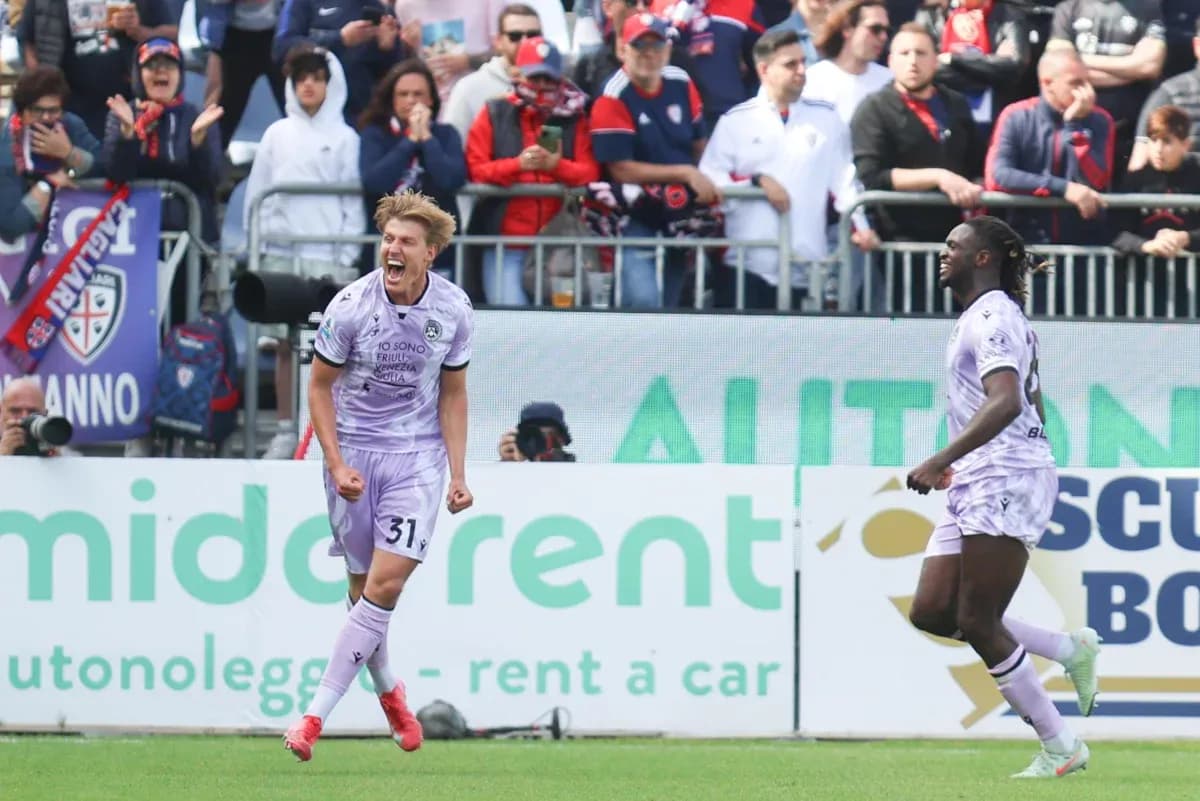
Under the bright Sardinian light of the Unipol Domus, a safety fight met an ambitious late-season charge – and it was Udinese who walked away with a cold, clinical 2–0 win that underlined the gulf in conviction between a side clinging to survival and one quietly chasing Europe’s fringes.
I. The Big Picture – contrasting trajectories laid bare
Following this result, Cagliari remain 16th in Serie A with 37 points from 36 matches. Their overall goal difference is -15, the product of 36 goals scored and 51 conceded. At home, they have taken 6 wins, 4 draws and 8 defeats from 18 games, scoring 20 and conceding 22. That home profile – 1.1 goals scored on average and 1.2 conceded – tells of a team that competes but rarely dominates.
Udinese, by contrast, consolidate a strong mid-table campaign. They sit 9th with 50 points from 36 games, their overall goal difference at -1 (45 for, 46 against). On their travels they have been quietly impressive: 8 away wins, 3 draws and 7 defeats, with 27 goals scored and 26 conceded. An away scoring average of 1.5, against 1.4 conceded, makes them one of the more dangerous counter-punchers in the league.
The 0–2 scoreline in Cagliari fits the season’s broader pattern: a home side that too often lacks cutting edge, and an away team comfortable absorbing pressure before striking.
II. Tactical voids and the weight of absences
Cagliari arrived into this fixture with their attacking deck heavily thinned. G. Borrelli (thigh injury), M. Felici and R. Idrissi (both knee injuries), J. Liteta (thigh injury), L. Mazzitelli (injury) and, crucially, L. Pavoletti (knee injury) were all unavailable. For a team that has already failed to score in 14 league games overall and only averages 1.0 goals per match in total, losing experienced penalty-box presence and creative depth was a serious blow.
Fabio Pisacane’s response was structural caution: a 5-3-2 designed to keep Cagliari compact. E. Caprile anchored a back five of M. Palestra, J. Pedro, A. Dossena, J. Rodriguez and A. Obert. Ahead of them, M. Adopo, G. Gaetano and M. Folorunsho formed a narrow midfield trio, with S. Esposito and P. Mendy tasked with stretching Udinese’s three-man back line.
Udinese were not without their own gaps. J. Ekkelenkamp (leg injury) and A. Zanoli (knee injury) were sidelined, while C. Kabasele missed out through yellow-card suspension – a notable absence in the heart of their defence. Yet Kosta Runjaic trusted a proactive 3-4-3: M. Okoye behind a back three of B. Mlacic, T. Kristensen and O. Solet; a mobile midfield line of K. Ehizibue, J. Piotrowski, J. Karlstrom and H. Kamara; and a front three of N. Zaniolo, A. Buksa and A. Atta.
The disciplinary backdrop of the season added another layer of risk. Cagliari have shown a tendency to fray late: 26.92% of their yellow cards arrive between 76–90 minutes, and both of their red cards this campaign have also come in that late window. Udinese, meanwhile, concentrate 26.87% of their yellows between 61–75 minutes, with an early-game red already on their record. This was always likely to be a match where emotional control in the final half-hour would matter as much as tactical structure.
III. Key matchups – Hunter vs Shield, and the engine rooms
The “Hunter vs Shield” narrative was clearest in Udinese’s attacking profile against Cagliari’s fragile overall defence. Overall, Cagliari concede 1.4 goals per game; Udinese score 1.3 in total and 1.5 on their travels. With creative hubs like N. Zaniolo – 5 goals and 6 assists in 32 appearances – floating between the lines, Udinese’s front line was primed to probe the spaces either side of Dossena and in front of Obert.
Cagliari’s best offensive hope lay in the boots and brain of S. Esposito. With 6 goals and 5 assists in 34 games, plus 65 key passes and 49 fouls drawn, he is both playmaker and pressure valve. His duel with Udinese’s double pivot of J. Piotrowski and J. Karlstrom was the game’s “Engine Room” clash: Esposito trying to turn, carry and slip passes into Mendy’s runs, while Piotrowski and Karlstrom sought to suffocate central progression and spring transitions to Zaniolo and Buksa.
At the back, A. Obert’s season-long profile – 63 tackles, 18 successful blocks and 40 interceptions – framed him as Cagliari’s key shield. But his aggressive style comes at a disciplinary cost: 9 yellow cards and 1 yellow-red this campaign. Up against a dribbler and contact magnet like Zaniolo, who has drawn 61 fouls and attempted 94 dribbles, Obert was always walking a tightrope between decisive intervention and dangerous over-commitment.
For Udinese, the absence of Kabasele put more responsibility on O. Solet and T. Kristensen to manage Cagliari’s direct balls towards P. Mendy and the runs of Esposito. Yet with Cagliari averaging only 1.1 goals at home and having failed to score in 7 home fixtures, the visitors could afford to hold a relatively high line and trust their cover.
IV. Statistical prognosis – why 0–2 felt “on script”
Following this result, the numbers still frame Cagliari as a side whose margin for error is minimal. Overall, they keep 8 clean sheets but fail to score in 14 matches; their biggest home win is 4–0, yet their heaviest home defeat is 0–2 – a scoreline this match duly replicated. Their season-long pattern is of narrow games decided by moments they too often lack.
Udinese, conversely, are built for days like this. On their travels they combine 5 away clean sheets with that 1.5 goals-per-game scoring rate, and their biggest away win – 0–3 – speaks to a team comfortable in vertical, ruthless football. With penalty reliability (5 scored from 5 overall, 0 missed) and high-impact forwards like K. Davis waiting on the bench, they carry threat deep into matches.
Marrying the underlying trends with the tactical shapes, a low-to-mid xG contest tilted towards Udinese’s sharper edge was always likely. Cagliari’s conservative 5-3-2, robbed of Pavoletti and creative alternatives, struggled to generate volume or quality of chances. Udinese’s 3-4-3, powered by Zaniolo’s playmaking and a balanced midfield, repeatedly found ways to stress a defence that concedes 1.2 goals at home and 1.4 overall.
In the end, 0–2 felt less like an upset and more like the logical endpoint of two seasons diverging: Cagliari hanging on, Udinese accelerating.
Related News

David Alaba Poised for Surprising Move to Udinese in Serie A
Milan Dominates Lecce: Tactical Analysis of a 3-0 Victory

Juventus Defeats Atalanta 2-0: Tactical Insights and Key Matchups
Frosinone's Tactical Mastery Shines in 2–0 Victory Over Como
Fiorentina and Napoli Share Points in Serie A Clash
AS Roma vs Inter: Tactical Insights from Serie A Clash