
Cremonese Dominates Pisa 3–0 in Serie A Match
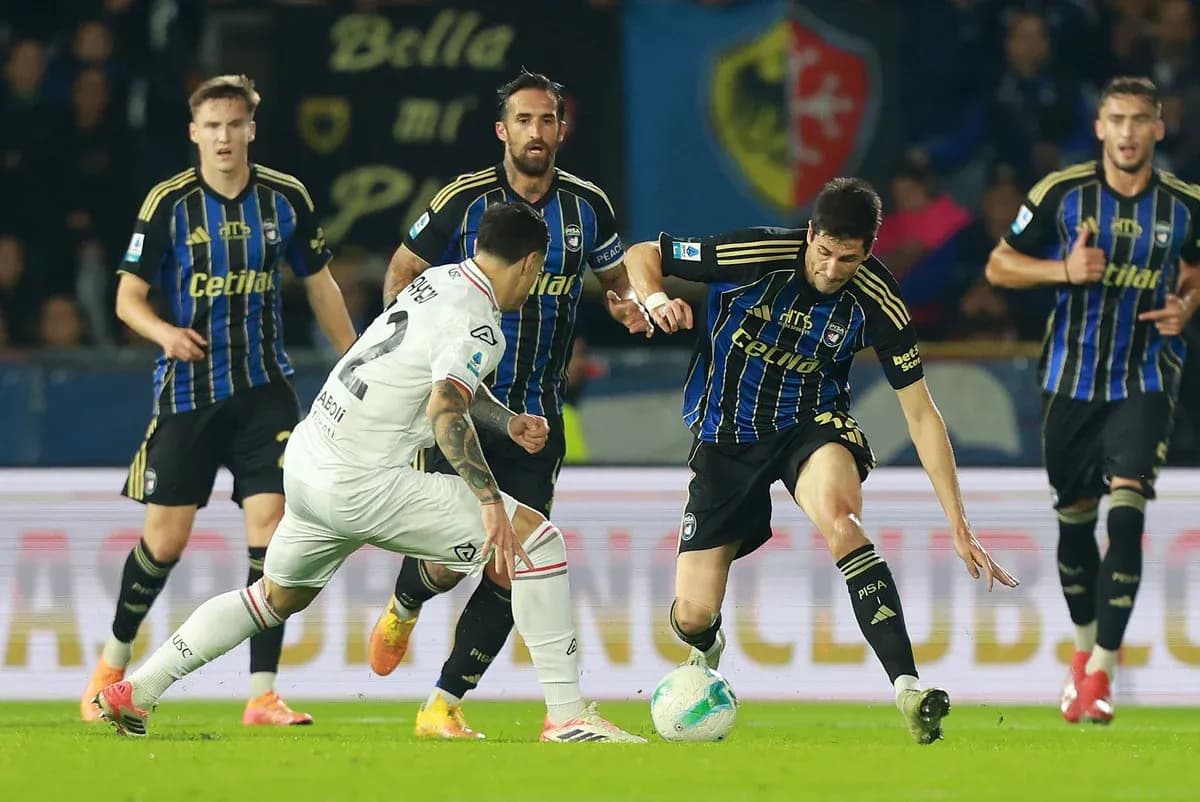
Cremonese’s 3–0 home win over Pisa at Stadio Giovanni Zini in Serie A’s Regular Season - 36 was a ruthless demonstration of control against a side reduced to nine men. Marco Giampaolo’s 4-4-2 dominated the ball and territory from the outset, while Oscar Hiljemark’s 3-5-2 never established a foothold. The hosts led 1–0 at half-time and converted their structural superiority and numerical advantage into a comfortable full-time scoreline of Cremonese 3–0 Pisa, with goals from J. Vardy, F. Bonazzoli and substitute D. Okereke.
Disciplinary Cards: Cremonese: 0, Pisa: 6, Total: 6.
The disciplinary pattern set the tactical tone. Bozhinov’s first yellow at 16' for “Foul” already hinted at Pisa’s reactive, last-ditch defending in wide areas of their back three. His second yellow, again for “Foul” at 23', immediately turned into a red card, leaving Pisa in a 3-4-2 shape out of possession and forcing their wing-backs deeper. From that point, Cremonese’s 4-4-2 had a permanent overload in midfield, reflected in the 77% possession and 735 total passes.
The scoring opened at 31' when J. Vardy struck for Cremonese. With Pisa a man down, Cremonese could circulate through A. Grassi and Y. Maleh, pulling Pisa’s remaining centre-backs wide. Vardy’s goal came as the natural product of repeated entries into the final third, exploiting the stretched three-man back line.
At 37', Hiljemark reacted: A. Calabresi (IN) came on for S. Moreo (OUT), and S. Angori (IN) came on for M. Leris (OUT). Pisa effectively shifted into a 4-4-1/4-3-1 hybrid, adding a defender and full-back profile to stabilise the flanks. The adjustment reduced the immediate chaos but surrendered almost all attacking threat.
After the break, discipline again undermined Pisa’s attempts to reorganise. Arturo Calabresi’s yellow at 49' for “Foul” underlined how exposed the new back line was against Cremonese’s wide rotations. Two minutes later, at 51', Cremonese doubled the lead: F. Bonazzoli finished after a supply line from the left, assisted by J. Vandeputte. This was classic 4-4-2 pattern play: full-back and winger (G. Pezzella and Vandeputte) pinning Pisa’s wide defenders, with Bonazzoli attacking the channel between centre-back and full-back.
The match effectively ended as a contest at 57', when Felipe Loyola received a straight red card, again for “Foul”. Pisa were now down to nine men, collapsing into a deep 4-3-1 block with almost no capacity to press. Giampaolo responded aggressively rather than conservatively: at 59', M. Thorsby (IN) came on for Y. Maleh (OUT), and A. Zerbin (IN) came on for G. Pezzella (OUT), turning the left flank into a more vertical, high-running lane and adding box-arrival from midfield.
Hiljemark continued to rotate in search of legs: at 65', M. Hojholt (IN) replaced I. Vural (OUT), and H. Meister (IN) replaced F. Stojilkovic (OUT), but with Pisa creating zero shots all game, these were survival substitutions rather than tactical levers. At 72', Giampaolo freshened his own front line: A. Sanabria (IN) came on for J. Vardy (OUT), and D. Okereke (IN) replaced J. Vandeputte (OUT), keeping Cremonese’s pressing and depth runs intense against a tiring, undermanned defence. Pisa’s last change at 72' saw G. Piccinini (IN) replace E. Akinsanmiro (OUT), further consolidating centrally.
Cremonese’s final defensive rotation came at 85', with F. Folino (IN) for S. Luperto (OUT), a low-risk change at 2–0 to maintain concentration. One minute later, the structure paid off again: at 86', D. Okereke scored the third, assisted by A. Zerbin. The pattern mirrored the second goal: wide overload, penetration from the flank, and a fresh forward attacking space between fatigued defenders. Pisa’s frustration culminated in Malthe Højlholt’s yellow card at 89' for “Foul”, completing a disciplinary profile of a side defending permanently on the back foot.
From a statistical perspective, the match was a study in territorial suffocation. Cremonese recorded 10 total shots (6 on goal), all generated within a possession share of 77%. Their 735 passes with 684 accurate (93%) illustrate not just volume but precision: circulation was secure enough that they were never exposed to counter-attacks, which is confirmed by Pisa’s 0 total shots and 0 expected goals. Pisa’s 218 passes, 161 accurate (74%), show a team mostly playing under pressure, often forced into clearances or low-percentage vertical balls.
Defensively, Cremonese’s goalkeeper E. Audero did not register a single save, underlining how effectively the 4-4-2 block, led by centre-backs M. Bianchetti and S. Luperto, controlled Pisa’s forwards S. Moreo and F. Stojilkovic, and later substitutes. Pisa’s A. Semper, by contrast, made 2 saves from 6 shots on target, conceding three times in a game where his side’s “goals prevented” figure of -1.18 underlines that the finishing against him was efficient relative to the xG of 1.15.
Overall form and defensive index both favour Cremonese: they combined high possession, efficient chance creation and perfect shot suppression, leveraging numerical superiority without losing structure. Pisa’s 12 fouls, 4 yellow cards and 2 red cards were not just ill-discipline but a tactical symptom of a system constantly forced into emergency defending, unable to contest the midfield or protect its back line.
Related News

David Alaba Poised for Surprising Move to Udinese in Serie A

Milan Dominates Lecce: Tactical Analysis of a 3-0 Victory

Juventus Defeats Atalanta 2-0: Tactical Insights and Key Matchups

Frosinone's Tactical Mastery Shines in 2–0 Victory Over Como
Fiorentina and Napoli Share Points in Serie A Clash

AS Roma vs Inter: Tactical Insights from Serie A Clash