
Everton vs Manchester City: A Chaotic 3-3 Draw in Premier League
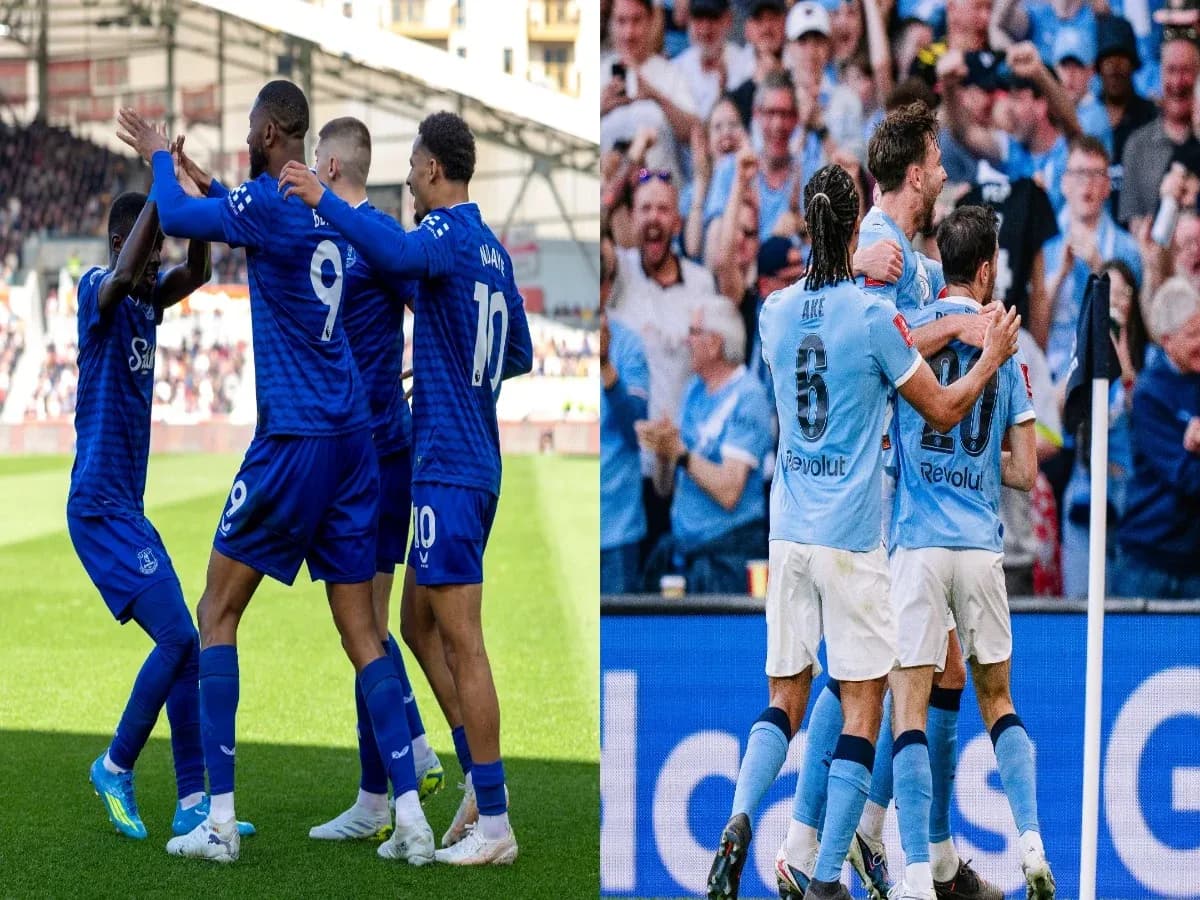
Everton and Manchester City produced a chaotic 3-3 draw at Hill Dickinson Stadium in Premier League Round 35, a match that flipped the usual script of City control into a study in transition violence and emotional swings. City led 1-0 at half-time and dominated possession throughout, yet Everton’s vertical 4-2-3-1, fuelled by impact substitute T. Barry, turned limited ball share into high-quality chances. With Everton generating 2.77 xG from just 25% possession against City’s 1.37 xG, the draw reflected a tactical contest where territory and control were repeatedly trumped by direct running and set-piece pressure.
First Half
The scoring opened on 43' when Manchester City’s structure finally converted their territorial dominance. J. Doku, operating from the left of the 4-2-3-1, finished a move assisted by R. Cherki, giving City a 1-0 lead that matched the first-half pattern: long Everton phases without the ball, but City needing patience to break a compact back four. The half-time score was 0-1, with Everton’s only major imprint on the record a 45' yellow card for Michael Keane, booked for a foul as he tried to hold a high line under pressure.
Second Half
The second half turned into a disciplinary and tactical pivot. Beto saw yellow on 48' for a foul, reflecting Everton’s growing aggression in duels as they pushed higher. James Tarkowski followed on 53', also for a foul, a sign that Everton’s centre-backs were being dragged into wider and riskier challenges as City rotated their front four.
The key inflection came with Everton’s first substitution on 64': T. Barry (IN) came on for Beto (OUT). Within four minutes, Barry equalised on 68', attacking space with a direct run and finish that punished City’s high line and slow rest-defence reset. Momentum flipped again on 73' when right-back J. O'Brien surged forward to score, assisted by J. Garner, as Everton exploited City’s full-backs being pinned high. That made it 2-1 Everton, and the emotional temperature spiked immediately.
On 74', Gianluigi Donnarumma received a yellow card for argument, underlining City’s frustration at conceding twice in five minutes despite near-total control of the ball. In response, Pep Guardiola moved to inject more incision: A. Semenyo (OUT) made way for P. Foden (IN) on 74', followed by Nico (OUT) replaced by M. Kovacic (IN) on 75'. Kovacic’s introduction in the double pivot aimed to speed vertical progression and add late box arrivals.
Yet Everton struck again first. On 81', Barry scored his second, again from open play, to push Everton 3-1 ahead. The pattern was consistent: Everton breaking rapidly from a deep 4-4-1-1 out of possession, with Barry attacking the channels behind City’s advanced full-backs.
City’s response was immediate. On 83', E. Haaland converted a move assisted by Kovacic, reducing the deficit to 3-2 and validating the Croatian’s impact as a more aggressive distributor from midfield. Everton’s defensive line, already stretched by repeated emergency defending, began to sag.
On 86', J. O'Brien – listed here as Jake O'Brien – collected a yellow card for a foul, emblematic of Everton’s late-game survival mode, repeatedly stepping out to halt City’s combinations. City then altered their attacking profile again on 87': B. Silva (OUT) was replaced by O. Marmoush (IN), adding another direct runner to attack the channels and second balls around Haaland.
Late Game Developments
Everton’s late substitutions came deep into stoppage time, focused on protecting the lead and adding legs in midfield. At 90+2', M. Rohl (OUT) was replaced by N. Patterson (IN), and K. Dewsbury-Hall (OUT) made way for C. Alcaraz (IN), effectively shifting Everton towards a more defensive, compact block with extra defensive presence in wide zones. At 90+6', T. Iroegbunam (OUT) was replaced by H. Armstrong (IN), a like-for-like midfield change aimed at fresh energy in the screen ahead of the back four.
But City’s pressure finally told in regulation time. On 90', J. Doku struck again, assisted by M. Guehi, to level at 3-3. The goal encapsulated the game’s tactical tension: City’s patient possession eventually finding a lane against a tiring Everton block, with a defender stepping out too late and Doku punishing the space.
Tactical Analysis
From a tactical standpoint, Everton’s 4-2-3-1 was built on compactness and verticality. J. Pickford, with only 1 recorded save, had a light shot-stopping workload relative to the volume of City possession, a product of Everton’s low block forcing City into blocked efforts (8 blocked shots for City) and lower-quality looks. Everton’s Defensive Index on the day was defined less by volume of interventions and more by last-ditch blocks and tactical fouls, as evidenced by 15 fouls and 4 yellow cards.
The double pivot of T. Iroegbunam and J. Garner had a dual role: screen central zones against Cherki and Haaland’s drops, and spring early passes into I. Ndiaye, K. Dewsbury-Hall and Beto/Barry. Everton completed 200 passes at 69% accuracy, but those passes were high-risk, high-reward verticals rather than circulation. Their 2.77 xG, combined with 10 shots inside the box, shows how effectively they converted rare possession phases into premium chances, especially after Barry’s introduction.
City’s 4-2-3-1, with Nico and B. Silva as the initial midfield pair, produced overwhelming control: 75% possession, 610 passes at 90% accuracy, and 20 total shots. However, their Overall Form in this match skewed towards sterile domination. The low 1.37 xG despite volume indicates Everton’s block repeatedly funneled City into less dangerous zones. Donnarumma, with 3 saves and 0.74 goals prevented, quietly underpinned City’s ability to escape with a point; he faced fewer shots on target (6 for Everton) but of significantly higher quality.
Statistical Verdict
Statistically, the verdict is stark. Everton, with 25% possession and 14 total shots (6 on target), maximised transitions and set-piece chaos, outperforming City in xG and shot quality. City, despite 9 corners to Everton’s 5 and far fewer fouls (5 vs 15), could not convert structural dominance into a decisive margin. Card totals were clear: Everton 4 yellows (Michael Keane 45', Beto 48', James Tarkowski 53', Jake O'Brien 86'), City 1 yellow (Gianluigi Donnarumma 74'). The 3-3 final scoreline, against the statistical backdrop, reads less like a fluke and more like the logical outcome of a game where Everton weaponised every turnover, and City needed late individual quality from Haaland and Doku to salvage a point.
Related News
Premier League Managers Facing Potential Sackings During International Break
Arsenal's Myles Lewis-Skelly Names Unexpected Tottenham Rival as Toughest Premier League Opponent
Three Premier League Players Shining Early This Season
Premier League Early Season Reactions: Man City’s Strength, Arsenal’s Flaws, United’s Struggles

Premier League Returns October 10 After Extended September-October International Break
Fulham and Manchester United Share Points in 1-1 Draw