
Manchester City Dominates Brentford in 3–0 Victory
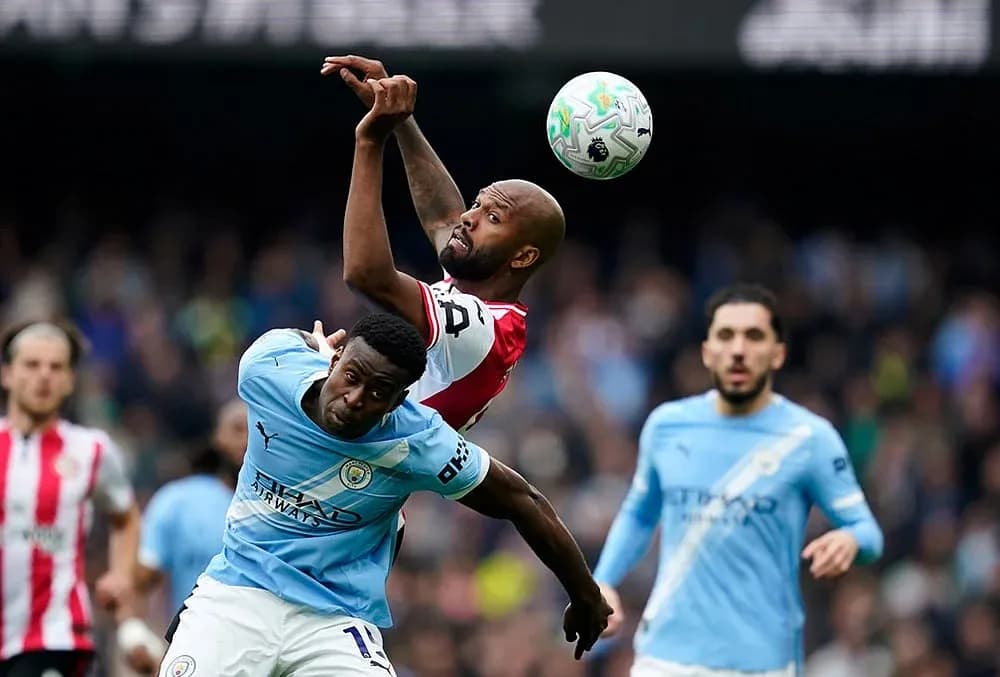
Manchester City’s 3–0 win over Brentford at the Etihad Stadium was a methodical dismantling built on territorial dominance and controlled risk. In a Premier League Round 36 fixture, Pep Guardiola’s side converted a 0–0 half-time into a commanding full-time scoreline, with the goals arriving after the hour and the game state increasingly reflecting City’s structural superiority in and out of possession.
Executive Summary
Across 90 minutes, City imposed a 59% share of possession, generated 25 shots to Brentford’s 4, and posted an xG of 2.98 against the visitors’ 0.24. The 3–0 scoreline aligned closely with underlying numbers, but the path there was shaped by patience: a first half of probing without reward, followed by a second half in which City’s rotations, substitutions and individual quality broke Brentford’s defensive block. Brentford, under Keith Andrews, defended in depth and tried to counter through Kevin Schade and Igor Thiago, but rarely progressed into threatening zones.
Scoring Sequence & Disciplinary Log
The first notable flashpoint arrived at 36', when Bernardo Silva (Manchester City) received a yellow card — Argument. It reflected a frustrated reaction in a half where City controlled territory but failed to translate it into goals.
The breakthrough came at 60', Jérémy Doku (Manchester City) scoring a Normal Goal to make it 1–0. Immediately after, Guardiola reshaped his attacking structure: at 60', Omar Marmoush (IN) came on for Rayan Cherki (OUT), and Phil Foden (IN) came on for Tijjani Reijnders (OUT), both for Manchester City. Those changes injected more direct running and final-third precision.
Brentford responded with their own adjustment at 61', Vitaly Janelt (IN) came on for Aaron Hickey (OUT), and later at 68', Dango Ouattara (IN) came on for Mikkel Damsgaard (OUT), seeking more athleticism and ball-carrying from midfield and wide areas.
City’s pressure continued to mount, and at 74', Nico O'Reilly (Manchester City) was booked — Foul — as Brentford briefly found transition spaces. One minute later, at 75', Erling Haaland (Manchester City) struck a Normal Goal to stretch the lead to 2–0, effectively killing Brentford’s hopes of a result.
At 79', Jordan Henderson (IN) came on for Yehor Yarmoliuk (OUT) for Brentford, adding experience in central areas. Discipline then flared again: at 80', Kristoffer Ajer (Brentford) was shown a yellow card — Foul, and at 88' there was a double flashpoint: Matheus Nunes (Manchester City) booked — Argument, and Jordan Henderson (Brentford) booked — Argument.
City’s control was underlined in stoppage time. At 90+2', Omar Marmoush (Manchester City) added a third with a Normal Goal, assisted by Erling Haaland, finishing a move that showcased City’s vertical threat against a stretched Brentford. At 90+5', Marmoush himself went into the book — Time wasting — as City ran down the clock. The final substitution saw Savinho (IN) come on for Jérémy Doku (OUT) at 90', giving fresh legs on the flank for the closing phase.
Card totals, locked from the events data, were:
- Manchester City: 4 yellow cards
- Brentford: 2 yellow cards
- Total: 6
Tactical Breakdown & Personnel
Guardiola’s starting structure was effectively a flexible back four ahead of Gianluigi Donnarumma in goal, with Matheus Nunes, Marc Guéhi, Nathan Aké and Nico O'Reilly listed as defenders. In practice, City’s dominance of the ball (463 passes at 86% accuracy) allowed fullbacks and midfielders to interchange roles: O'Reilly often stepping into higher lines, while Reijnders and Bernardo Silva orchestrated central circulation.
The attacking midfield band of Antoine Semenyo, Rayan Cherki and Jérémy Doku supported Erling Haaland. Doku’s 60' opener was emblematic of City’s wide overload strategy: repeated isolation of the winger against Brentford’s fullback line, using quick switches and underlaps from midfield to create 1v1s. Semenyo’s presence between the lines and Cherki’s drifting into half-spaces helped pin Brentford’s midfield, limiting their ability to step out.
Defensively, City’s “Defensive Index” for this match was defined by control rather than volume of actions. Donnarumma needed to make only 2 saves, underlining how effectively the back line and screening midfielders suppressed Brentford’s shot quality (only 4 total shots, 2 on target, xG 0.24). Guéhi and Aké managed Igor Thiago’s movements, while Schade’s runs in behind were largely contained by early pressure on the ball and compact rest-defense.
Brentford’s overall form in this match was reactive. With 41% possession and 320 passes at 76% accuracy, their offensive sequences were short and often ended before reaching the final third. The double pivot of Yehor Yarmoliuk and Mathias Jensen had to cover large distances laterally, frequently sliding across to plug channels opened by City’s rotations. Keane Lewis-Potter and Aaron Hickey, listed as defender and midfielder respectively, were forced deep, effectively forming a back five out of possession.
Keith Andrews’ substitutions were clearly aimed at shifting the dynamic: Janelt for Hickey to stabilise central zones, Ouattara for Damsgaard to add direct running, and Henderson for Yarmoliuk to bring composure and leadership. However, with City already 2–0 up by the time Henderson entered, Brentford’s structure remained more about damage limitation than a genuine late surge.
On City’s side, the introduction of Marmoush and Foden sharpened the attack. Marmoush’s goal and subsequent yellow card for Time wasting underline his impact on both the scoreboard and game management. Foden, operating between lines, increased the tempo of combination play around Brentford’s box, contributing to the sustained pressure that led to Haaland’s 75' strike and the late third.
The Statistical Verdict
The numbers strongly support the 3–0 outcome. City’s xG of 2.98, 25 total shots (10 on target) and 10 corners reflect a sustained territorial siege. Brentford’s 0.24 xG and just 4 shots illustrate how rarely they threatened. Both goalkeepers posted 1.5 goals prevented, but context matters: Donnarumma’s 2 saves came in isolated moments, while Caoimhin Kelleher’s 7 saves were part of a continuous rearguard effort.
Discipline also tracked the game’s narrative: Manchester City’s 4 yellow cards (Bernardo Silva — Argument; Nico O'Reilly — Foul; Matheus Nunes — Argument; Omar Marmoush — Time wasting) contrasted with Brentford’s 2 (Kristoffer Ajer — Foul; Jordan Henderson — Argument), reflecting both City’s assertiveness in duels and their late-game management. Overall, this was a performance of controlled aggression and attacking clarity from City against a Brentford side forced into survival mode for long stretches.
Related News
Premier League Managers Facing Potential Sackings During International Break
Arsenal's Myles Lewis-Skelly Names Unexpected Tottenham Rival as Toughest Premier League Opponent
Three Premier League Players Shining Early This Season

Premier League Early Season Reactions: Man City’s Strength, Arsenal’s Flaws, United’s Struggles

Premier League Returns October 10 After Extended September-October International Break

Fulham and Manchester United Share Points in 1-1 Draw